


A landscape opens the show, and no one is in it.
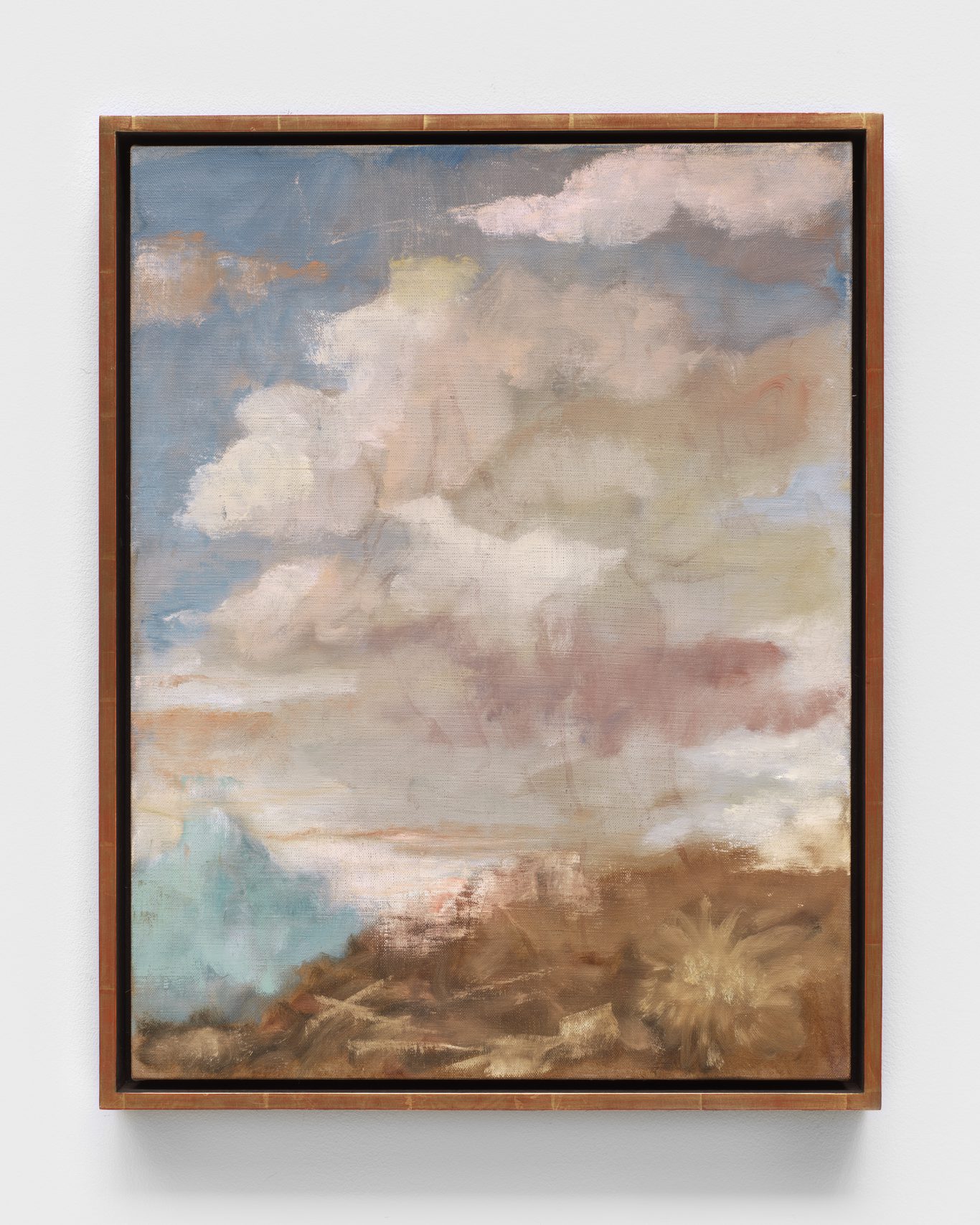
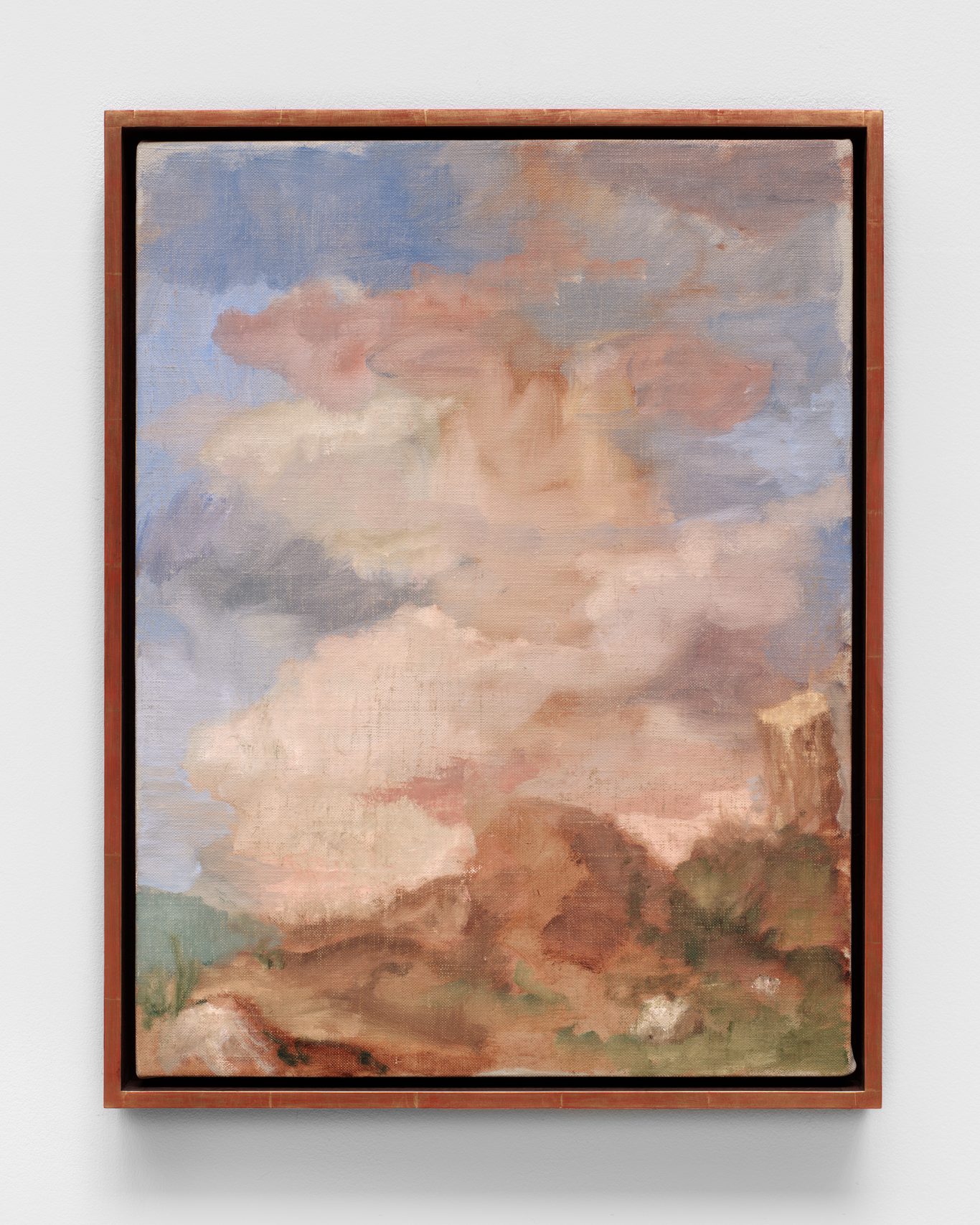
Opening Credits, the painting that gives the exhibition its name, is a small sky over a low stretch of scrub: cloud moving from blue toward worn pink, a pale stone shape at the left, a dry burst of thistle at the right. Weather and stone. The brushwork is loose, thinned by its own light. There is nothing to look at except a place, and the place is empty.
The title changes the landscape. A credit sequence runs over an establishing shot before the actors enter. The painting becomes a set before it becomes a memory: the ground, the light, the atmosphere, the cleared space in which names can appear. The exhibition begins before its cast arrives, and it begins by admitting that what follows has already passed through staging.
Arcadia is close to the surface here: Poussin, Watteau’s voyage to Cythera, Acadia in Maine, childhood, time passing, a golden world kept in recollection. Those references are useful because they do not have to be corrected. They already contain loss. Arcadia was never simply the opposite of time. It was a place imagined from somewhere later, a landscape made sweeter by distance. Watteau’s Cythera sharpens the uncertainty: the lovers may be arriving, or they may already be leaving. The ideal is never only present. It is present as something already touched by departure.
Currin’s sharper move is to place another golden world inside that older one: the world of the 1970s clothing catalogue, with its promises about wanting, bodies, leisure, and time.
The catalogue is Arcadia in a late-modern form. It offers posed ease, available happiness, idealized bodies, garments made persuasive by the life around them. A coat is never only a coat. It arrives with a body, a season, a palette, a place, a life into which the image proposes entry. The old pastoral asked the eye to imagine an elsewhere. The catalogue made that elsewhere current.
That currentness depended on replacement. The catalogue stayed young by refusing duration. Each season replaced the last and called the new image present. Its real promise was not only the garment. It was the body kept inside the season.
Now the catalogue looks almost archaic because its present had edges. It arrived by season and expired by season. Its before and after were part of its seduction. Currin paints a commercial image-form that still had a beginning and an ending, then places it inside a medium that makes both visible.
Painting and catalogue do not keep the present in the same way. The catalogue refreshes the present by replacement. Painting thickens it. It slows the image, dates it, lets other times show through. Currin brings those two promises into the same frame, and the catalogue’s clear season begins to loosen.
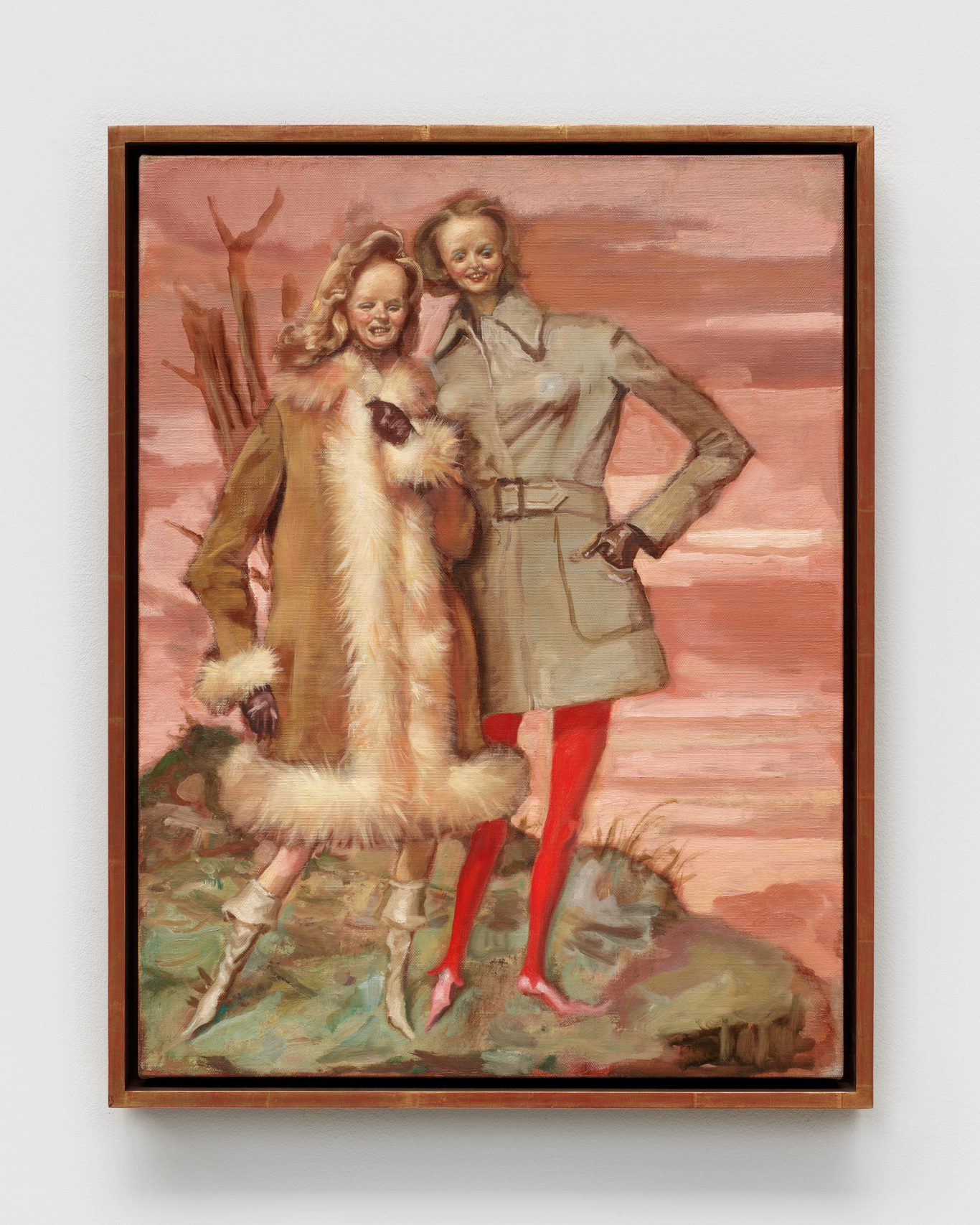
In Dark Harbor, the clothes are among the most finished things in the exhibition: a shearling-trimmed afghan coat painted almost hair by hair, a belted suede safari jacket modeled down to the seams, red tights holding their full brightness against a flat salmon backdrop scraped in horizontal bands like a photographer’s wall. The garments remain exact. The leisure is staged in a studio pretending to be outdoors, which is what a catalogue does and what a fête galante also knows how to do: build a pastoral condition and place figures inside it. The pink wall keeps the pastoral from becoming landscape. This Arcadia has been made indoors.
The face above the fur does not keep the coat’s promise. The left figure’s features are bunched into a grimace, aged hard, while her companion smiles with the even symmetry of a display head. The coat holds longer than the face above it. Product, pose, and body no longer age at the same speed.
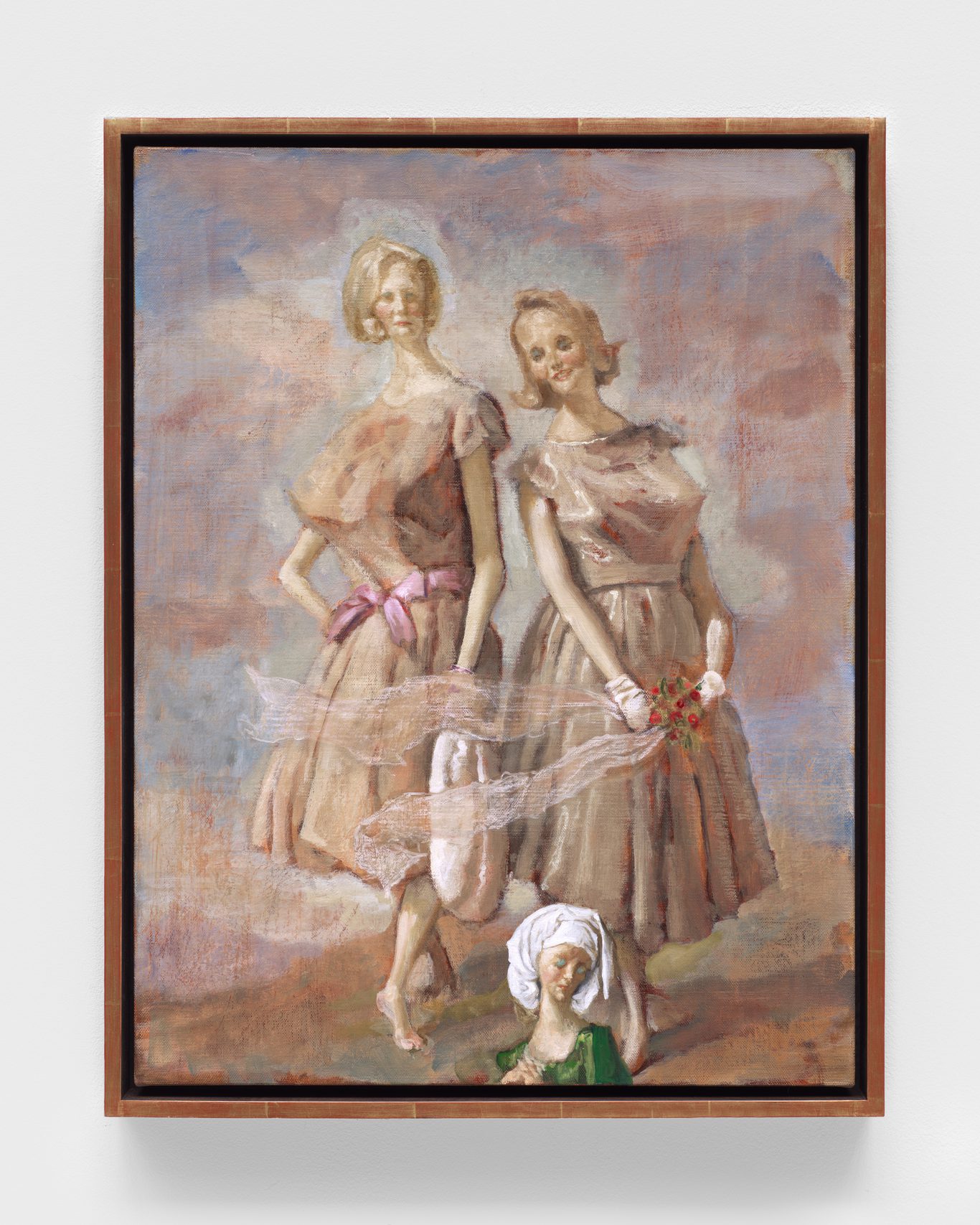
Color carries the same pressure. The salmon pink in Dark Harbor is not only backdrop. It is catalogue color, sweetened and artificial, a commercial sky made in a room. The powder palette of Carol, Alice and Mary, the orange and green of The Hidebehinds, the pink sky of Wonderland, and the small ringlet shapes in Asticou keep returning to that artificial sweetness. The color offers ease. Paint lets the ease become unstable.
The catalogue makes the body carry more than clothing. It turns the figure into garment support, lifestyle evidence, a pose held long enough to photograph. Currin’s strongest evidence is not that the figures collapse. It is that they do not collapse evenly. The coat can remain legible while the face changes register. The red tights can hold their brightness while the body begins to look assembled. The product remains clear after the figure has begun to shift.
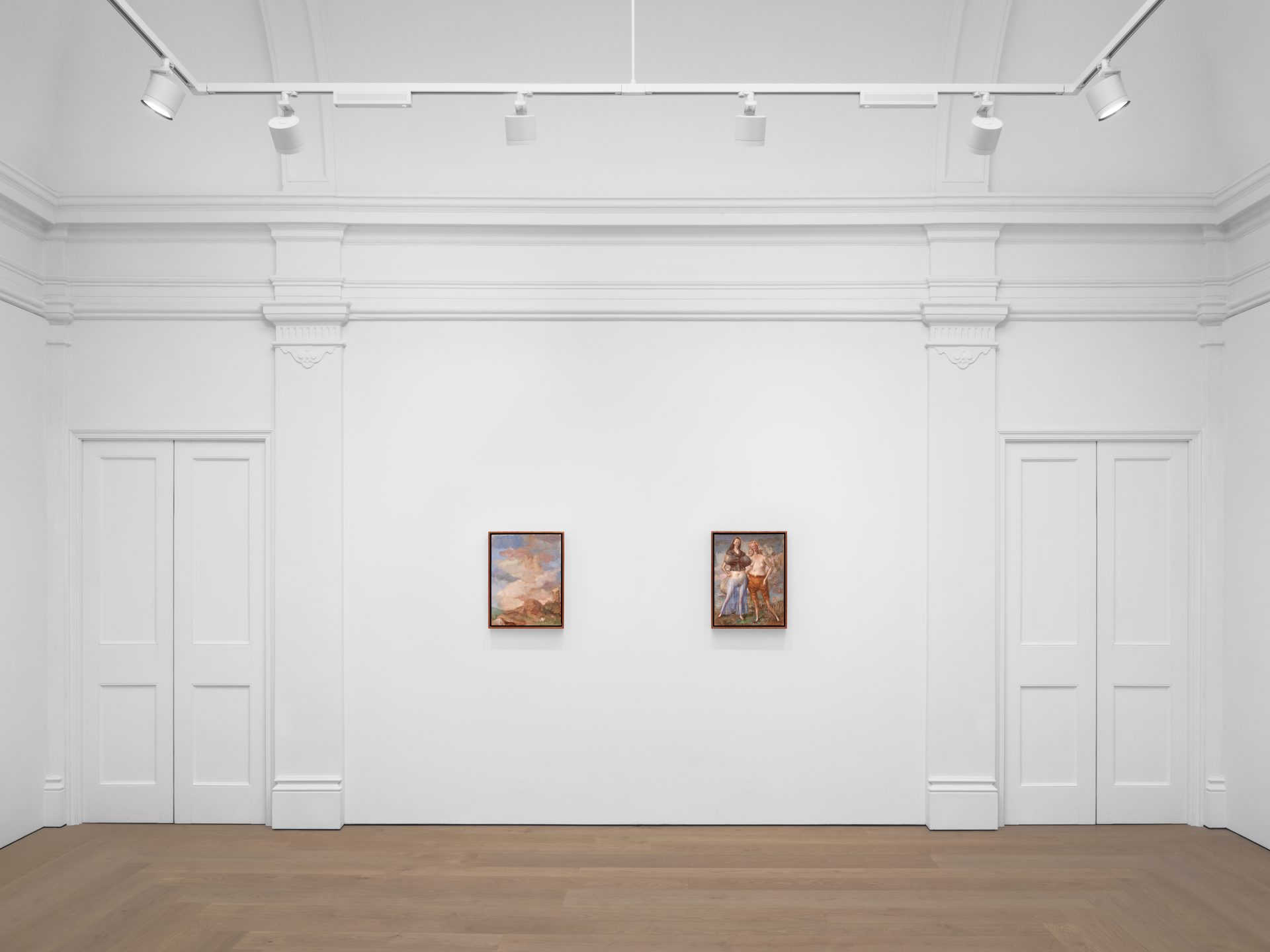
The show is not a single story about getting old. It holds the commercial ideal at several stages at once, and the stages hang side by side. The twelve oils keep one size, so landscape and figure are held at one pitch. Nothing receives the hierarchy of a hero image. The room has the flatness of a catalogue sequence, where every body, garment, place, and interval is made equally available.
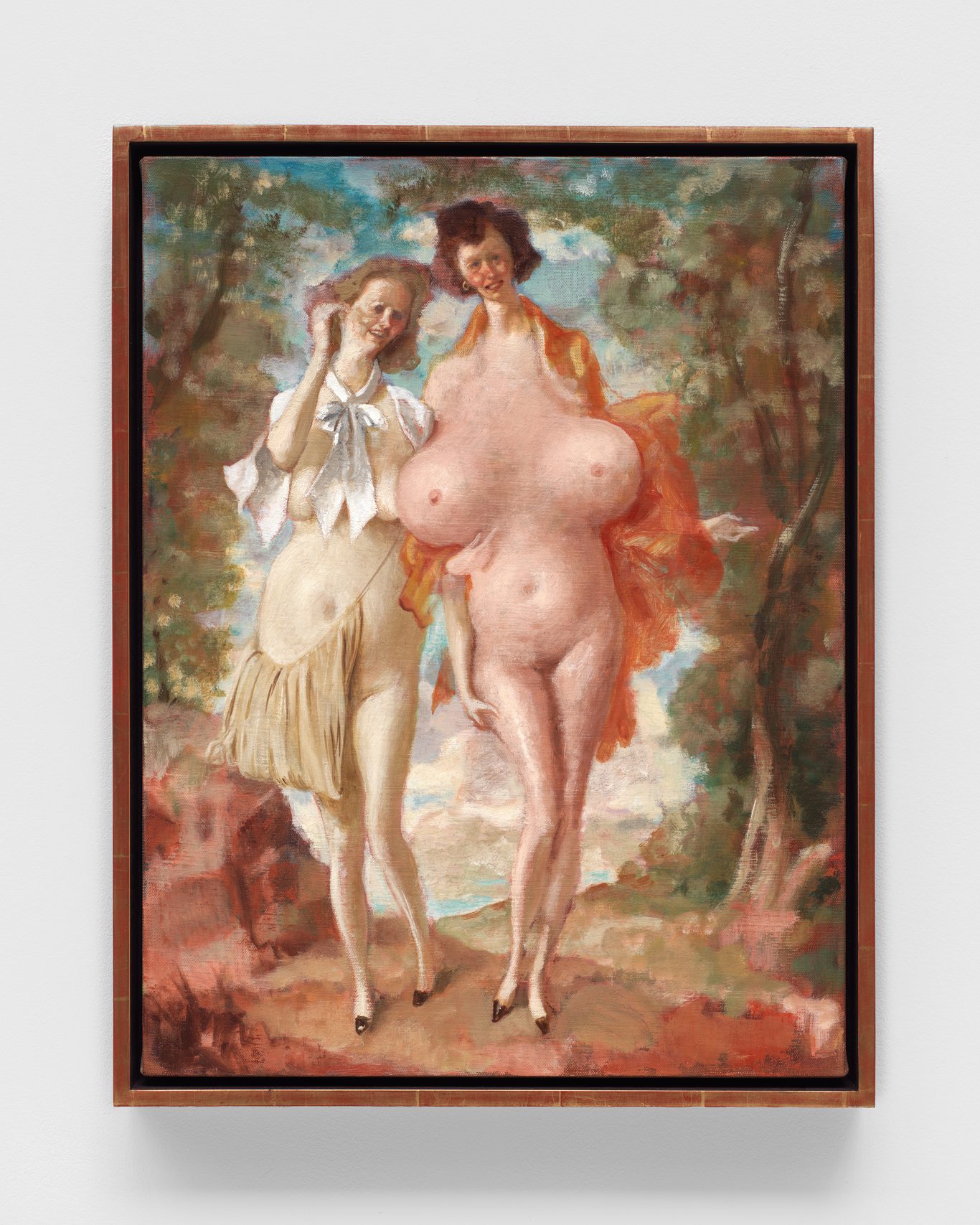
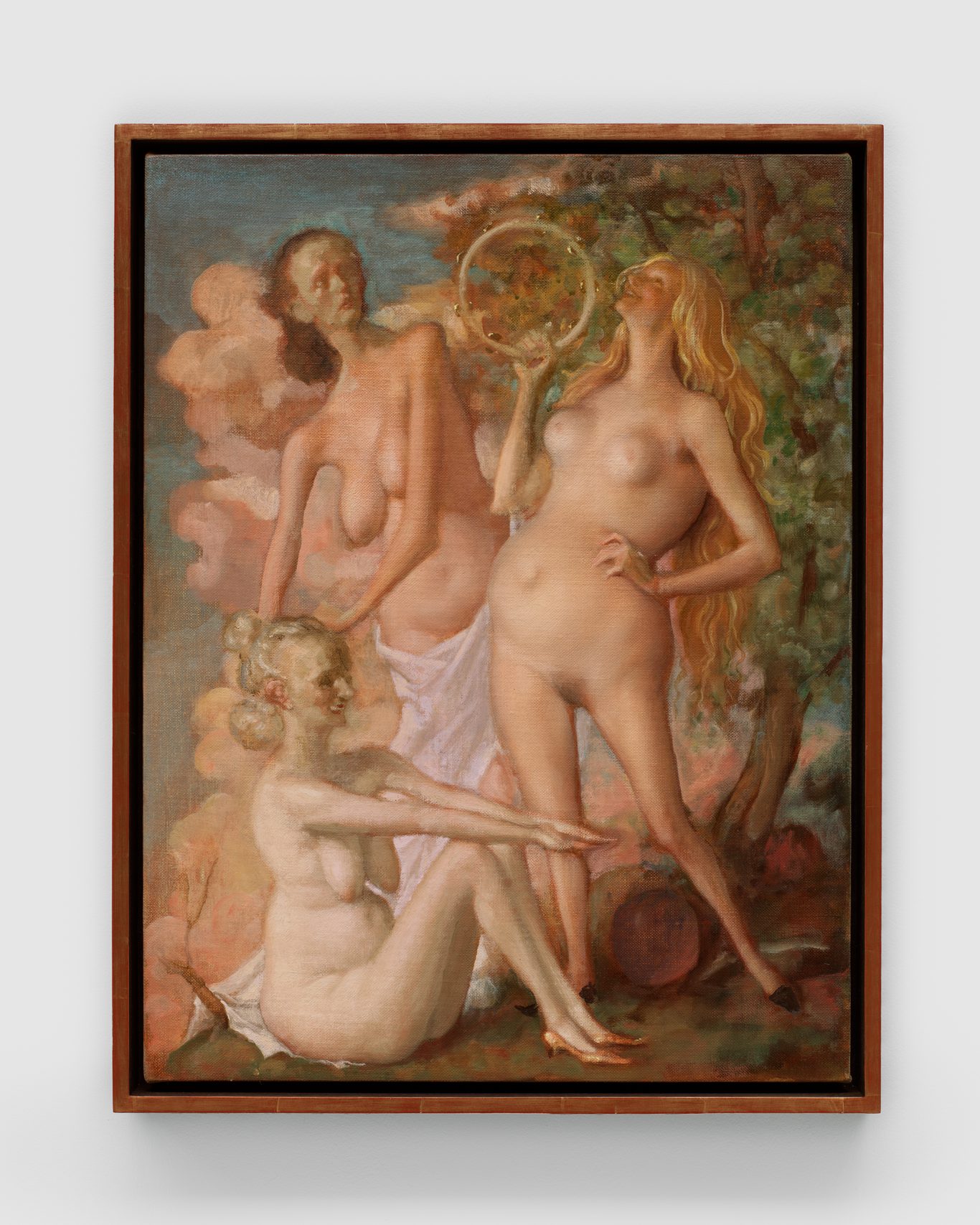
Some pictures still work the way the catalogue wanted. Grotto, in its oil version, tests the argument because it is painted with such fullness: a pink nude and a companion in a fringed white top stand in a soft screen of green and cream foliage, the flesh pearly and fully turned, the orange shawl warm and convincing. The catalogue body is not exposed here. It is made desirable again.
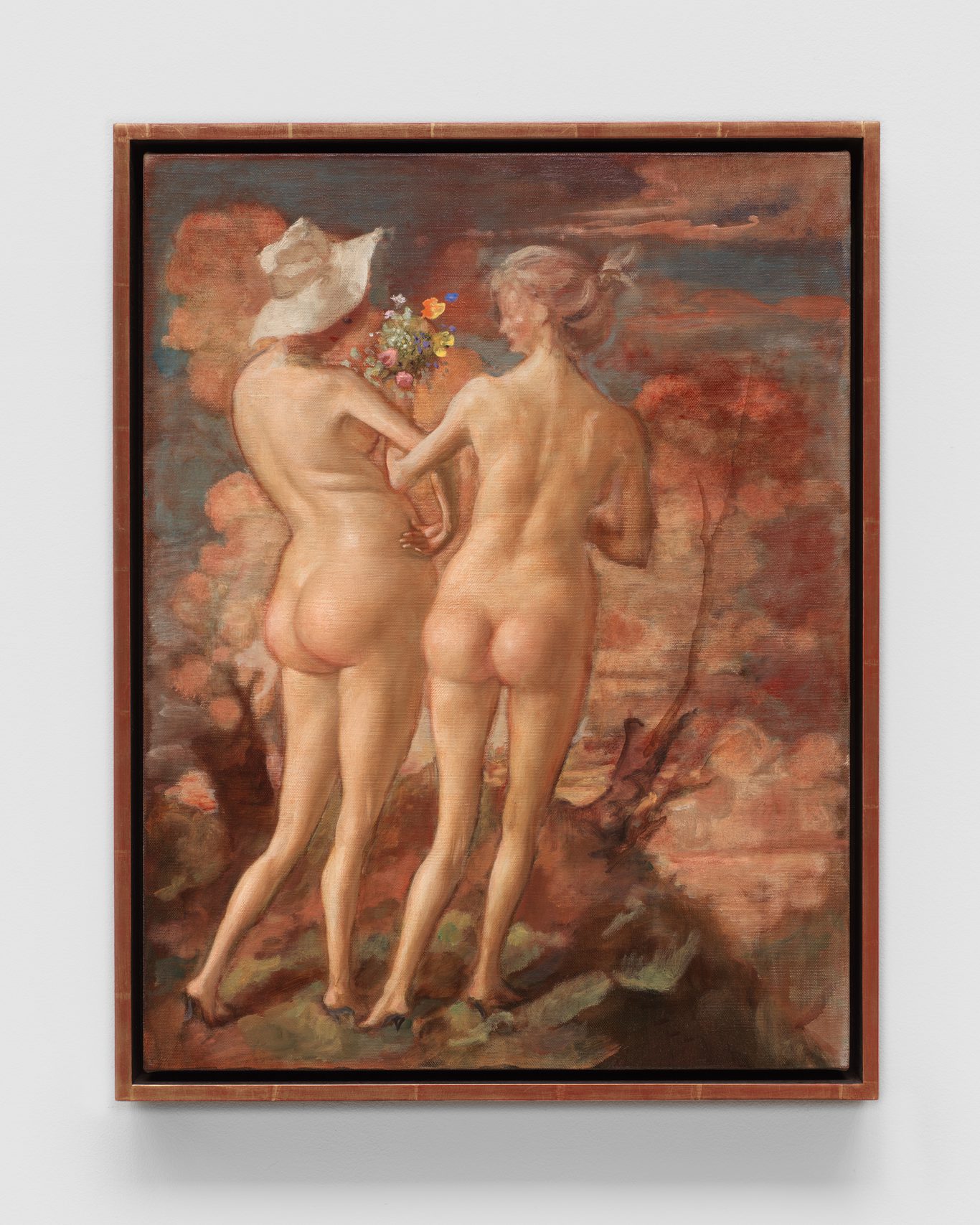
Beech Cliff gives two nudes from behind, the fullest flesh in the room, smoothly modeled back and thigh against an Acadia cliff. But the sharpest, highest-keyed passage is the small bouquet passed between them, a fistful of cut flowers rendered crisper than any body, while both faces are withheld, turned away.
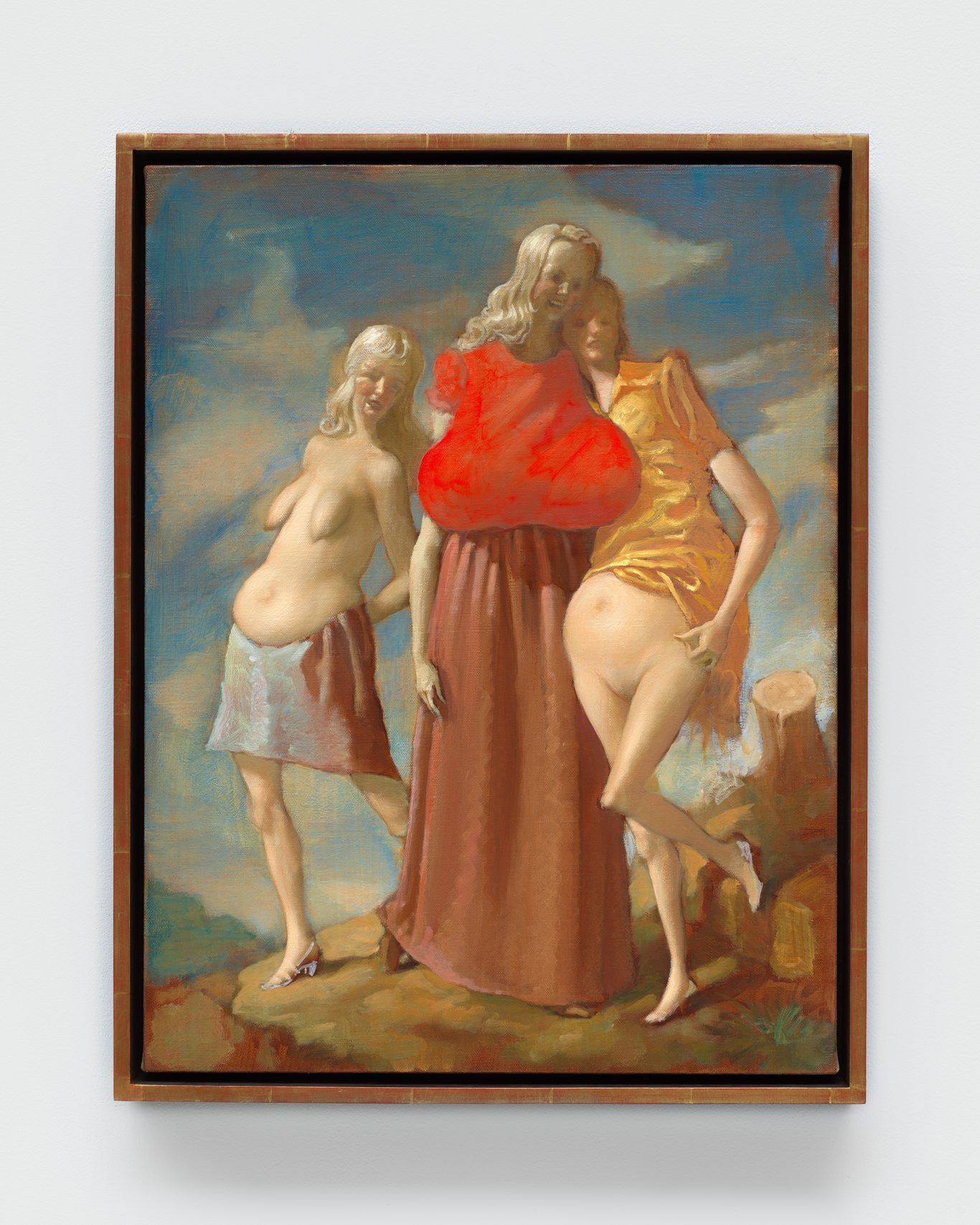
Eclipse looks ripe until its center. The standing figure’s red bodice is not painted so much as scrubbed in raw: a flat, unblended vermilion with no fabric and no modeling, a flare of pure pigment burned into the middle of an otherwise finished picture. The title names an eclipse, but the eclipse is made in the handling, where fabric, bodice, and finish give way to the same exposed red.
Elsewhere the freezing gives way in the handling, not in the mood. Carol, Alice and Mary turns the gap between product and body into faces. The two tall figures stand in pale bridal dresses, and the most carefully worked passage is the gauze veil dragged between them in translucent white scumble, the leg visible through it. The faces do not receive the same care. One is thumbed back into the ground; the other holds the blank symmetry of a doll. The figurine in a white Dutch cap at their feet is painted sharper and more solid than either of them, its green dress and features held with a clarity the larger faces do not receive. The picture has inverted its hierarchy: the smallest figure is the most finished body in the scene, while the larger models remain closer to display than portrait.
The Hidebehinds sharpens that display quality without needing to move far from it: flat blue eyes, a small red mouth, hair holding the head more firmly than the face beneath it. The figures stay upright on the clarity of their clothes.
Wonderland lets the setting come apart instead of the bodies. The two figures stand fairly firm, one face wiped to almost nothing in the shadow of a blue hat, but the landscape behind them runs: pale streaks hang and drip from the branches where the paint has been pulled straight down the canvas, and the pink sky bleeds up into the teal without a seam.
Asticou loses its hold more quietly. The sheer blue skirt is described stripe by stripe, the orange plaid trousers keep their grid, and then the bare legs beside them thin out and lose their contour into the brown scrub. The body drains into its own background while rust-colored rings drift in the air, bright marks that keep the surface from settling into depth.
Set beside the ripe pictures, the structure becomes clear. The catalogue tried to hold one moment. Painting cannot keep it sealed. The moment scatters: ripe here, masked there, thinning, staged, finished in one place and rubbed open in another, all in the same Arcadia, all at the same size. This is not aging applied to a young image after the fact. It is the discovery that the frozen present was unstable from the beginning.
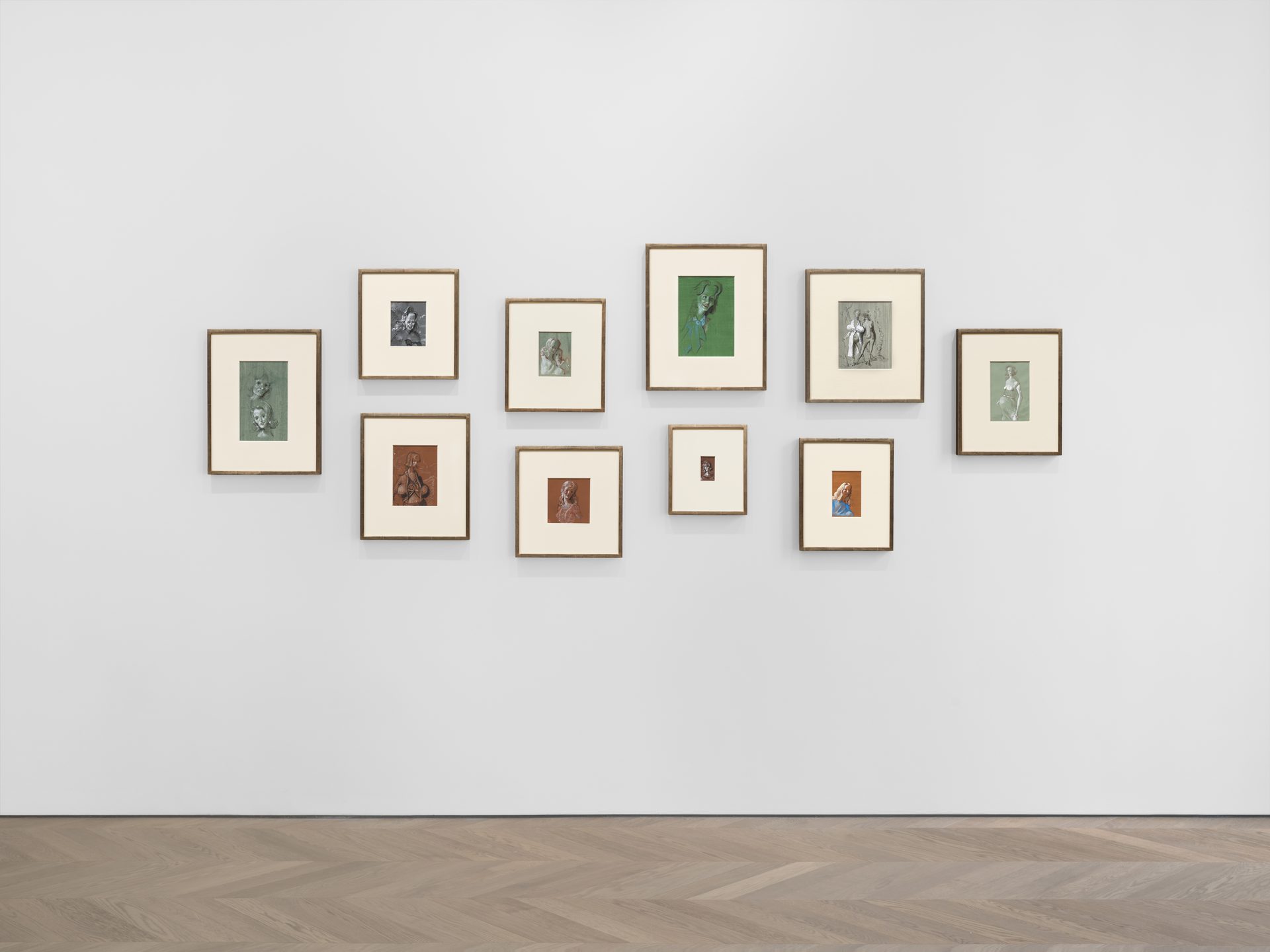
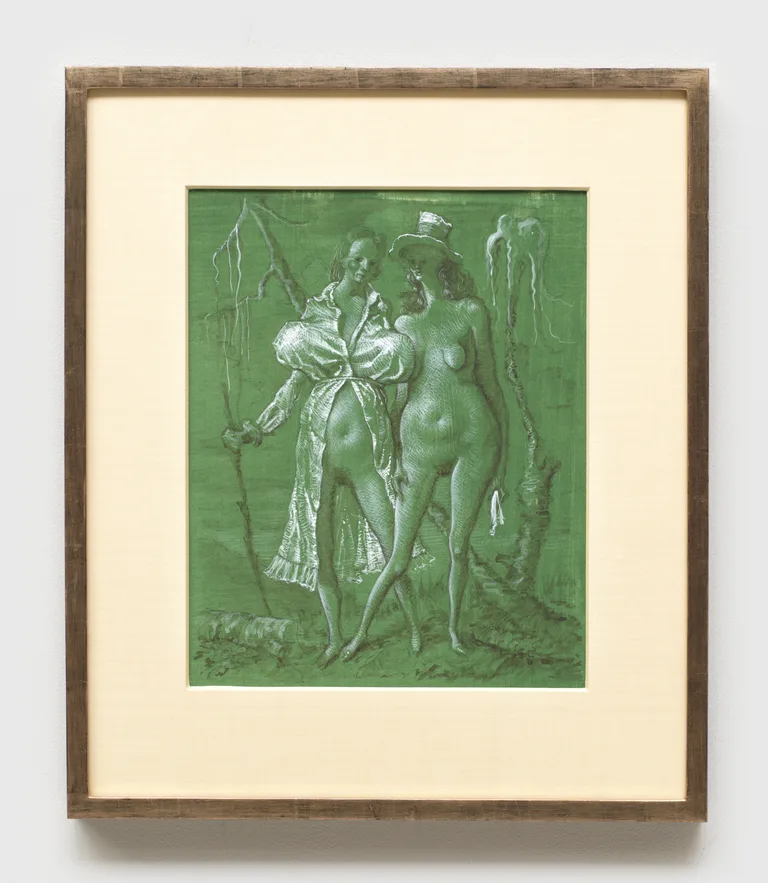
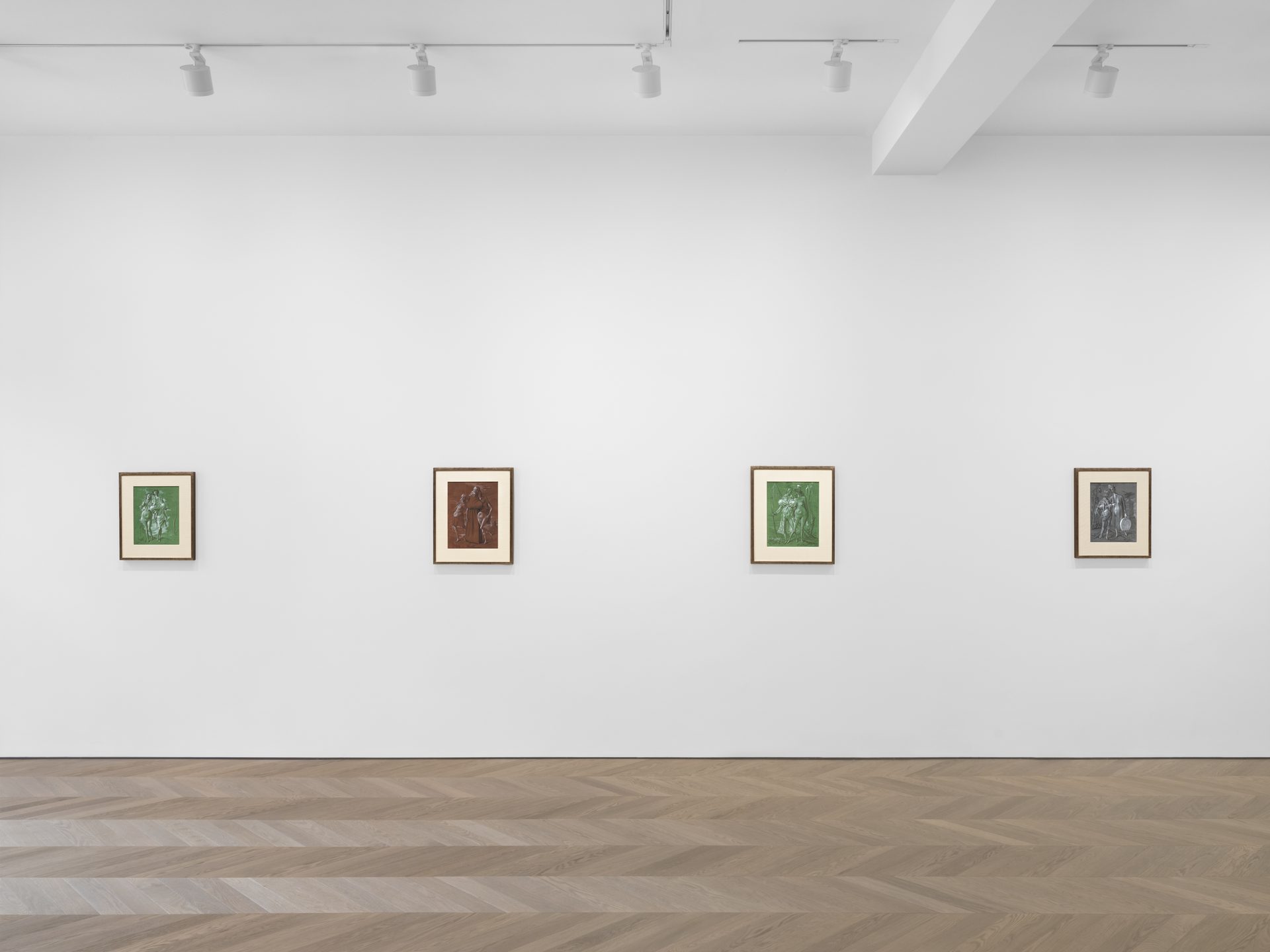
The works on paper make the conversion explicit, though not as studies. Several are worked on prepared grounds, green or sanguine red, built up in dense white cross-hatched heightening, tight in contour, matted and framed like Renaissance sheets. One green sheet shares its title, Grotto, with the oil but shows different figures entirely; a red sheet carries the composition of Eclipse. Their importance is not inventory. It is the method. The catalogue body, inflated and posed, is issued again in the classic tints of old master drawing and presented as relic rather than sketch.
A disposable seasonal image is passed through an apparatus built for duration. Nothing about the conversion is hidden. It is captioned. The catalogue body receives the one thing the catalogue could never give it: the long look. Duration is exactly what begins to undo it.
The show closes the way it opened, on an empty sky. Closing Credits is the near-twin of the first painting: the same low scrub, pale stone, banked cloud, the same size as everything hung between them, all of it thin and rubbed and dry, the weave of the canvas showing through the weather. The two landscapes are almost the same painting.
Between them, the cast has entered and left. The stage has barely changed. What records the passage is not narrative but paint: softened edges, rubbed ground, weather that will not hold its contour. The catalogue stayed current by replacing each image before it had to last. These two skies cannot be replaced with a new season. Whatever has changed between them has been left on the surface, which is the one place the commercial present was never built to survive.
Credits appear administrative, but they structure perception. Names, roles, and attributions tell viewers how to read before any encounter takes place. The exhibition asks whether a work can ever arrive free of the systems that announce it.
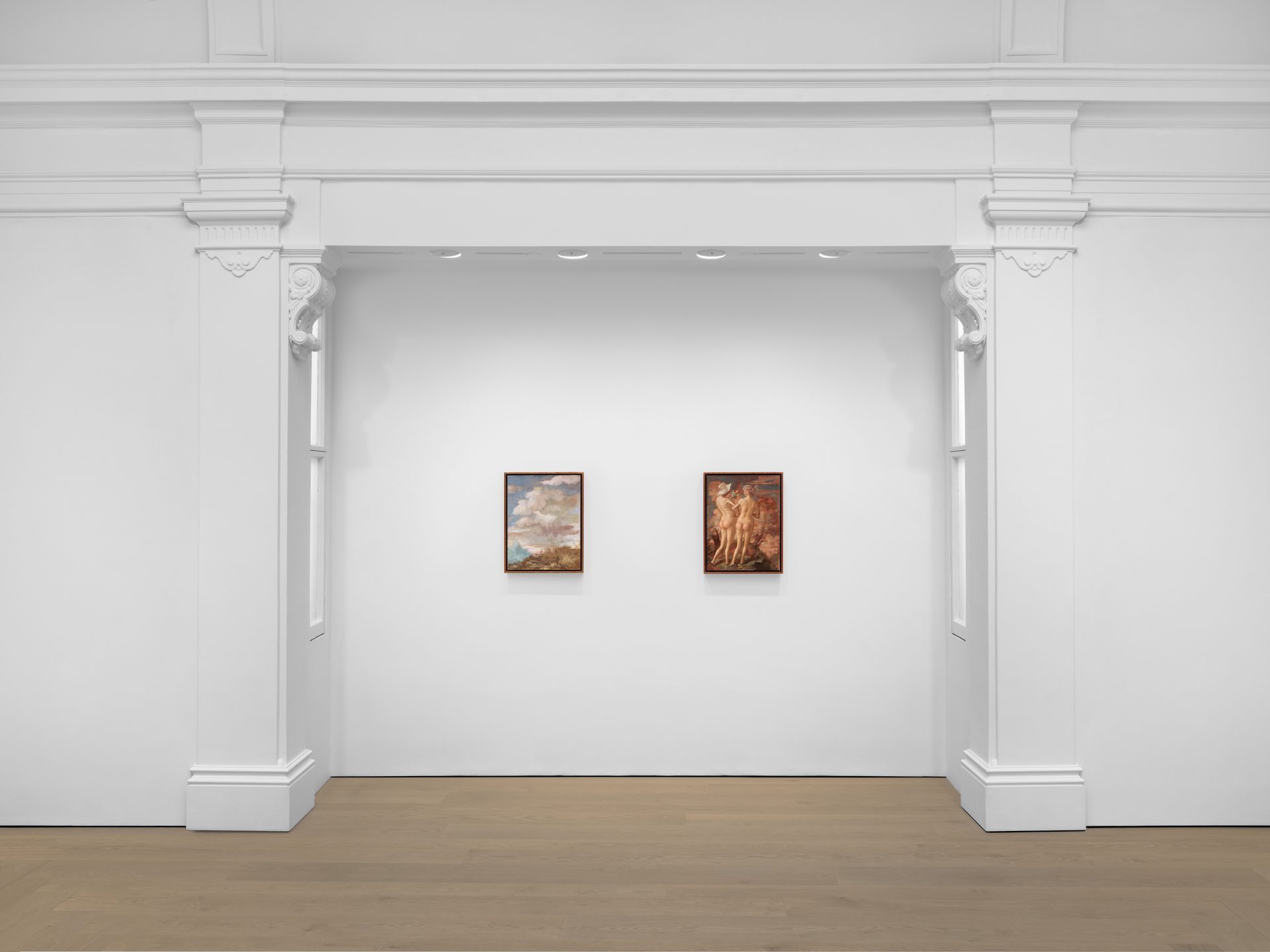
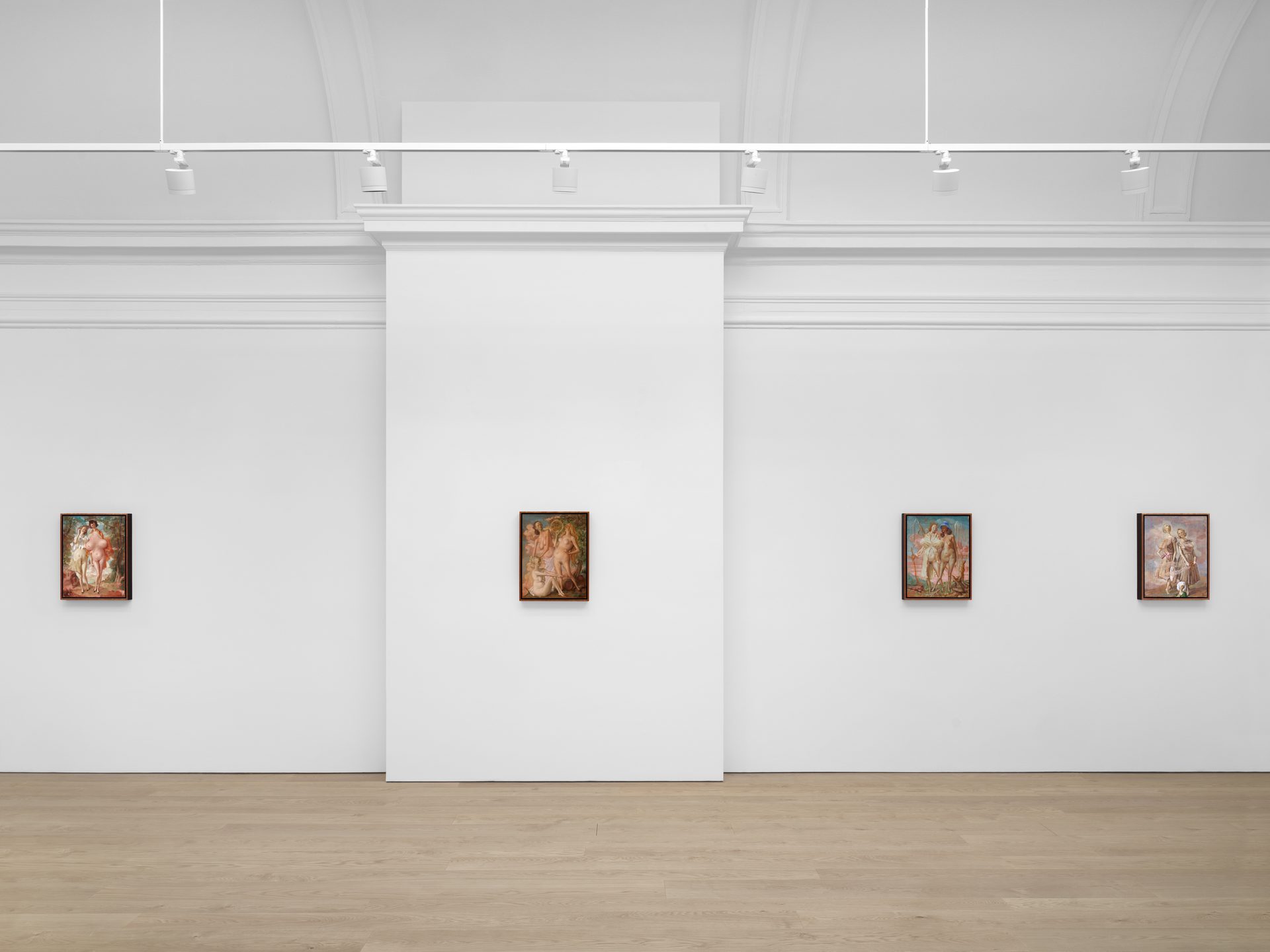
Cover Image: Installation view, John Currin, Opening Credits, 4 June – 12 September 2026, Sadie Coles HQ, London. © John Currin. Courtesy the Artist and Sadie Coles HQ, London. Photo: Maris Hutchinson.
All images © their respective rights holders.
Image rights & attribution →