


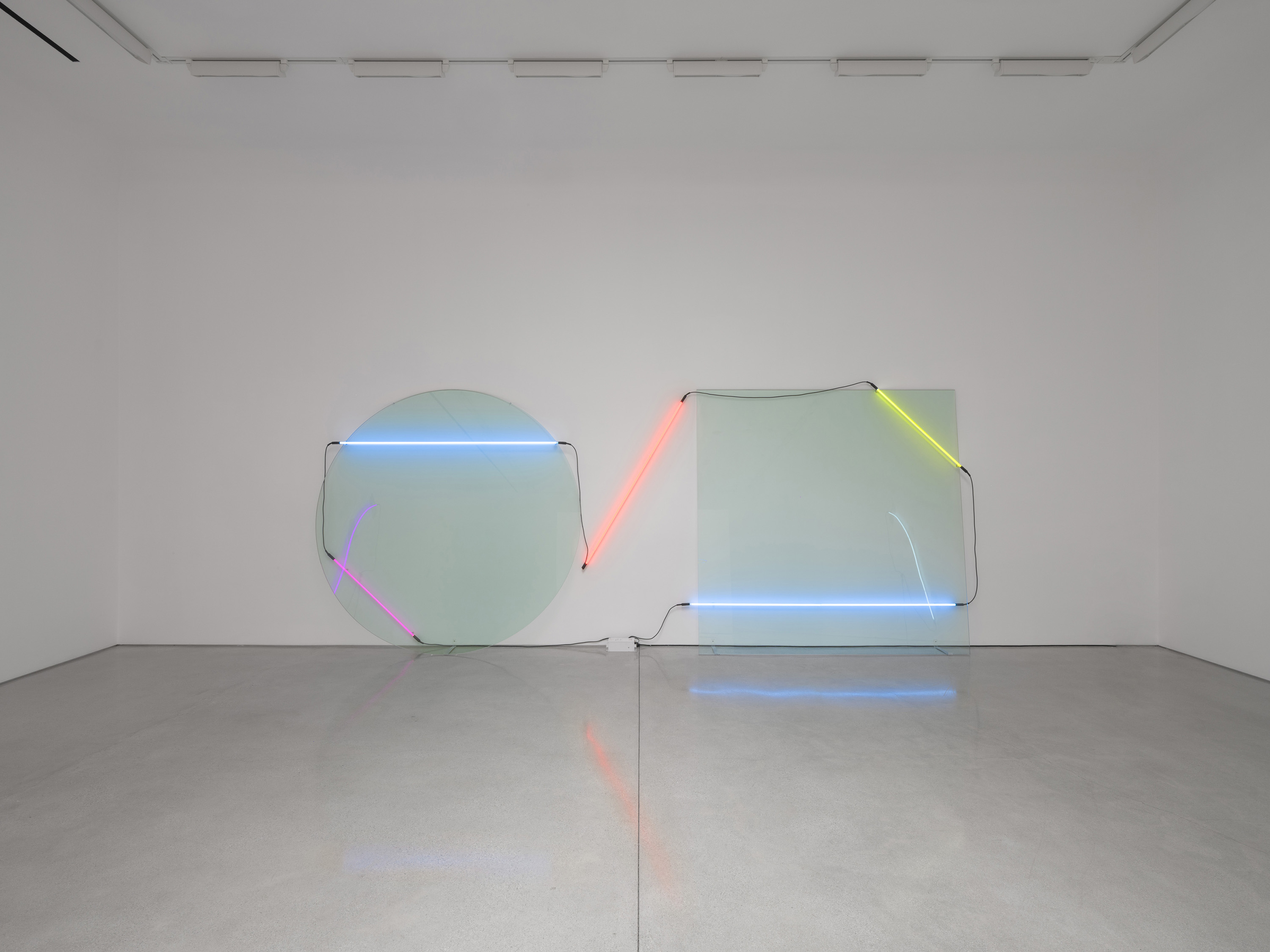
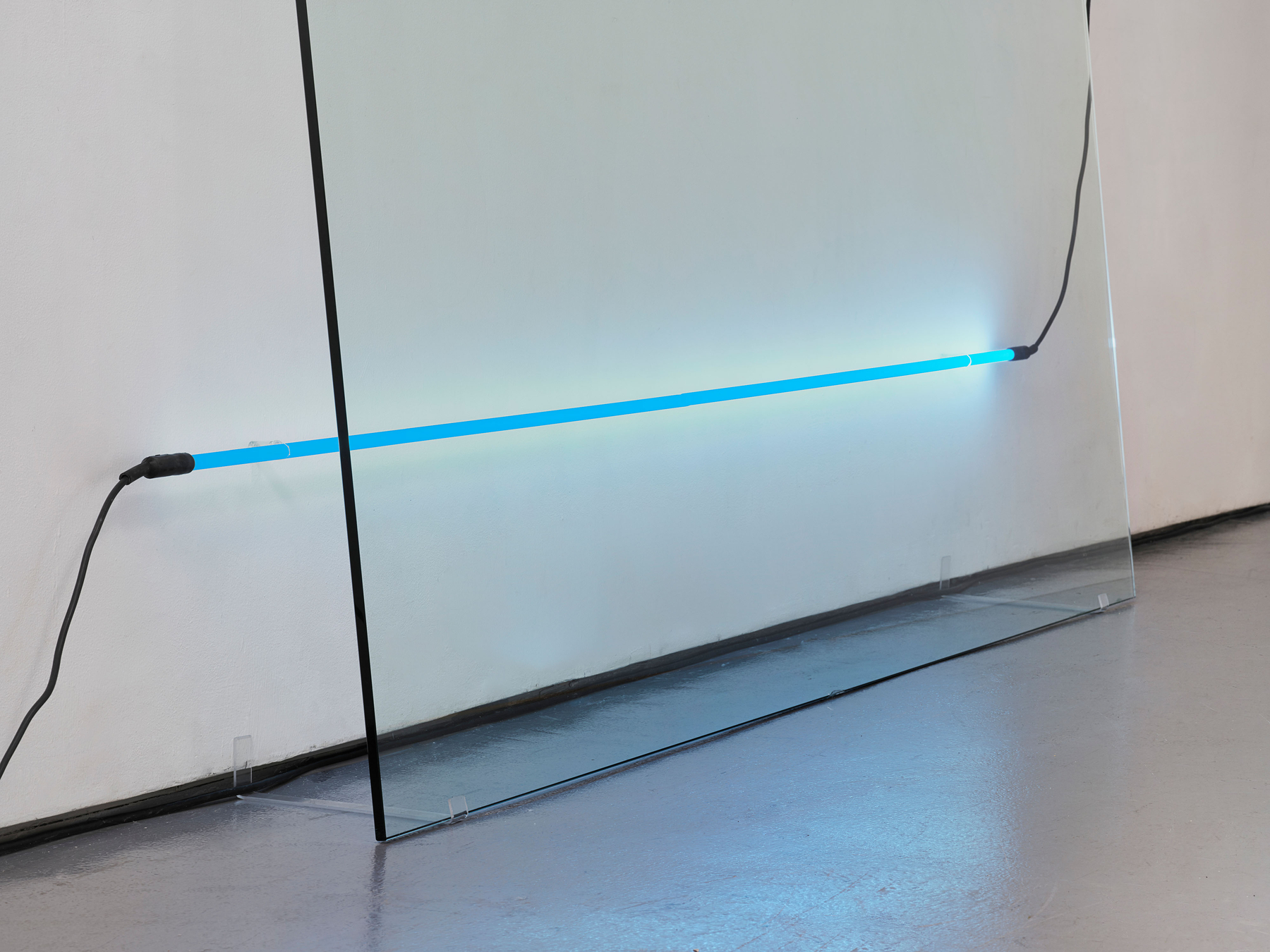
Through the opening in the title wall, the first work is finished before anyone gets near it. Two lines of neon run above two pieces of glass: a level one over a half-disc set curve-down on the floor, a rising one over a four-sided pane whose top slopes up toward the right. A black band drops down the middle of the half-disc as far as the floor. A black square sits near the pane’s right edge. Between them, low, a flat box, with cables running to it along the concrete; and under the whole arrangement, in the polished floor, both lines again. Dyad Cut Ba-O-Ba, 1969.
The exhibition is called Inside Light, and the checklist gives this work as glass, paint, neon and a transformer, with neon in the same place on the line for five more: Ba-O-Ba I and Untitled Neon Corner Piece, both 1969; Neon Wrapping Incandescent V, 1970; and two Arced Neons from 1968, one Cool White, one Violet. Six works made with light. From the opening, that is a complete description of the first of them.
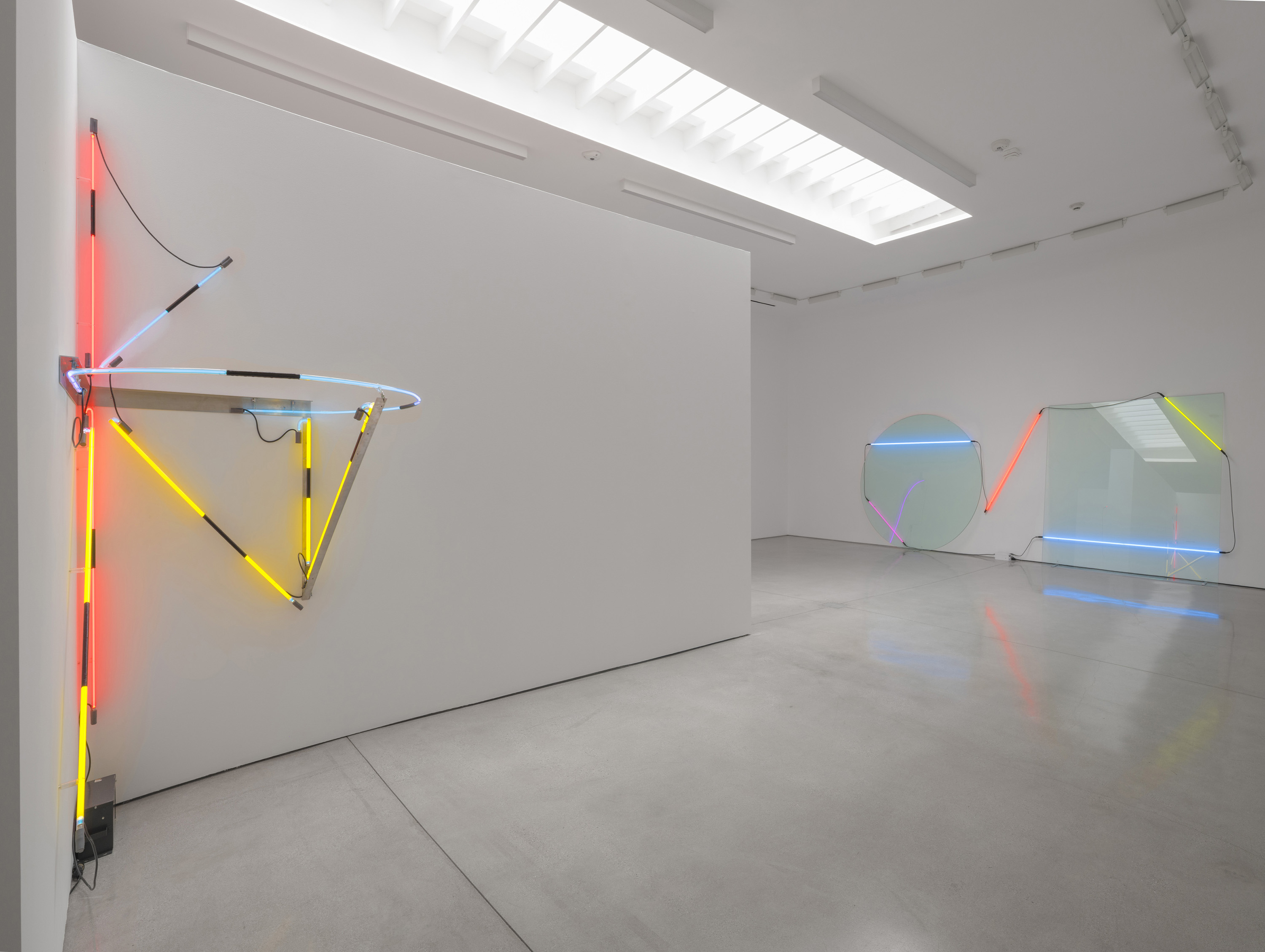
From the east end of the partition the room opens differently. A plain partition face ahead; on the far wall, a disc and a square of glass with lines between them. Dyad Cut has turned sideways, and something the opening withheld becomes obvious. The four-sided pane leans. Its bottom edge stands well out from the partition, its top returns to the wall under the rising tube, and the black square hangs on a surface that is plainly tilted.
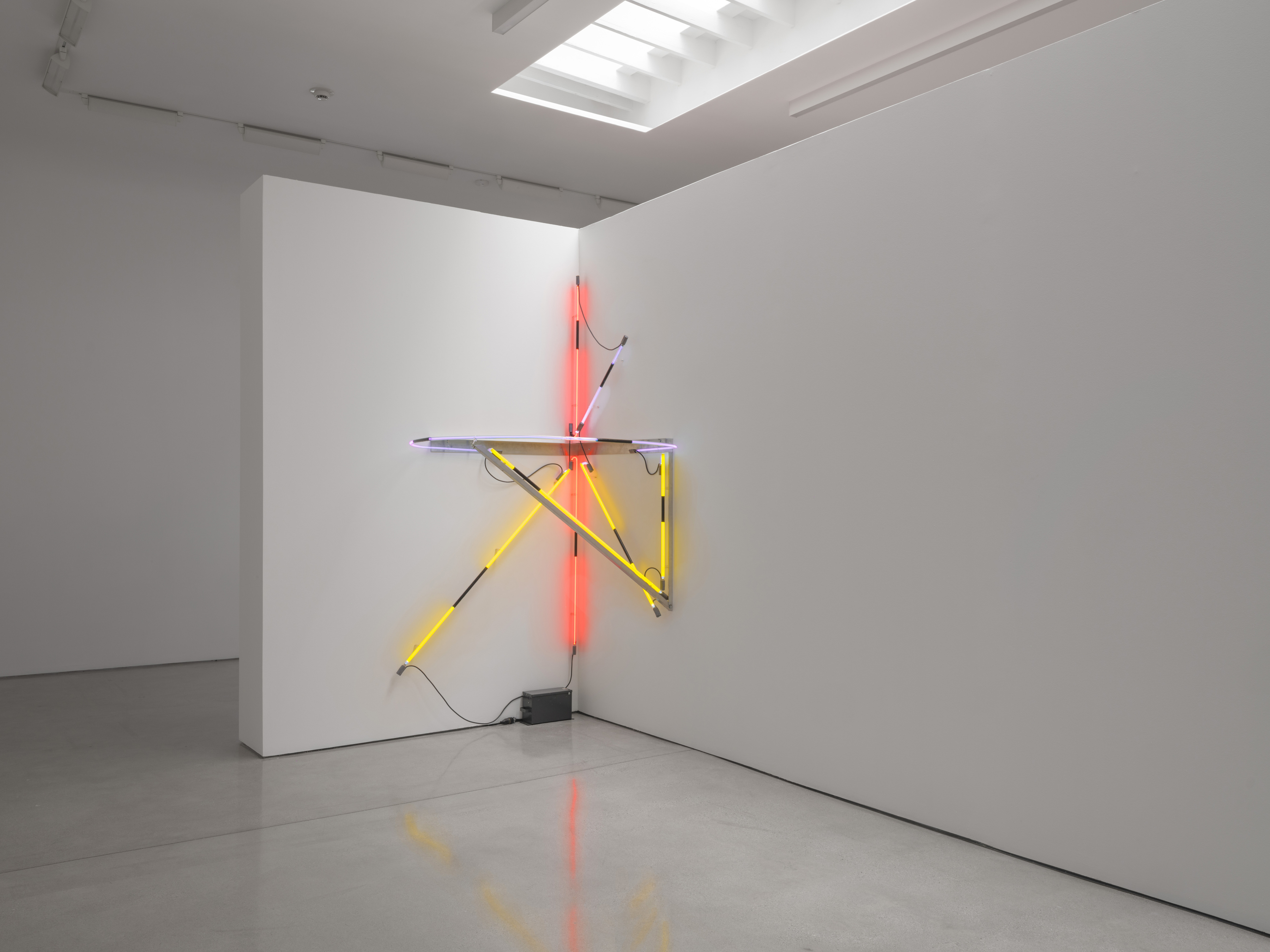
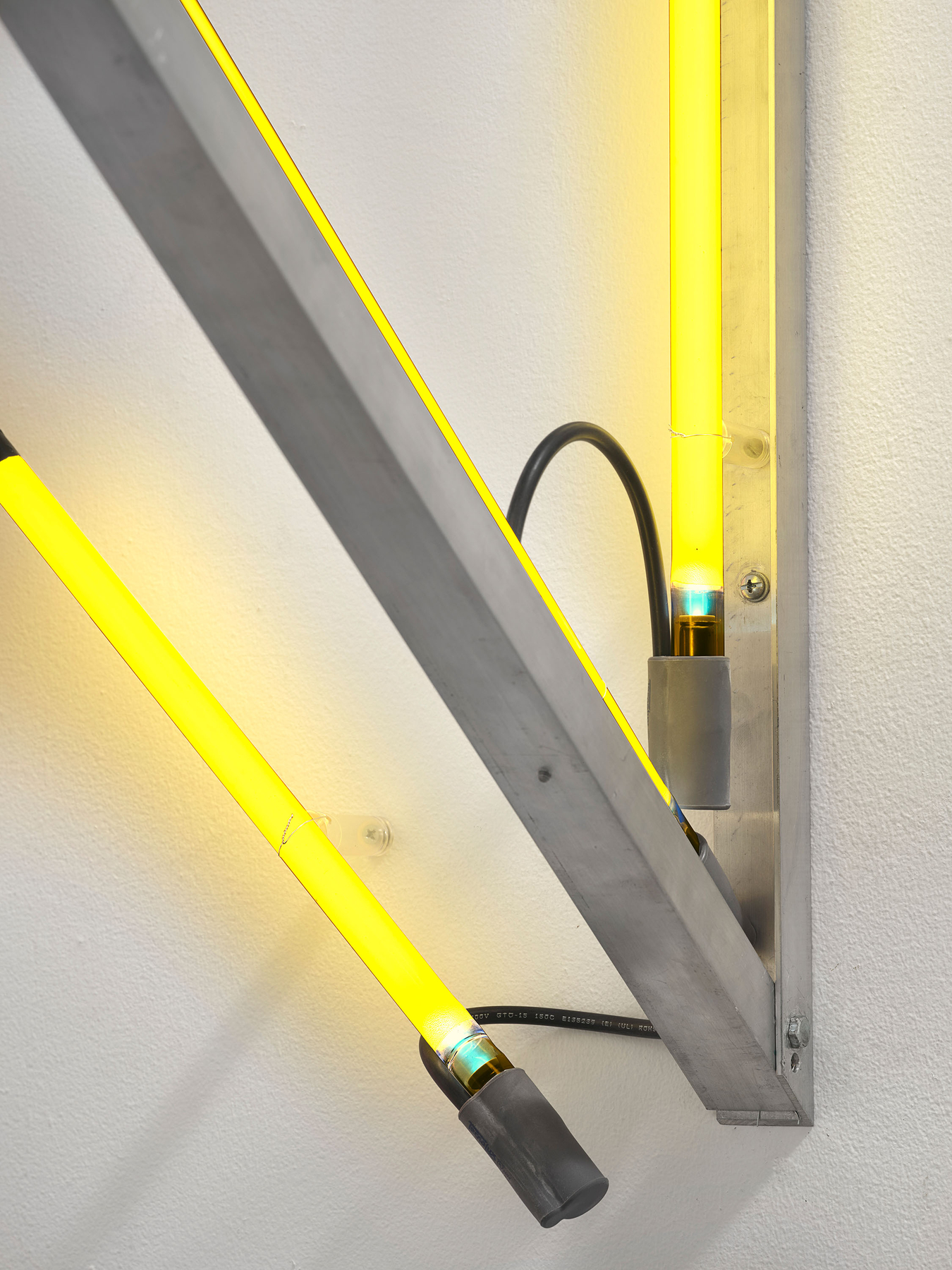
Behind the partition, the first bay ends in an occupied corner. Untitled Neon Corner Piece needs two walls meeting and has been given two partition faces at a right angle. One tube runs down the corner line itself, and everything else takes its place from a frame that has been screwed across the corner in front of it: a straight length of aluminum angle bridging from one face to the other, with a triangle of air behind it because the member is straight and the corner is not; a second member dropping from its left end at a diagonal onto the right-hand face, crossing in front of the vertical tube; a short vertical angle where the diagonal lands. A tube bent into a ring lies flat above the bridging member on small clear clips, its ends reaching onto the walls on either side. The remaining tubes lie along the aluminum or sit inside its channel, except one, which keeps to the left-hand face on clips of its own. Every tube is broken at intervals by an opaque black band; every end sits in a grey housing; a black box waits on the floor beside the corner.
The bay closes on it. There is no way through.
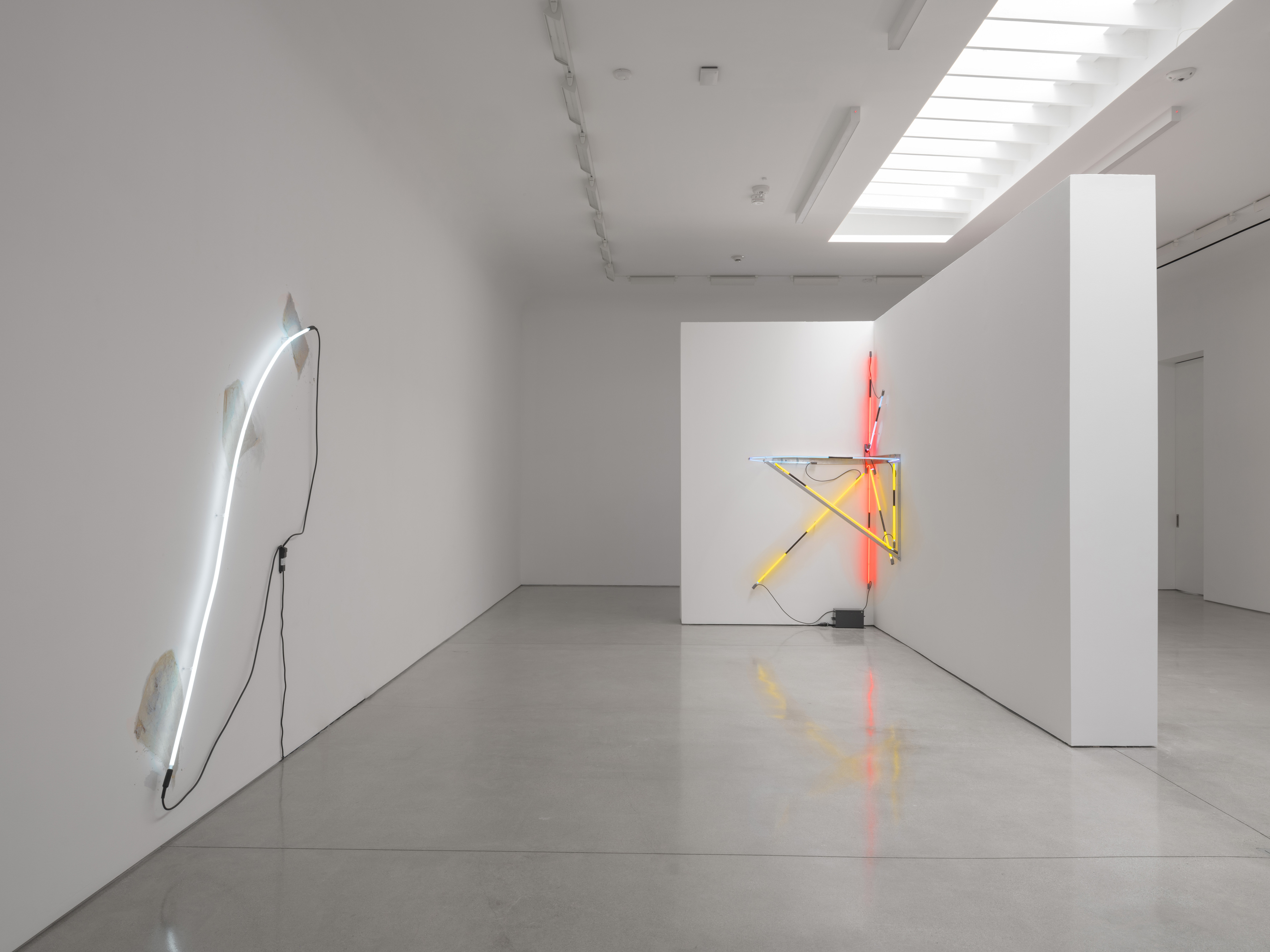
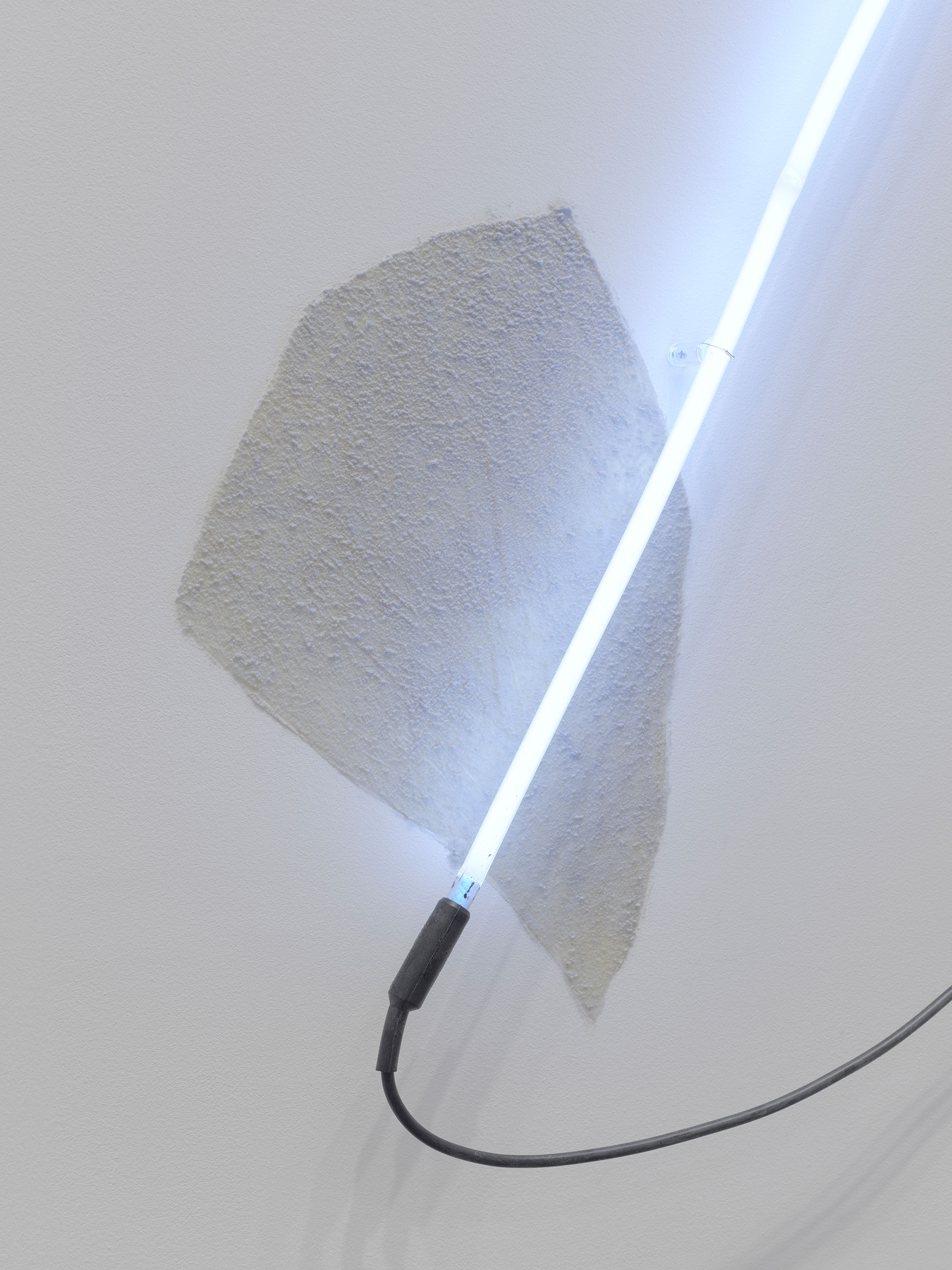
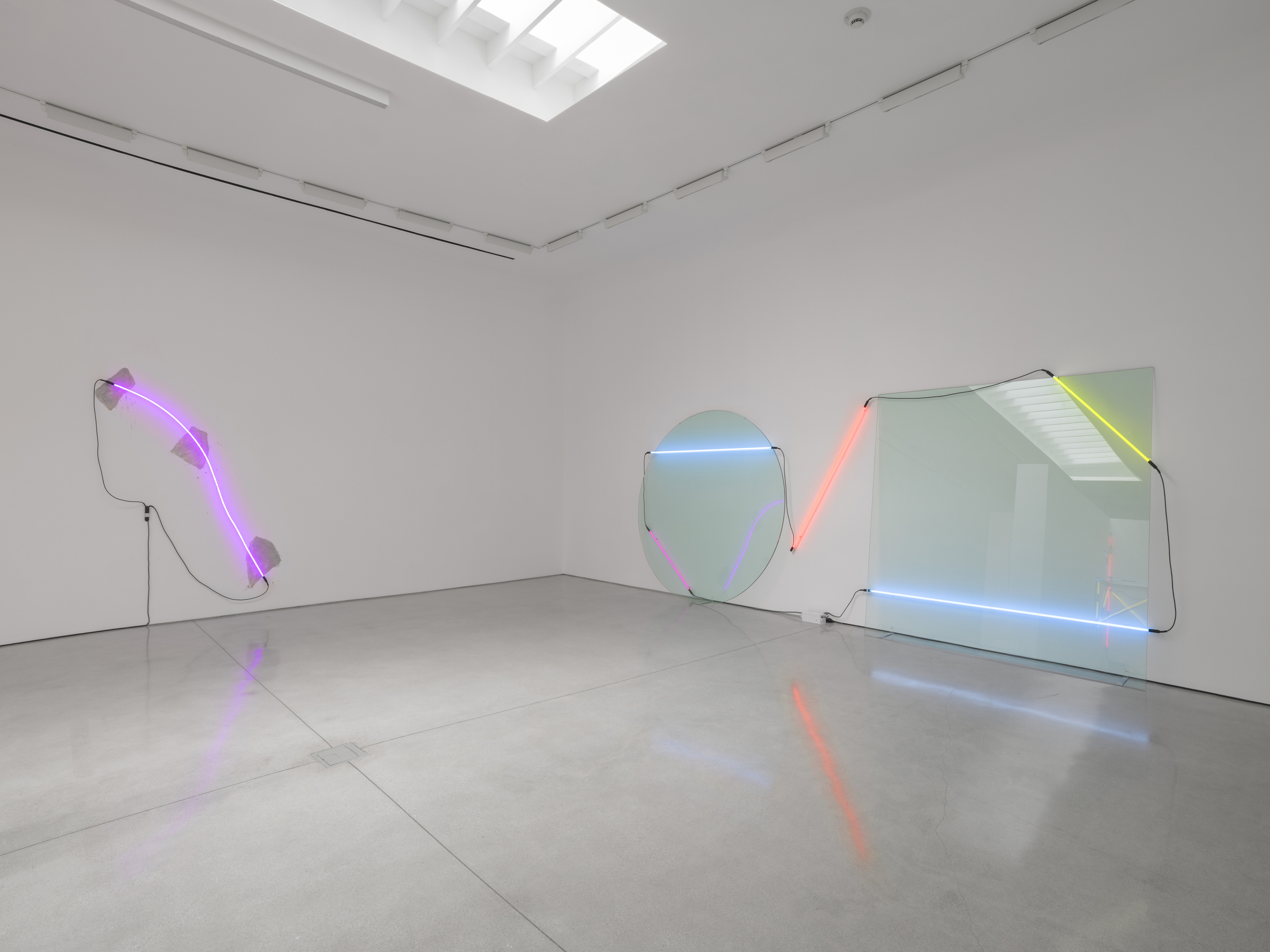
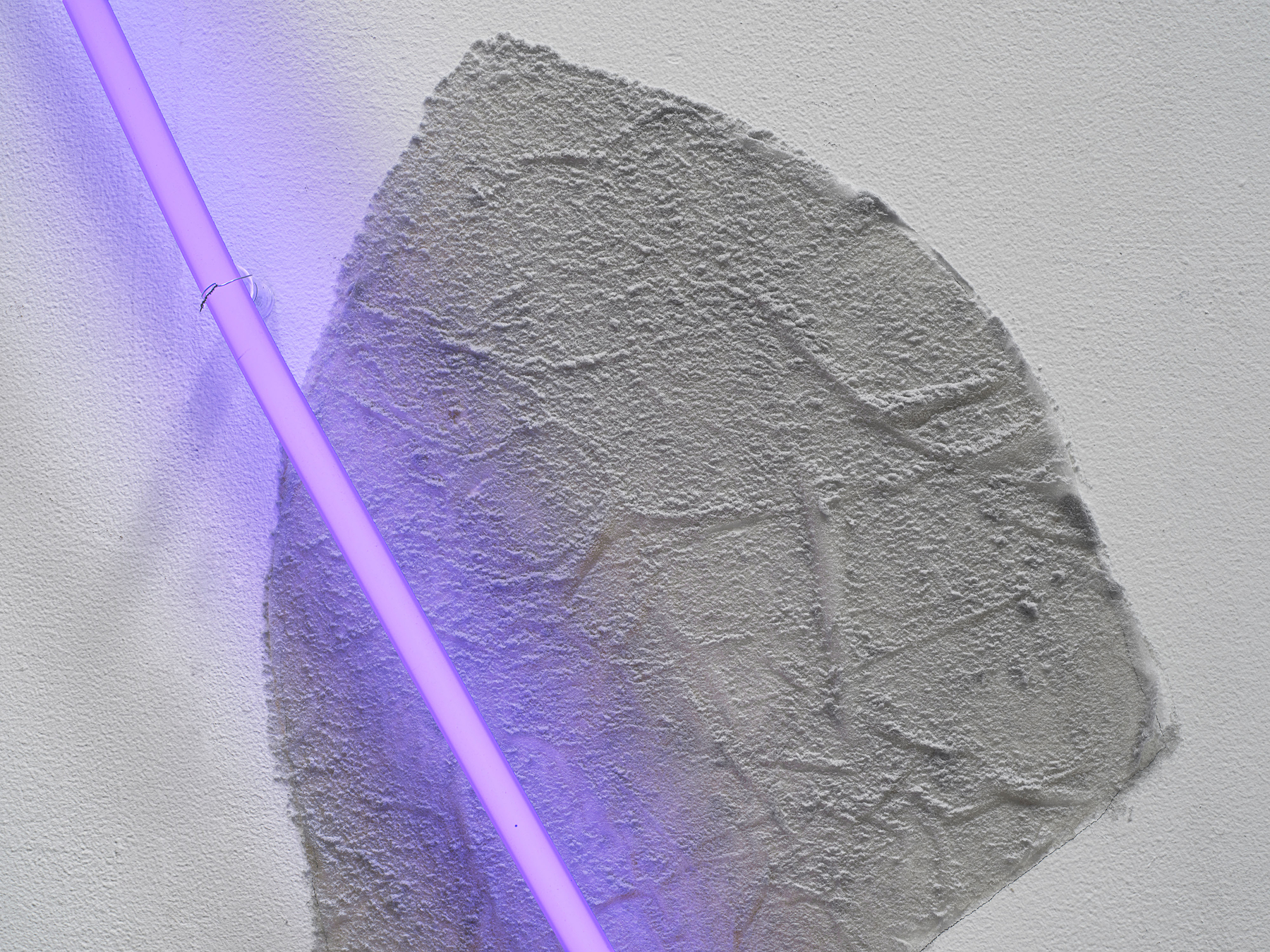
On the east wall, past the mouth of the bay, Arced Neon (Cool White) is one tube bent into a long shallow S that starts near the floor at the left and rises to end above head height at the right. It stands off the wall on small clear standoffs, each with a screw at its centre. Behind it, flat to the wall, are three sheets: one under the lower end, one part-way up, one under the top end. Their edges are torn, not cut. Their surface is pebbled and granular, and on at least one of them the coat stops short of the edge and leaves a smooth, faintly tan margin. The black cap on each end of the tube sits over a sheet rather than beyond it. From both caps a cable runs to a small labelled unit on the wall, and from the unit one cord drops to the floor and runs off along the base of the wall. The checklist says neon, transformer, clear poly sheeting and flock, ninety-two inches high and two and a quarter deep.
Of the six, it is the one that reaches furthest back. In 1982, asked what had come before his video work, Sonnier began with a piece he called an arc of neon with cloth, which turned on and off in sequence. Here is an arc of neon over soft, torn, flocked sheet, three pieces of it.
What came before that arc he had described ten years earlier, in August 1972, at thirty-one. In 1966, geometric constructions of plywood and clear vinyl fed by an air pump; some had a timed sequence that altered their structure; all destroyed. In New York, a two-by-four covered in lumps of foam rubber and then in cloth, ten feet of it; pieces of window screening in sections, fastened together; latex pieces built into the wall itself. Then light. From 1969, light pieces made as props for a video camera, with the recording projected at the same scale as the live action. He was working with video and sound by then, and he explained the attraction in terms that took light as the earlier case: material that was around, easy to work with, quicker, a way of presenting the same idea in another format. In the same conversation the light pieces themselves came out differently. In New York they had been very difficult to get made, at a phenomenal cost. In Germany he had gone to the largest factory, spent two days working five pieces out on its floor, and had them made the next day.
And in 1982, having named the arc, he gave the early work a shape. “They were all involved with either light sequence or some sort of tactile element.” It is a sentence with two words in it, and nothing on the east wall says which of them this arc answers to.
Ba-O-Ba I is the widest thing in the room, two hundred and ten inches from end to end, and it has been visible twice already, from the east end of the partition and from the mouth of the bay. Up close it becomes a count. Two panes of glass lean against the wall: a disc, resting on the floor at a single point of its rim, and a near-square, standing on small clear pads at its bottom corners, both with their tops back at the wall and their bottoms out. Five tubes run across them and between them in one chain. A level chord crosses the upper part of the disc. A short diagonal sits at the disc’s lower left. A long diagonal runs on the bare wall between the panes, from the disc’s right edge up to the square’s top-left corner, touching neither. A shorter diagonal cuts across the square’s upper-right corner. A horizontal runs along near the square’s bottom and does not stop at the square: its left cap lies out on open wall. Black cables drape along the pane edges from cap to cap, and both ends of the chain come down to a small white box on the floor between the panes.
Disc, wall, square. Two leans, one point of contact, four pads, one overshoot. A chain that crosses three separate supports and returns to one box. The glass had been in his hands a year earlier, holding latex against a wall, with light bulbs on a timer at either side.
Across the room, on the west wall, Arced Neon (Violet) answers Cool White: the same materials, three-quarters of an inch different in width and in depth, the arc reversed, top end at the left and lower end at the right, the unit on the other side. The sheets are the difference that is not a mirror. Where Cool White’s are pebbled and lie flat, Violet’s are creased and folded, with the wrinkles legible from across the floor, and the cable from the lower end swings out in a wide, low loop before it climbs to the unit. Between the two arcs the differences are handedness, the side the unit hangs on, three-quarters of an inch, and the state of what lies under the tube.
South of Violet the plain partition has another face, and the other bay lies between it and the back of the first partition. Its inside corner is empty. Neon Wrapping Incandescent V, 1970, hangs on the face beside it.
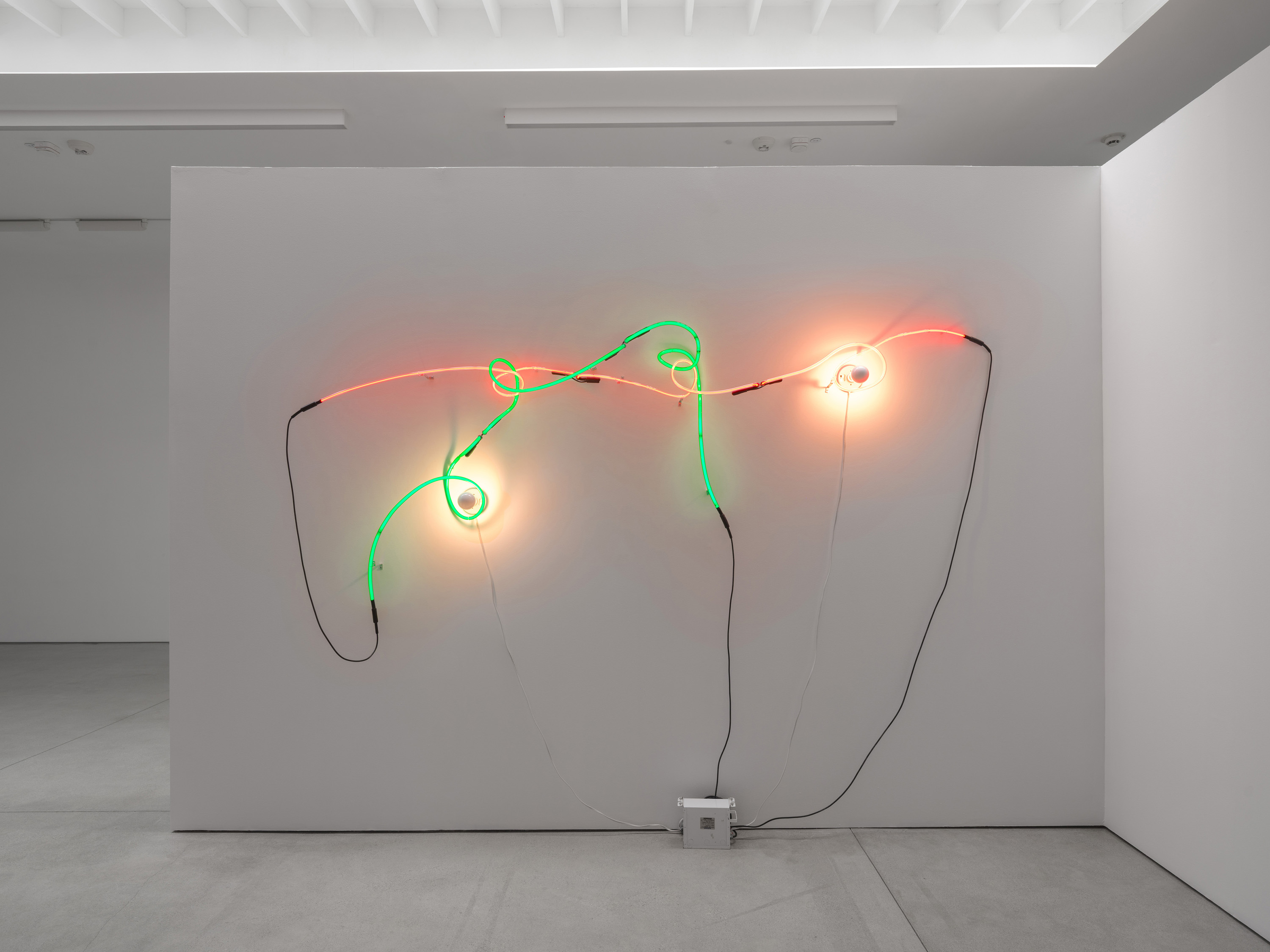
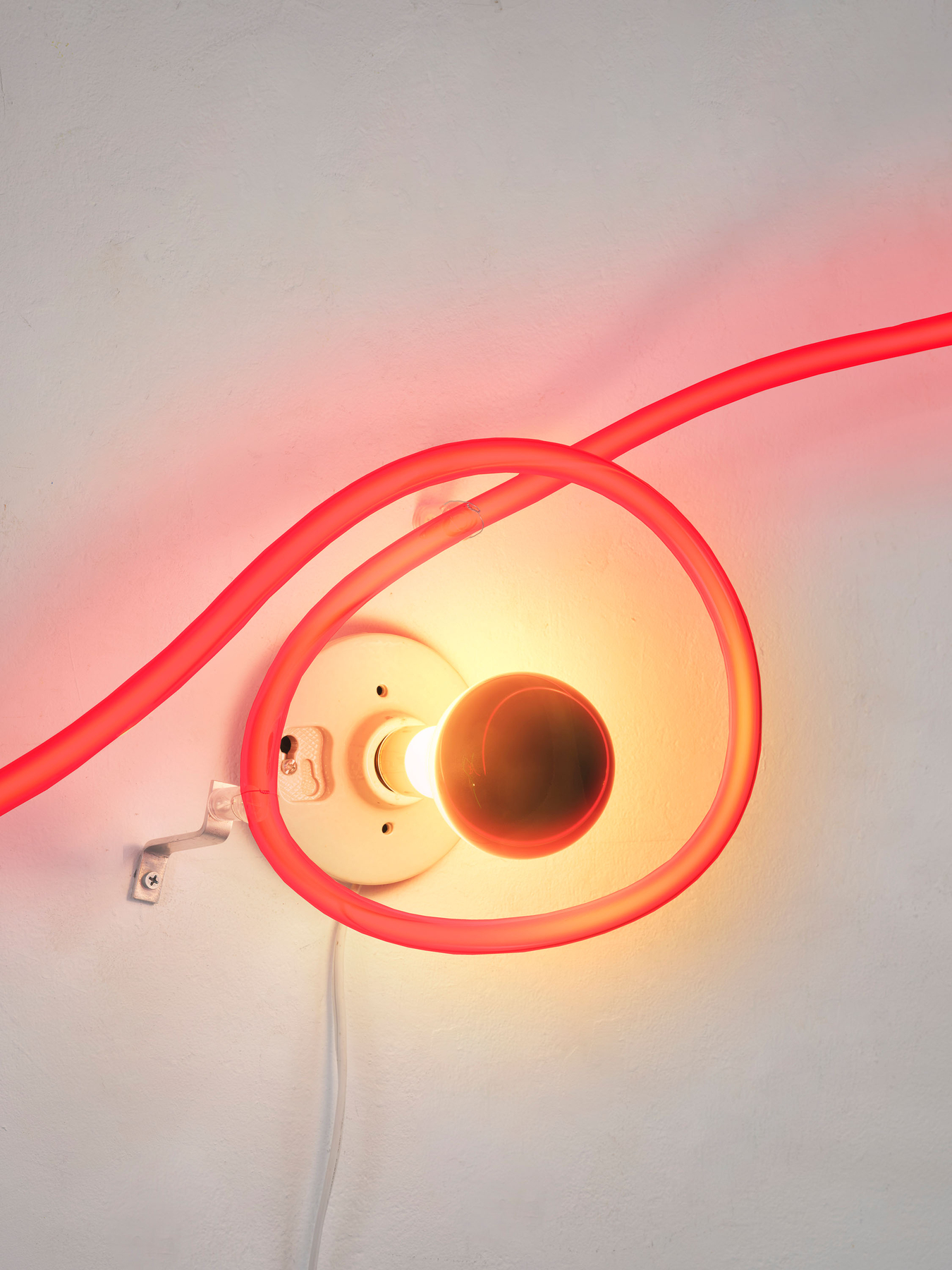
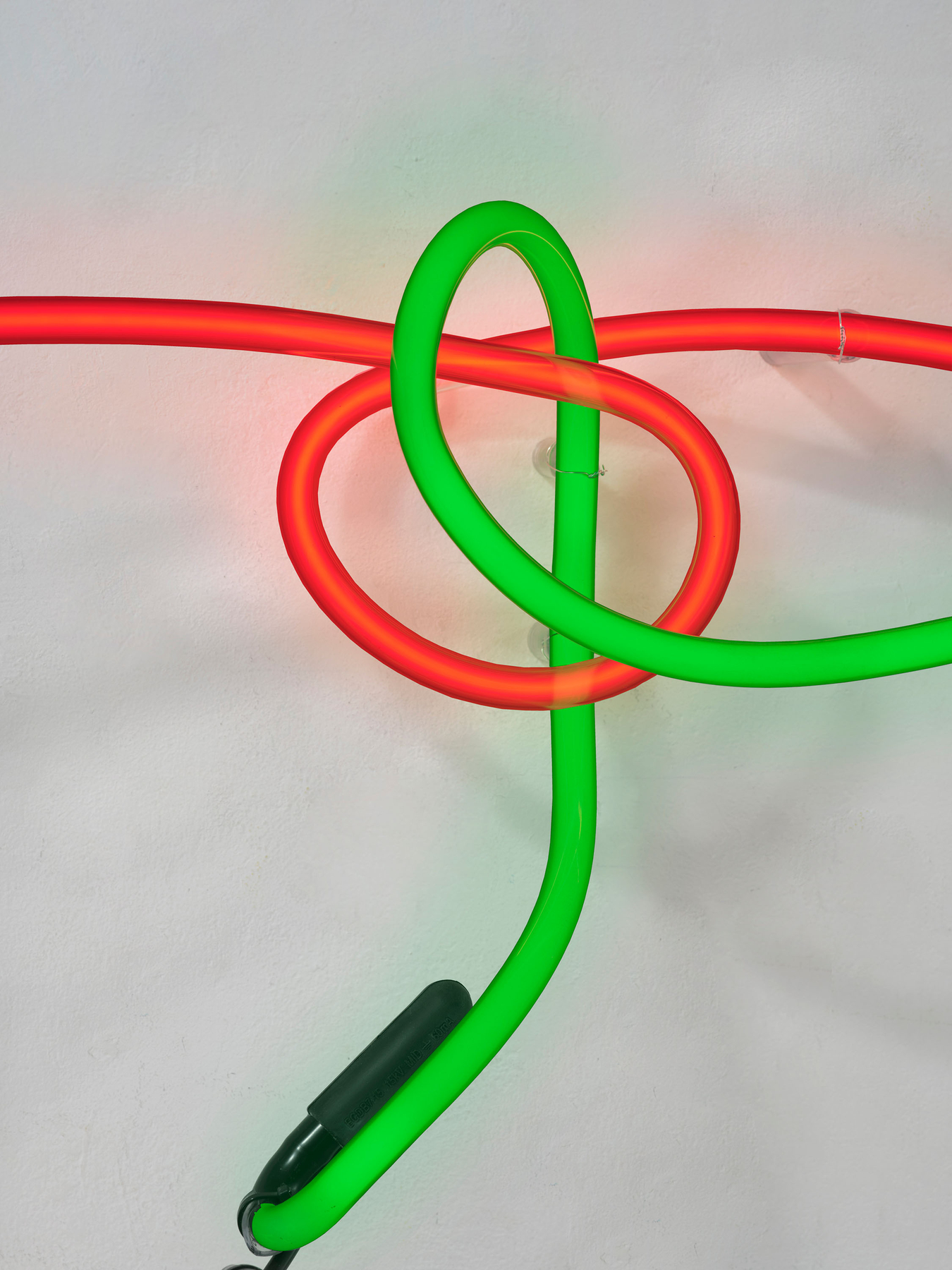
Two tubes, and the eye can follow either of them from end to end. One is a long line across the top, with a loop tied into it at two points and a third loop at the right. The other starts low on the left, coils once round a fixture, rises, passes twice through the loops of the first, and comes down to end right of centre. The fixtures are two round white porcelain lamp-holders screwed flat to the wall, a bulb in each, at about the height of a head; each appears to be ringed by its loop with a small gap, the tube going round the lamp without touching it. Black sleeves cover the joins where the tubes were made in sections, and small metal clips hold them to the wall. Where the two tubes pass through each other they are not connected. Their only electrical join is at the far left, where a black jumper leaves the end of the top line and hangs down the wall in a long slack loop before it climbs to the other tube’s end, and the lamps are on cords of their own, thin and white, running down to the same galvanized box on the floor.
Two kinds of light, on two circuits, in one object, and the only place they meet is the box. This bay closes too. What remains of the room is on the far side of the partition.
Two people who wrote about the work when it was new used other words for it. In May 1969, when the Whitney showed him in Anti-Illusion, James Monte read the wall as a ground, and sometimes as a picture plane the work played tricks on. Marcia Tucker wrote of an interest in “linear drawing and surface incident”, and of the wrapping works, in which one light source was wrapped by another so that each changed the other without the two being handled. She was writing about the principle of those works, a year before this one.
Light is his word too.
He went on making neon for the rest of his life, and in October 2009, asked about another artist’s pulsing text, he said he had never been so interested in the movement of the light. He could have gone that way at one point, he said, but neon carried connotations, it was a loaded material, and he had played it down; what had interested him were the physical properties of the light, that it was gas, the way it went out into the atmosphere, the volume of colour it made. The early pieces, he said in the same session, were all about touch. In 1982 the first piece he had named had turned on and off. And a month before, in the first session of the same oral history, on the subject of public commissions: “you do get to be pigeonholed sometime that oh, he does light.”
The west end of the partition gives Dyad Cut back, from its other side. The half-disc is nearest now. It stands on the lowest point of its curve, and the black band comes down its middle to meet the floor at that same point. Beyond it the pane leans out, its bottom edge well off the partition, a cable dropping from the rising tube’s far cap down the pane’s right edge to the floor and along it to the flat box. The two tubes sit on the wall, each just above a glass edge, and the edge shows as a pale line beneath. Where the half-disc’s top-right corner and the pane’s top-left corner close on each other, the two tubes end, and a short black jumper joins them above the meeting. Past the partition’s end, the loops of Neon Wrapping Incandescent V; beyond them, the disc and the square on the far wall.
His words for the early work, across thirty-seven years, all come near this one: material that was around; sequence, or some sort of tactile element; touch; gas, and the volume of a colour; light, the word on the wall. Between them stand two panes of glass on a concrete floor, one of them leaning far enough out that a hand could pass behind it, a band, a square, a jumper, a cable, a box, and two tubes on the wall above the glass.
Across thirty-seven years, Keith Sonnier described his early work through different terms: available material, sequence, touch, gas, atmosphere, colour volume, light. None is false. None quite settles the six works gathered in Inside Light. Neon crosses flocked sheet, leaning glass, aluminum, incandescent lamps, cables and electrical hardware; the same object can approach several of Sonnier’s descriptions without resolving into any one of them. The work remains more particular than the account.
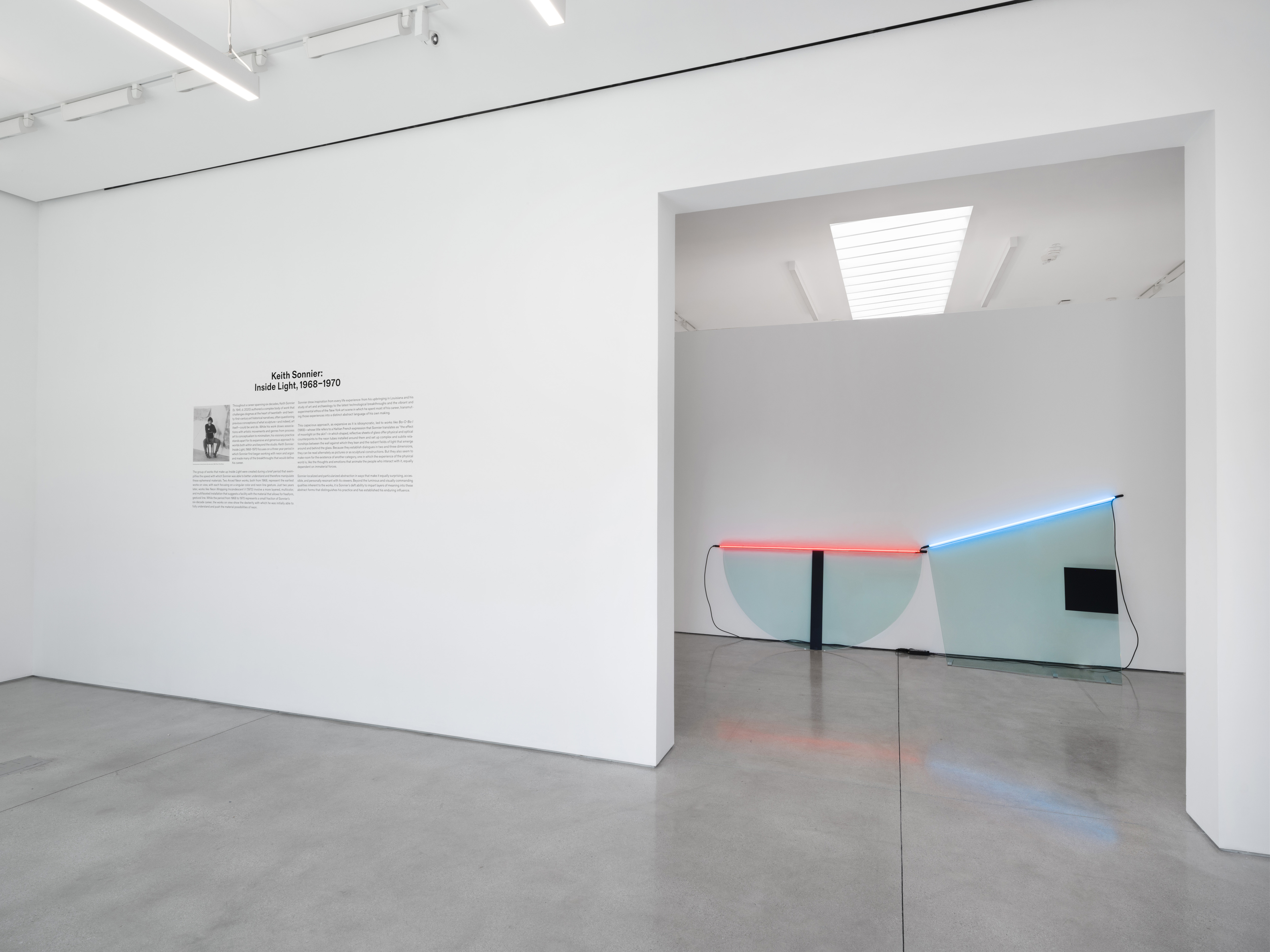
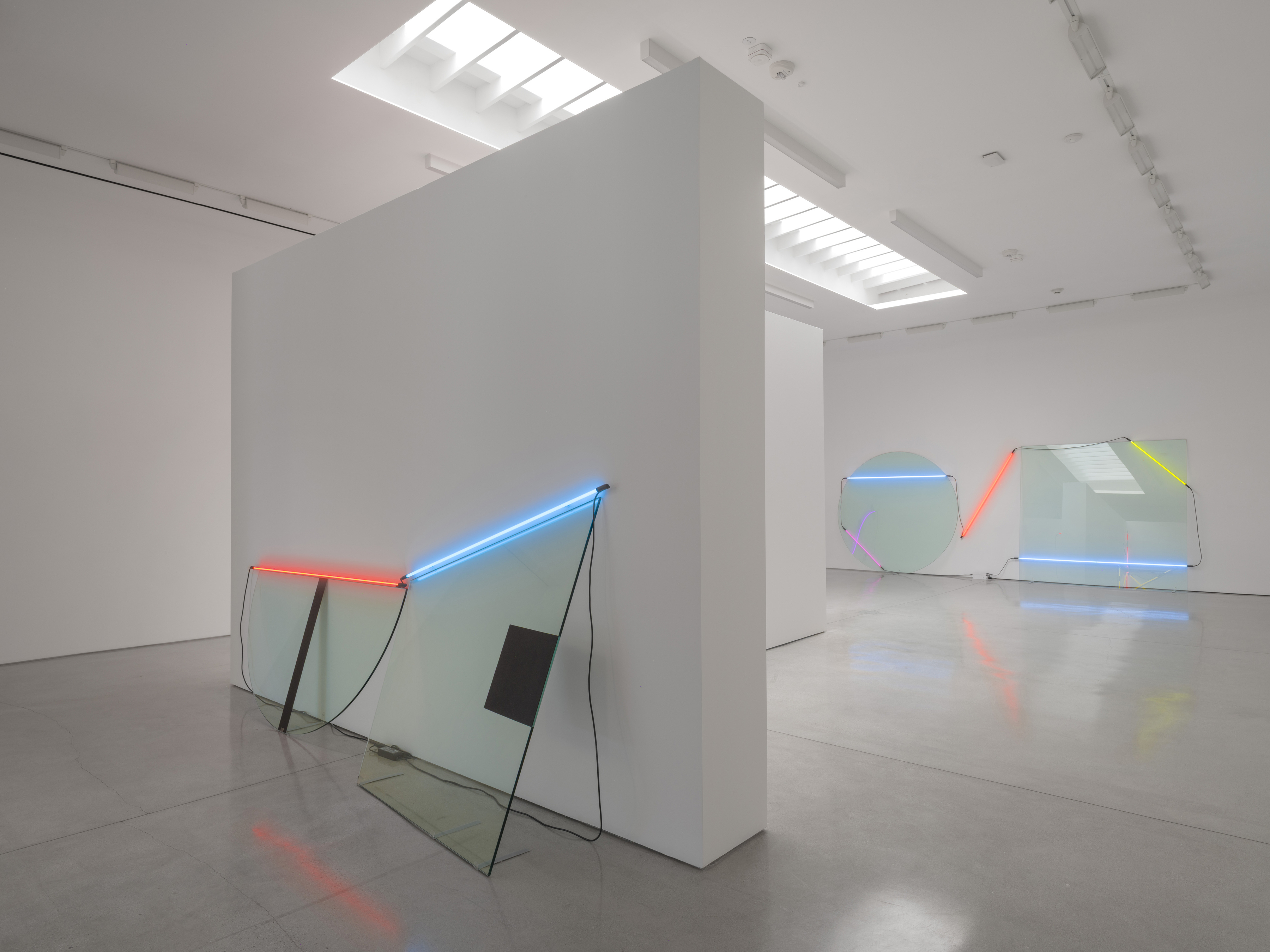
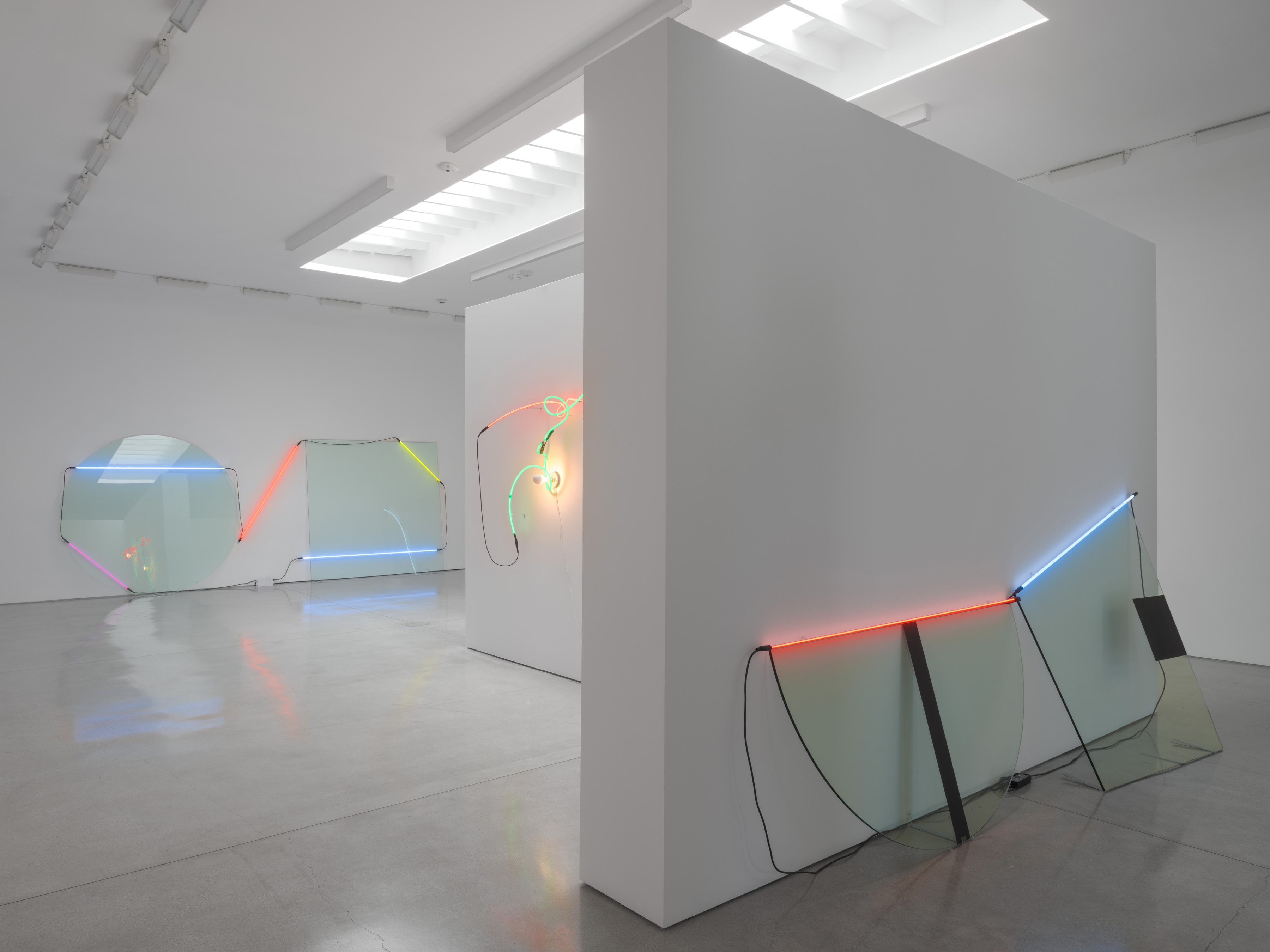
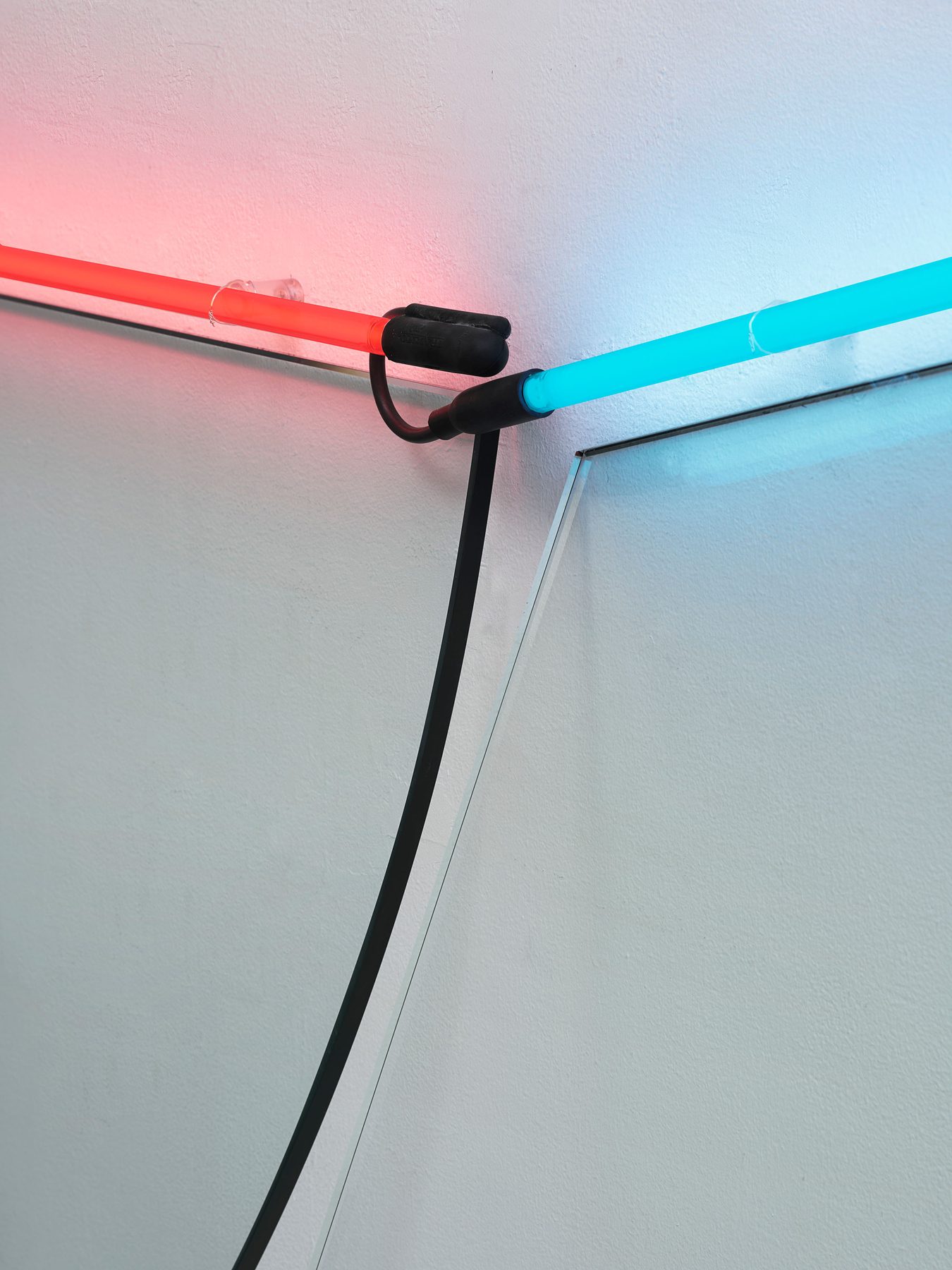
Cover Image: Keith Sonnier: Inside Light, 1968–1970, David Kordansky Gallery, Los Angeles, September 18–October 24, 2026. Installation view. © 2024 Estate of Keith Sonnier/Artists Rights Society (ARS), New York. Courtesy Estate of Keith Sonnier and David Kordansky Gallery. Photo: Jeff McLane.