



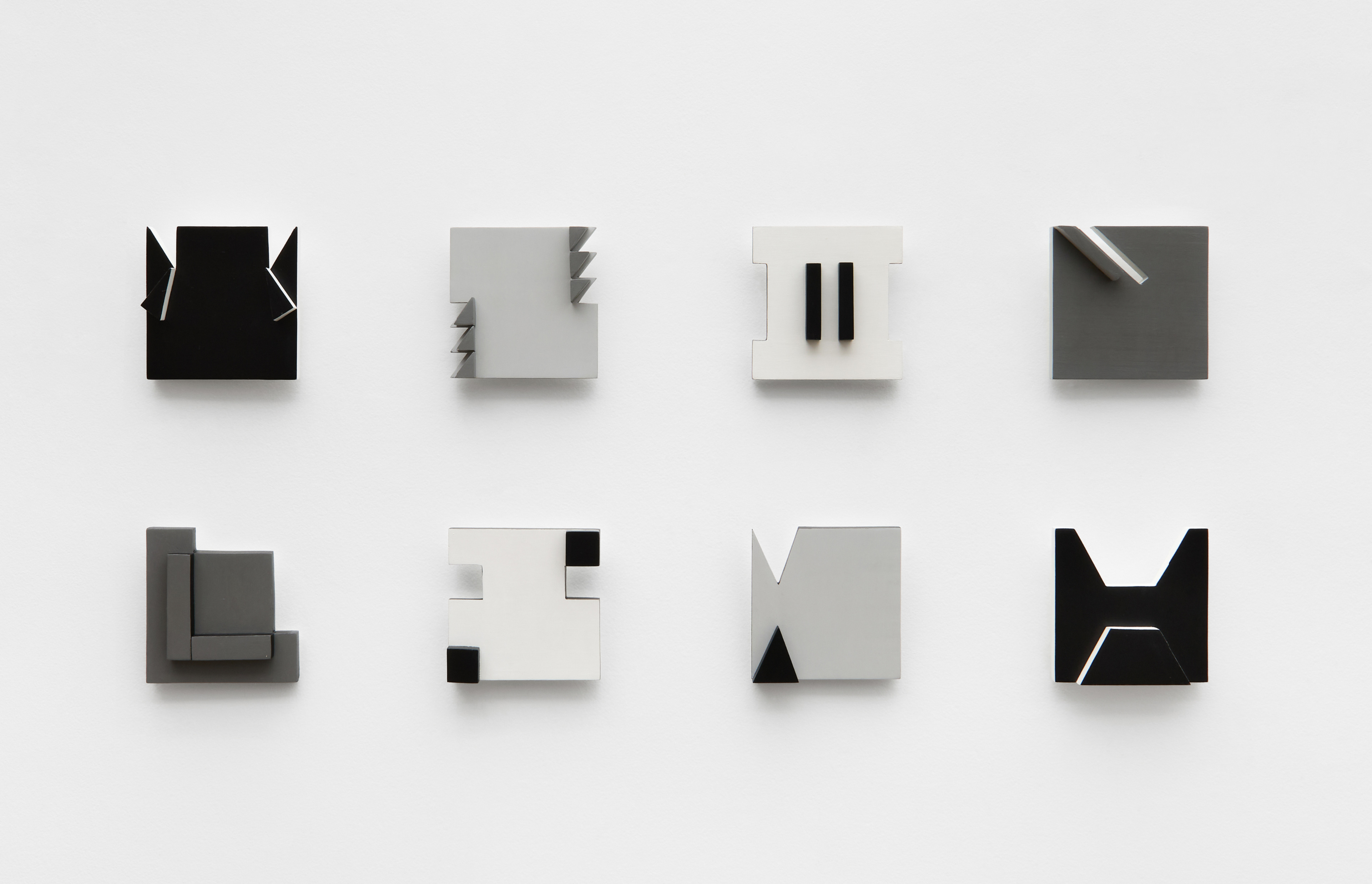
A sculpture conceived in 1961 and fabricated in 1998 is not usually where one looks for an argument about embodied perception. But in Sendo, KV 256 makes the issue impossible to avoid. One of the stainless-steel works is a diagonal wedge held against a rectangular support; the other is a hollow T-shaped frame, volume reduced to edge and void. Both are exact, cool, and already complete. The long gap between conception and fabrication matters because it makes one point unusually hard to miss: the form was settled long before the object existed in steel, and certainly before any viewer arrived before it. If Lygia Pape’s work requires the body, it is not because the work opens toward completion. It is because the work is precise enough to make the body’s position count.
That is the difficulty Pape still poses, and the reason the usual language around her work remains insufficient. She is routinely described as participatory, immersive, inviting, sensorial. None of those words are entirely wrong. But they all imply, in slightly different ways, that the work becomes bodily by loosening itself — by opening, dissolving, or yielding part of its structure to the viewer’s encounter. Pape’s work suggests something harder. The body enters not because form relaxes, but because form is precise enough to register position, movement, and proximity without surrendering its own closure.
Presented across two venues, Sendo does not read as a single installation but as a divided proof. Early geometric propositions, compact sculptural works, grouped reliefs, and later environmental structures are held apart just enough for their common logic to become visible. The question is not how Pape moved from geometry into experience, but how she kept geometry intact as experience became bodily.
The earliest works in the exhibition show that this logic was present from the beginning. The Tecelares do not need the viewer’s body in any explicit sense, yet they already make clear that relation in Pape begins inside form. Thin incised lines run across the surface in parallel, then break just enough to generate planes, pressure, and depth. What Projeto Lygia Pape called “magnetised space” is already there — not between work and spectator, but between one line and another, inside a formally closed system. The charge comes from a minimal disruption inside the grid itself: parallel incision held long enough to establish a field, then broken just enough for depth and pressure to appear. Pape’s relational thinking does not begin with participation. It begins with geometry charged from within.
That same exactness appears in the grouped relief works distributed through the exhibition. Across multiple square units, planes, cuts, and directional shapes hold with almost diagrammatic clarity. The work unfolds through grouped relations rather than through a single image, but the proposition remains bounded at every point. Before Pape’s structures become environmental, they appear here as formal relations already fixed, asking perception to move across them without completing them.
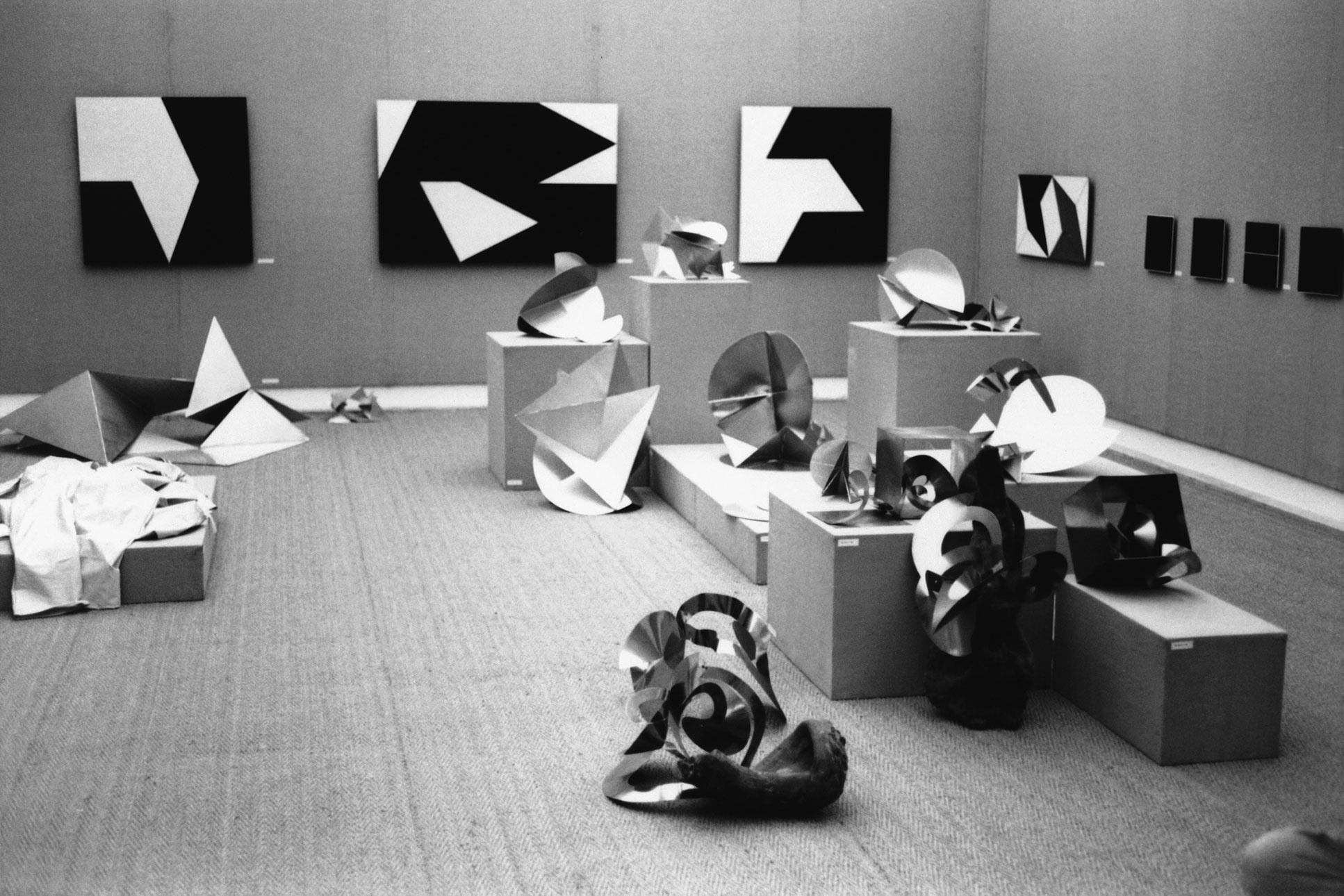
On pedestals, compact sculptural works push the same logic into space. Small geometric propositions sit as self-contained problems of edge, support, and interval. They do not yet surround the body, but they already ask it to register distance, orientation, and relation. Before Pape’s structures become atmospheric, they appear here as objects already complete, requiring approach without yielding themselves to it.
Iron and automotive paint, industrial materials carrying circles, squares, triangles, and projecting arms into relief: the Amazoninos restage that internal logic at the scale of the body. Their structure is topographic before it is relational. The surfaces are hard, cool, and non-expressive. Nothing in them asks to be completed. Yet they cannot be fully grasped from a single position. The shadows shift, the depth changes, the relations between forms tighten or loosen as you move. Movement matters here because each change in position registers against a structure that does not give way.
In Sendo, the Amazoninos do not appear as a single signature object but as a clustered family of variations distributed across the wall: disks, squares, projecting loops, and strip-like extensions staged as related propositions. The point is not one form perfected, but a serial testing of how far a bounded structure can enter space without ceasing to belong to the wall. Their grouping matters. Seen together, they make visible a formal language moving through variation rather than a solitary emblem.
Projeto Lygia Pape and Mendes Wood describe the Amazoninos as deriving from aerial views of the Amazon forest — geometry extracted from looking down rather than built from bodily encounter. Whether or not that origin can be traced to Pape’s own words, it clarifies something the works themselves make visible. Paula Pape has said that before building the series in iron, Lygia first made paper models, combining the forms through something like an origami process, with the aim of making iron appear as light as paper. That contradiction matters. These are heavy industrial objects determined to produce an impression of lightness, fixed forms generating a perceptual instability they never themselves undergo. As Paula Pape put it, “The work should touch the spectator, and not the opposite.” The direction is exact: the body is not asked to complete the form, only to receive what the form does to it.
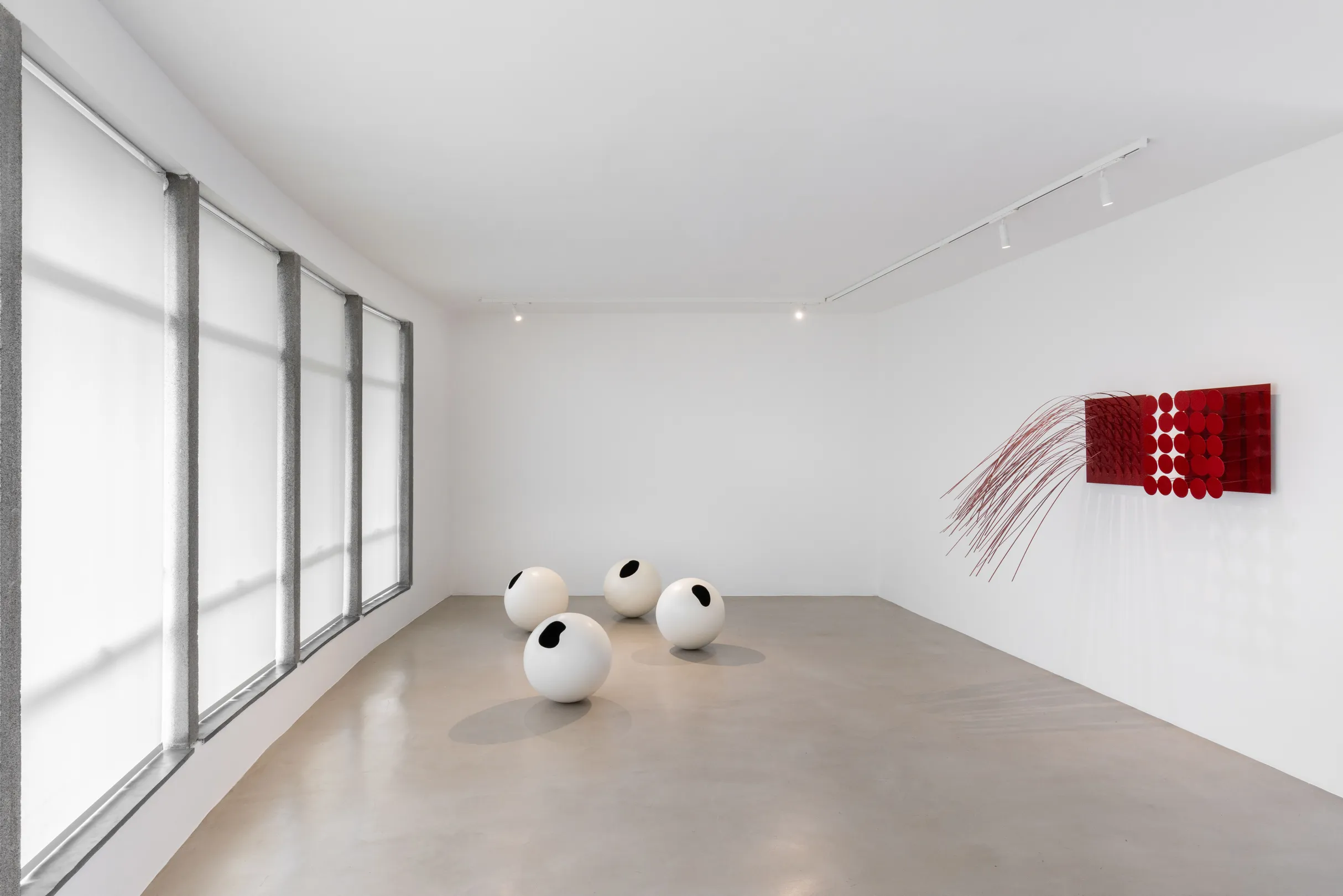
One work in particular makes the argument with unusual force: the red Amazonino in which a field of projecting strands arcs outward from the wall. Here the series becomes almost impossibly split between weight and lightness, attachment and release. The structure remains fixed to the wall, yet the projecting elements seem to pour outward, as if the work were testing how far a relief can move toward atmosphere without ceasing to be an object. The work changes as you move before it, but the proposition stays where it is.
Nearby, the white floor spheres make the same point with greater quiet. Each is a closed volume interrupted by a single dark opening, bodily in scale yet fully self-contained. They do not open the work to the viewer; they place the viewer in relation to a form already complete.
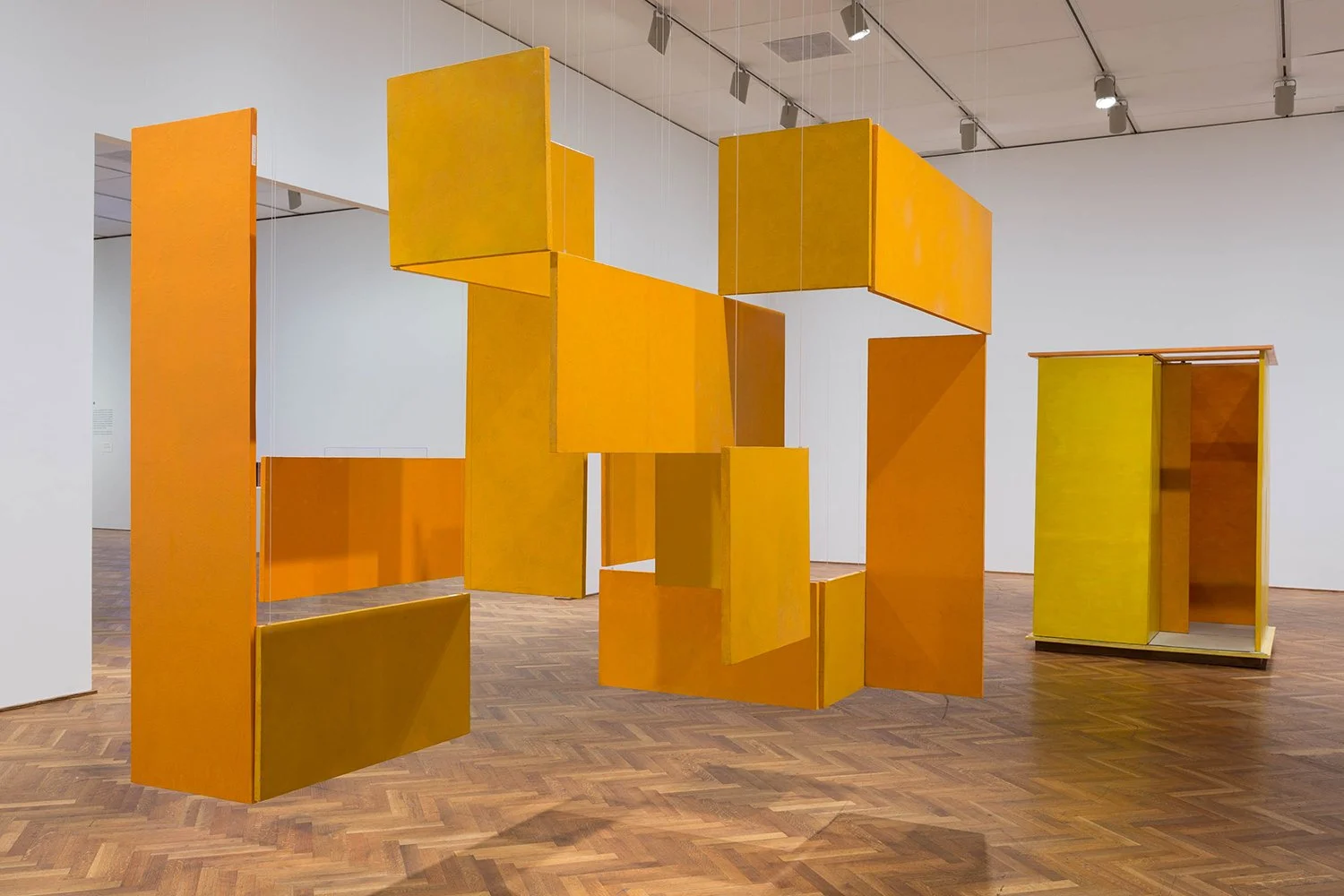
If the Amazoninos make the body move before a form that remains closed, the two configurations of Ttéia in Sendo extend the same logic into space by opposite means. In Barra Funda, Ttéia nº 7 appears as two pyramids in darkness under blue light, their pigment seeming to spill downward into the room’s atmosphere. The blue does not simply surround the forms; it loosens their edges, so that the pyramids seem at once fixed and slightly unheld within the dark. Pape described the work as existing in “permanent flux of transformation,” but the transformation is not structural. The pyramids do not shift; the light does not improvise; the geometry stays fixed. The atmosphere is generated by a set arrangement rather than by any loosening of form. The work becomes atmospheric without becoming open.
At Casa Iramaia, Ttéia 1 b makes the same point with greater formal economy. Fine silver threads stretch between circular anchors across the room, crossing wall to wall in diagonal bands that appear and nearly disappear with the viewer’s position. Nothing in the work changes; the structure is fully set. What shifts is visibility itself. The threads gather into translucent planes, then thin toward near-vanishing, making perception a function of angle rather than participation. This is one of the clearest demonstrations in the exhibition of what Pape’s work asks of the body: not completion, but position. The viewer does not activate the structure. The structure determines the conditions under which it can be seen.
The strongest challenge to this argument comes not from the atmospheric works but from Roda dos prazeres – 16, where participation seems unavoidable. Sixteen white porcelain jars, arranged in a circle, hold colored liquids with distinct scents and flavors; the viewer is meant to taste, smell, and test them. At first glance, this is the exception that proves the rule wrong — the point where Pape finally yields the work to sensorial openness. But even here the structure does not loosen. The number is fixed. The containers are identical. The circle is exact. More than that, the circle refuses sequence, hierarchy, or compositional climax: each jar occupies the same structural position, so variation in taste and smell occurs inside a form that withholds formal difference. What varies is the encounter, not the form that organizes it. Roda dos prazeres matters because it shows the same distinction under different conditions: sensorial unpredictability can occur inside a bounded proposition. As Pape insisted elsewhere, each work is “a kind of closed universe… in itself.” Even at the point where she comes closest to Clark, the work remains determined before anyone enters it.
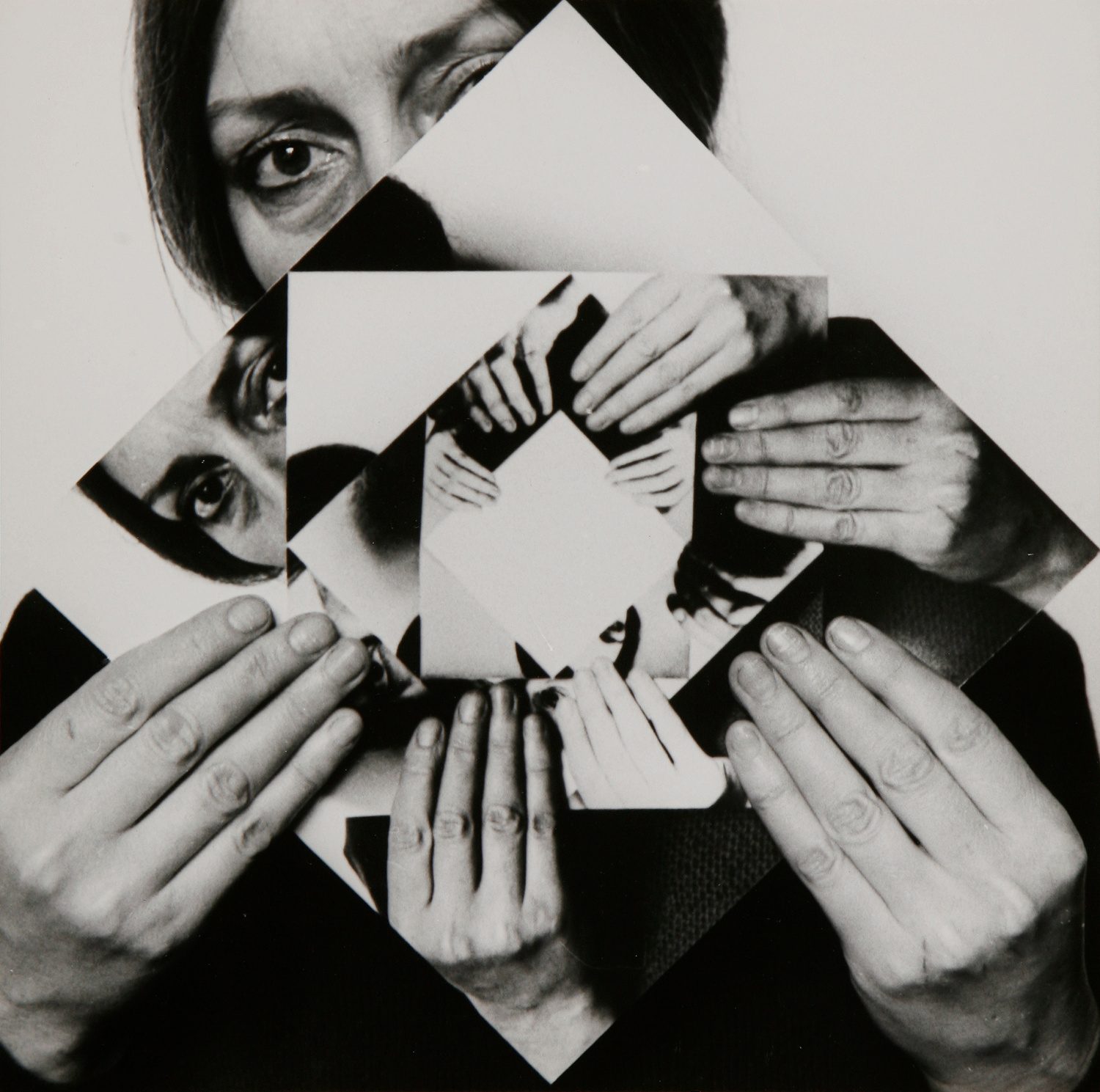
This is where Pape’s position inside Neo-Concretism becomes clearer, and more singular, than the usual trio narrative allows. Lygia Clark’s work moves toward the incomplete object: the form is not finished until the participant handles it, folds it, or closes it through use. Hélio Oiticica’s moves toward environment, participation, and the dissolution of the bounded work into social field. Pape does neither. She keeps the formal proposition intact and makes the body answer to it. That does not make her the least radical of the three, but the one who held a different line: geometry could become bodily, environmental, and sensorial without ceasing to be exact. If Clark tests what happens when the object yields itself to the participant, and Oiticica what happens when art yields itself to life, Pape asks a harder question. What happens when form remains complete and the body must still enter it?
Pape never abandoned form; she changed what form requires from the body.
Lygia Pape is often framed through participation, immersion, and sensorial experience. This essay argues for something harder: her work does not become bodily by loosening form, but by making form exact enough to make the body’s position count. Reading Sendo through KV 256, the Tecelares, the Amazoninos, Ttéia nº 7, and Roda dos prazeres, the piece repositions Pape as the Neo-Concrete artist who kept the formal proposition intact even as it became environmental, sensorial, and bodily.






1. Lygia Pape, KV 256 - Prateado, 1961 / 1998. Stainless steel / aço inox, 50 × 50 × 30 cm (19 3/4 × 19 3/4 × 11 3/4 in). © Projeto Lygia Pape. Courtesy Mendes Wood DM.
2. Exhibition view: Lygia Pape, Sendo, Mendes Wood DM, São Paulo, 7 April–June 2026. Artwork © Projeto Lygia Pape. Courtesy Mendes Wood DM. Photo © Gui Gomes.
3. Lygia Pape, KV 256, 1961 / 1998. Stainless steel / aço inoxidável, 50 × 30 × 50 cm (19 3/4 × 11 3/4 × 19 3/4 in). © Projeto Lygia Pape. Courtesy Mendes Wood DM.
4. Lygia Pape, Tecelar, 1957. Paint on Japanese paper / tinta sobre papel japonês, 30 × 30 cm (11 3/4 × 11 3/4 in). © Projeto Lygia Pape. Courtesy Mendes Wood DM.
5. Lygia Pape, Tecelar, 1959. Paint on Japanese paper / tinta sobre papel japonês, 44.5 × 35.5 cm (17 1/2 × 14 in). © Projeto Lygia Pape. Courtesy Mendes Wood DM.
6. Lygia Pape, Livro Noite e Dia I, 1963 / 1976. Tempera, latex and acrylic on wood / têmpera, latex e acrílica sobre madeira, 16 × 16 × 3 cm (6 3/10 × 6 3/10 × 1 1/5 in). © Projeto Lygia Pape. Courtesy Mendes Wood DM.
7. Lygia Pape, Amazonino Vermelho, 1989 / 2003. Iron and automotive paint / ferro e tinta automotiva, 120.7 × 50.2 × 114.9 cm (47 1/2 × 19 3/4 × 45 1/4 in). © Projeto Lygia Pape. Courtesy Mendes Wood DM.
8. Exhibition view: Lygia Pape, Sendo, Mendes Wood DM, São Paulo, 7 April–June 2026. Artwork © Projeto Lygia Pape. Courtesy Mendes Wood DM. Photo © Gui Gomes.
9. Detail: Lygia Pape, Ttéia nº 7, 1991. Wooden pyramids, light, pigment, cloth / pirâmides de madeira, luz, pigmento, pano, variable dimensions / dimensões variáveis. © Projeto Lygia Pape. Courtesy Mendes Wood DM.
10. Lygia Pape, Ttéia nº 7, 1991. Wooden pyramids, light, pigment, cloth / pirâmides de madeira, luz, pigmento, pano, variable dimensions / dimensões variáveis. © Projeto Lygia Pape. Courtesy Mendes Wood DM.
11. Detail: Lygia Pape, Ttéia 1, B, 2000. Metallized nylon threads, nails and light / fios de nylon metalizados, pregos e luz, 370 × 650 × 330 cm (145 7/10 × 255 9/10 × 129 9/10 in). © Projeto Lygia Pape. Courtesy Mendes Wood DM.
12. Lygia Pape, Ttéia 1, B, 2000. Metallized nylon threads, nails and light / fios de nylon metalizados, pregos e luz, 370 × 650 × 330 cm (145 7/10 × 255 9/10 × 129 9/10 in). © Projeto Lygia Pape. Courtesy Mendes Wood DM.
13. Lygia Pape, Amazonino Vermelho, 1989 / 2003. Iron and automotive paint / ferro e tinta automotiva, 130.2 × 49.8 × 68.6 cm (51 1/4 × 19 5/8 × 27 in). © Projeto Lygia Pape. Courtesy Mendes Wood DM.
14. Exhibition view: Lygia Pape, Sendo, Mendes Wood DM, São Paulo, 7 April–June 2026. Artwork © Projeto Lygia Pape. Courtesy Mendes Wood DM. Photo © Gui Gomes.
15. Lygia Pape, Roda dos prazeres – 16, 1968. White porcelain jars, colored aniline dyes, various flavors and scents, dropper with saucer / potes de porcelana branca, anilinas coloridas, sabores e cheiros variados, conta-gotas com pratinho, variable dimensions / dimensões variáveis. © Projeto Lygia Pape. Courtesy Mendes Wood DM.
16. Lygia Pape, Amazonino Verde, 1989. Iron and automotive paint / ferro e tinta automotiva, 1 m circumference and 50 cm circumference. © Projeto Lygia Pape. Courtesy Mendes Wood DM.
Cover: Exhibition view: Lygia Pape, Sendo, Mendes Wood DM, São Paulo, 7 April–June 2026. Artwork © Projeto Lygia Pape. Courtesy Mendes Wood DM. Photo © Gui Gomes.
All images © their respective rights holders.
Image rights & attribution →