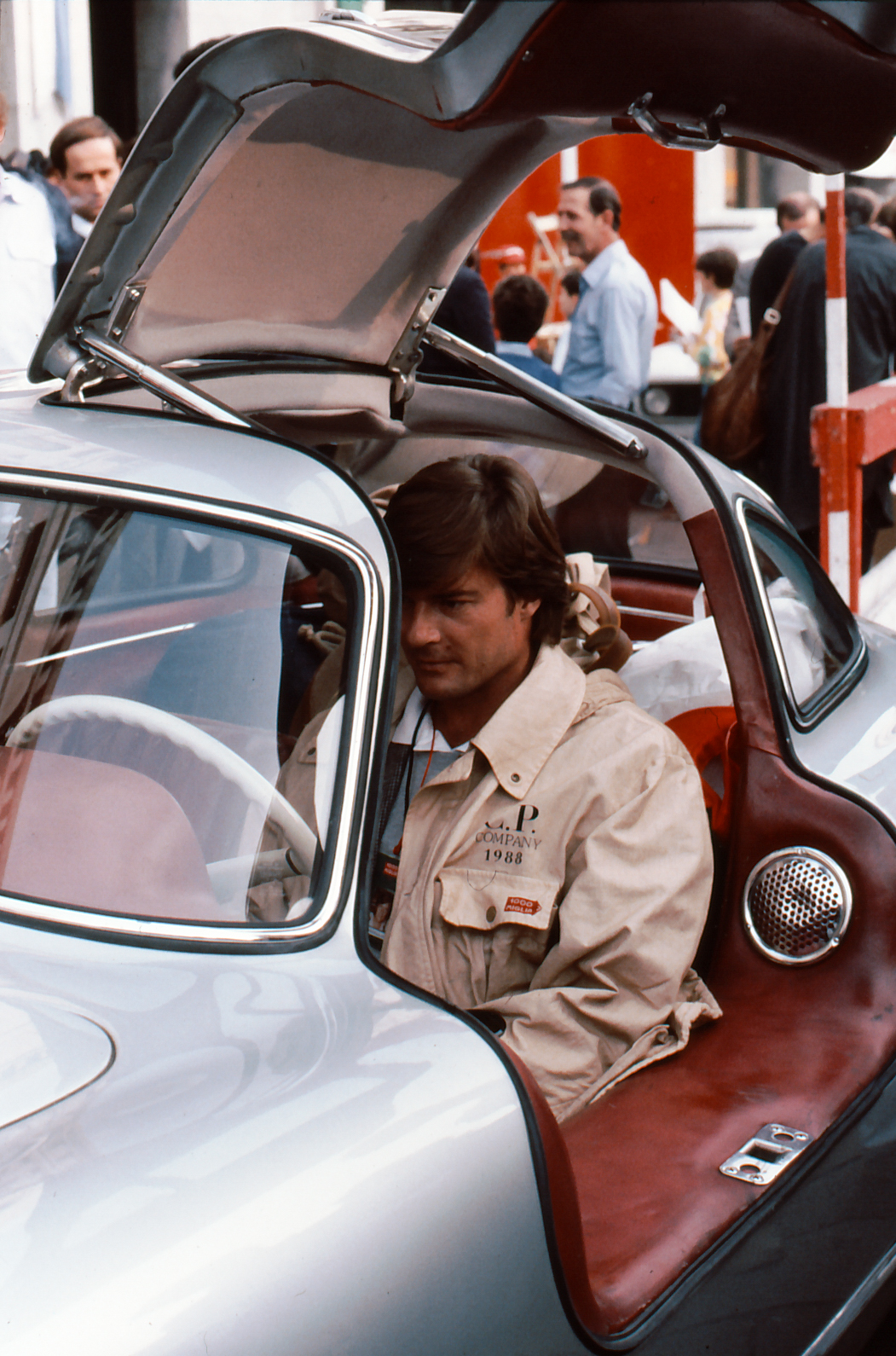
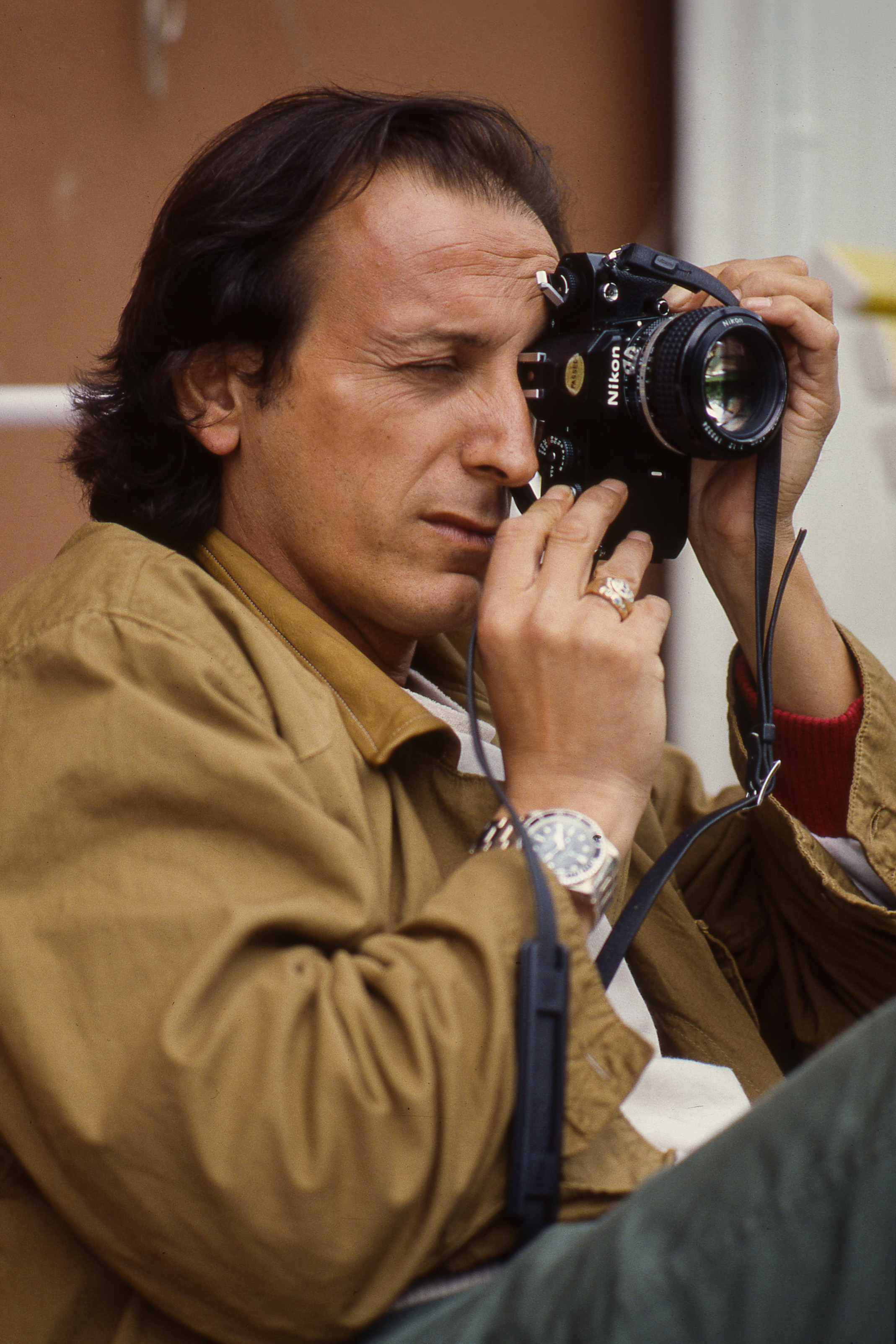




The benches were rough wood. On 23 October 1988 they held the Paris fashion crowd, Jean-Paul Gaultier among them, in a café-theatre of three hundred places in the Marais, the Café de la Gare, come for the first show of a new house called Maison Martin Margiela. Nothing had appeared yet, but the room was not quiet. Frédéric Sanchez, who made the soundtrack, had put microphones backstage, and people finding their places were, as he said years afterwards, “listening to what was going on backstage”. He thought of it as an introduction.
Before there was a show there was an audience: on benches, with nothing yet in front of it, listening.
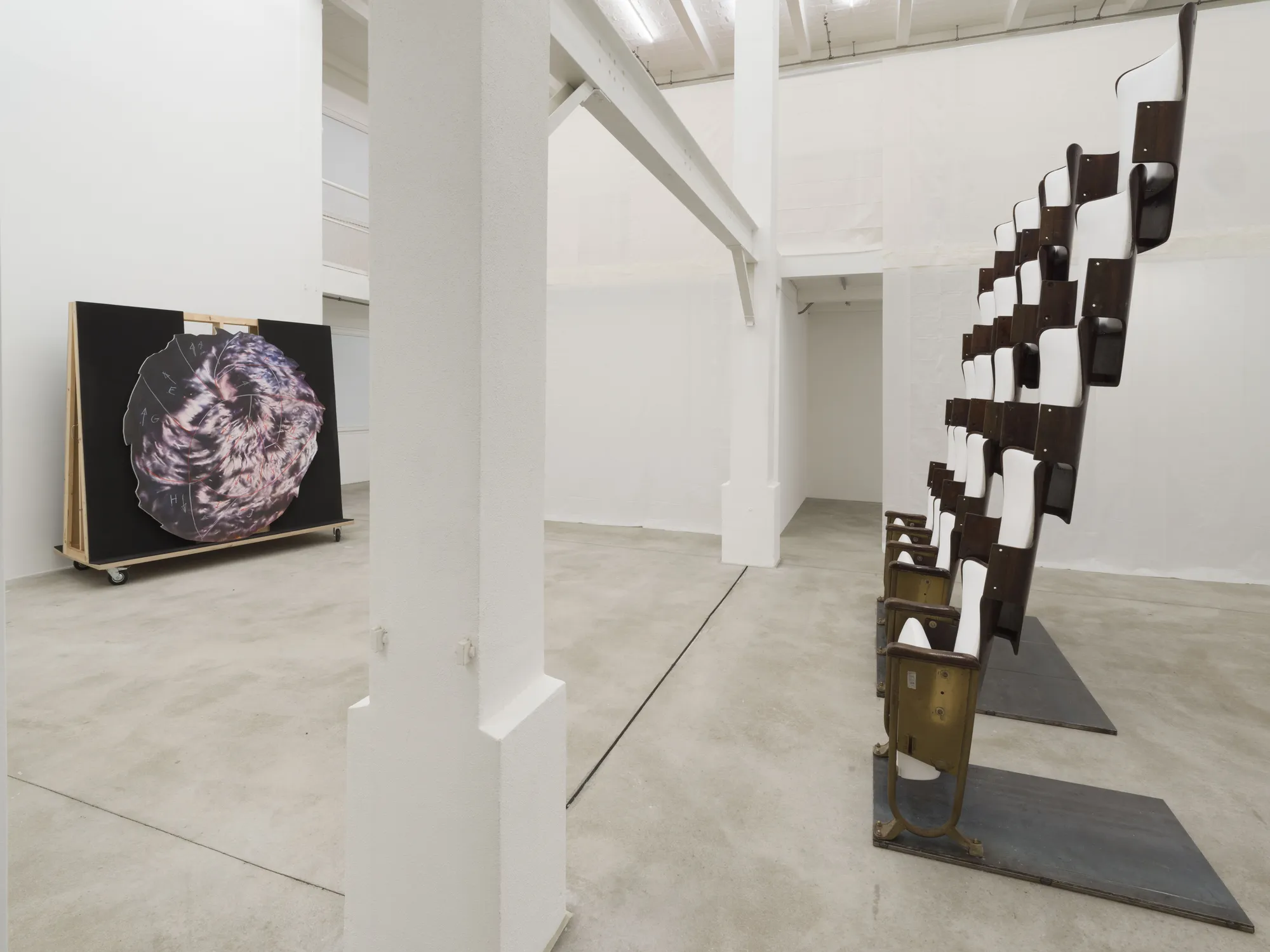
The man whose name that house carried now exhibits as an artist, and his first solo exhibition in Germany is at Konrad Fischer Galerie in Berlin. At its centre is a work called Audience. There is nobody in it. It is the furniture alone: reclaimed cinema seats in the double-height hall, a row of them with one set apart across an aisle's width, on brass-coloured standards bolted to plates of dark steel, their pans up as the pans of empty cinema seats are. Above and behind them, where a hall would have its other rows, white seat backs rise in ranks to 245 centimetres, higher than anyone standing beside them.
An empty house is recognised at once. Counting takes longer.
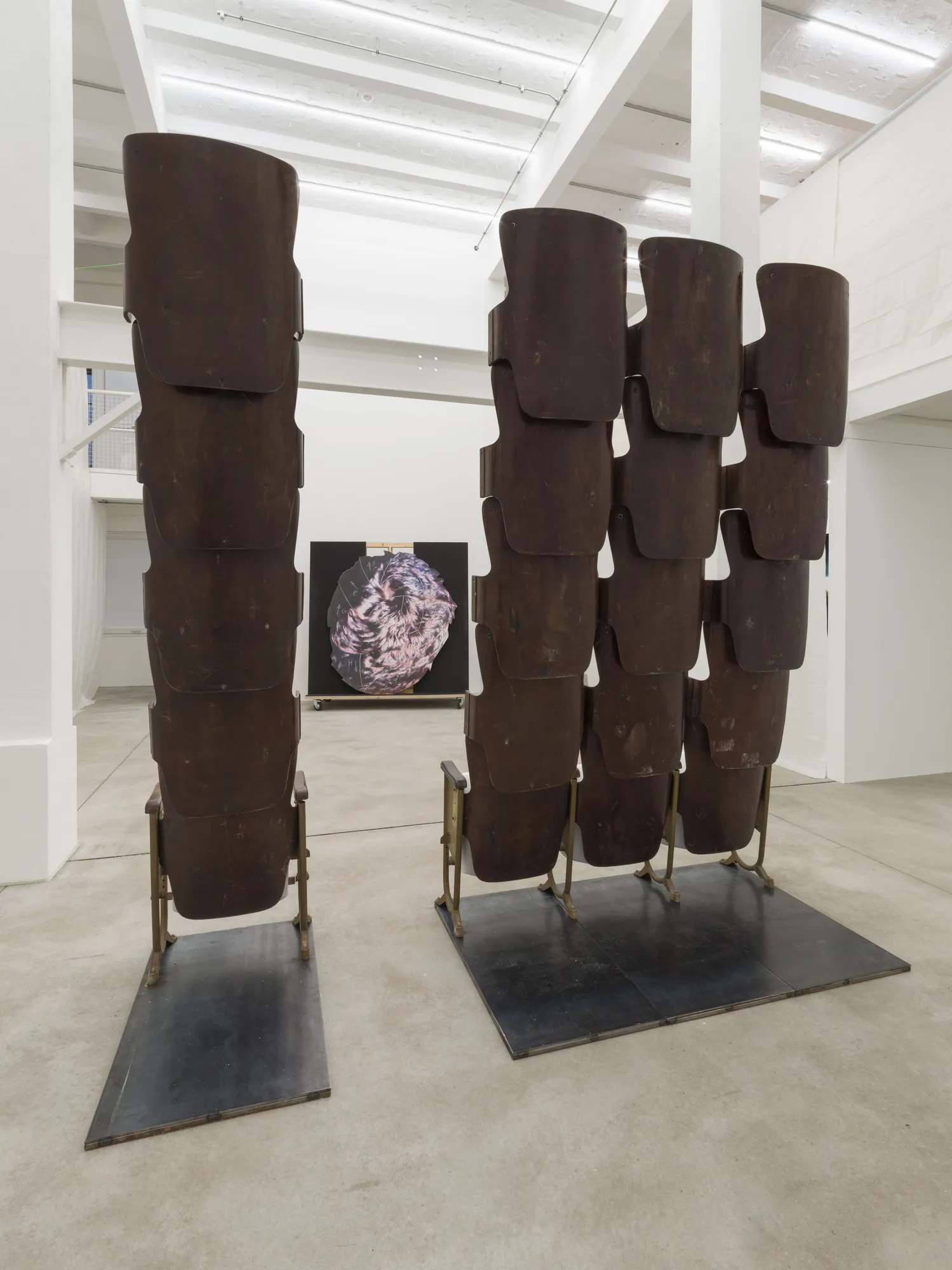
There are four seats, three joined in a row and the one apart. Over each stand five backs, its own and four more, every one a shell of bent plywood holding a white pad, each set a few centimetres behind the one below and lapping it like a shingle. From the side the ranks climb like a stair, the rake of an auditorium drawn up almost to the vertical. Twenty backs to four seats.
The other sixteen backs have nothing beneath them but the back below: no pan, no standards, no floor.
The gallery's text speaks of human presence and absence, and a work called Audience with nobody in it seems to say which of the two. But the people are the smaller part of what is missing. From the front of a raked house, the rows behind the first show as backs rising above backs, and that view is what has been built here: the backs, without the seats they would belong to.
The four seats that do exist have their pans up. It is tempting to count this among the things done to them, with the stacking and the bolting down, but a cinema seat stands like this whenever it is left, and nothing to be seen says these four would do otherwise. What each turns to the hall is its underside, white, with a black slot low in it and two screw heads.
The pads are another matter. The seating is reclaimed, and where it was upholstered it now has casts in plaster and acrylic, smooth, matte and all alike, without seam, piping or button. They keep the general shape of a cushion and show no mark of anyone's having leant on one. From the front the work is immaculate.
Each back is a separate piece, and the caption has a word for that. It describes the work as chair backs, with no mention of seats; it calls them “detachable”, and it gives them “in one, two, three or four rows”, with 245 centimetres as the height at four. Four are up in Berlin, the ranks above the seats' own backs. The house, then, comes in sizes. With a row taken away nothing else would change; the four seats would stay where they are bolted, under a lower wall.
The hall around the work has been half closed. Painter's sheeting hangs over the windows behind the seats, along the balustrade of the mezzanine and across openings off the hall, pale and not quite opaque, so that whatever is behind it shows as a shape. Audience stays in view all the same: from the side past a column, from above through the mesh of the mezzanine rail, from behind. It faces one way and is seen from all the others.
What it faces is across the hall. The row of three and the single seat leave an aisle between them, and from behind the seats, down that aisle, the thing in front of this audience comes into view. It is the top of a head.
Cartography print (2026) does not hang. It is a picture of hair seen from above, printed on board, cut to a roughly oval, uneven outline and leant against the black lining of a timber trolley on castors, the kind on which a museum moves its paintings. A crown whorl sits a little above centre, and the hair sweeps round it in bands of violet, rose and grey, silver where the light is. The edge is notched, most deeply on the right.
Lines in white and red oil pastel divide the hair into regions that curve with the whorl, wide wedges along the left rim and smaller pieces toward the middle. A dozen of the regions carry a capital letter, from somewhere in the run A to N, and beside many of the letters is an arrow laid along the hair. The arrow beside G points up the rim. The arrow beside H, in the next region down, points the other way.
The arrows have an explanation. Cartography print is a version of Cartography, a work of 2019 that was shown at Lafayette Anticipations in Paris, and Zeno X, Margiela's gallery in Antwerp, says of the earlier work that “the arrows drawn in pastel indicate the directions observed”. They record which way the hair was seen to run. The accounts of that work also say what the observing was for. Margiela had wanted to remake the hair on top of a head in fake fur, and the difficulty was one of direction: hair leaves a crown every way at once, turning as it goes, and fake fur lies one way. There were several experiments, the construction of patterns among them.
A cutter would know the difficulty. Because the pile lies one way, every piece of a fur pattern is cut to lie that way too, and an arrow goes on the backing of each so that none gets turned. A crown breaks the rule at every point. To make one, the whorl would have to be divided into pieces small enough to pass for straight, and each piece turned on purpose.
That is a fair description of the drawing: bounded pieces, a letter to tell each from its neighbour, an arrow to say which way it lies. The accounts explain the arrows and say nothing of the letters, and the drawing may be less practical than it looks. But it behaves like a pattern, and like an honest one. Hair bends continuously and an arrow is straight, so each lettered piece is a stretch of the crown across which a curve has been allowed a single direction, and the lines show, piece by piece, how much of the turning a cut would give up. The white lines and the red cross one another. The board does not say which came first, or whether both still stand.
A cutter's marks go on the backing, the side nobody sees. These are on the face, and nothing has been cut along them; the only cuts in the board are the notches at its rim.
The title says cartography. The nearest thing to a map in the exhibition belongs to another work, where it lies face up on a stack of old magazines.
Fur Portrait with magazine stack I (2026) is collages on vintage magazine covers and three stacks of vintage magazines wrapped in plastic. One of the covers hangs on the wall above one of the stacks, and the stack has a cover too, its top issue, face up under the plastic. It is a Paris Match headlined “Toute la Terre vue de l'espace”, all the Earth seen from space, promising the astronauts' own colour photographs and the flight log of Schirra, Stafford, Borman and Lovell, the Gemini crews of December 1965. The picture is not all the Earth. It is one stretch of it under cloud, with the curve of the horizon and black space above, and the magazine has printed names across the view: FRANCE, MALAGA, DÉTROIT DE GIBRALTAR, TANGER, MER MÉDITERRANÉE, MAROC.
Two of the names are cities. From that height a city is a word.
This is cartography in the ordinary sense, names laid on a view from above so that a reader can find a place, and it is all the magazine's work. Nothing has been done to the cover that can be seen. It has been put on top of a stack.
The cover on the wall has had more done to it. It is a Jours de France with the line “La femme idéale” and, in smaller type, the news that Anouk Aimée has been chosen to play “ce personnage” in a film to come. Over the woman's head lies a round mass of white fur. It keeps to the outline of a head and its hair and stands out a little past it against the red ground; her shoulders show below, and some blond hair. The gesture is a practised one. The hair portraits Margiela showed in Paris in 2021 are magazine faces covered in much the same way, and a covered face is recognised as his almost before it is looked at.
On this cover it does something particular. The magazine printed a face and a name; the fur has taken the face and left the name, and with the face gone there is no telling from the object whether the woman in the picture is the actress in the type.
Audience had seemed to be the opposite case, a sight that says what it is before any word reaches it: an empty house, recognised at once. It says so from the front. The white backs in their ranks and the row of seats beneath them are all on that side, and everything white on that side is unworn.
From behind, where the aisle gave onto the top of a head, the white is gone. What stands there is a wall of dark plywood, twenty shells overlapping one above another with light showing between them, and it is old: scratched, rubbed pale in patches, chipped at the edges, pierced with fixing holes, no two shells alike. This is the side of a cinema seat that the row behind gets at, with its knees and its shoes. Whatever its audiences left on this seating is on this face. The empty house is on the other, and from this one it cannot be seen.
In Audience, more than the people. Four reclaimed cinema seats stand under twenty backs, so sixteen backs have no seat beneath them. The caption calls the backs detachable, gives them in one, two, three or four rows, and never mentions seats. The work keeps what an empty auditorium shows from the front and leaves out most of the seating behind that view.
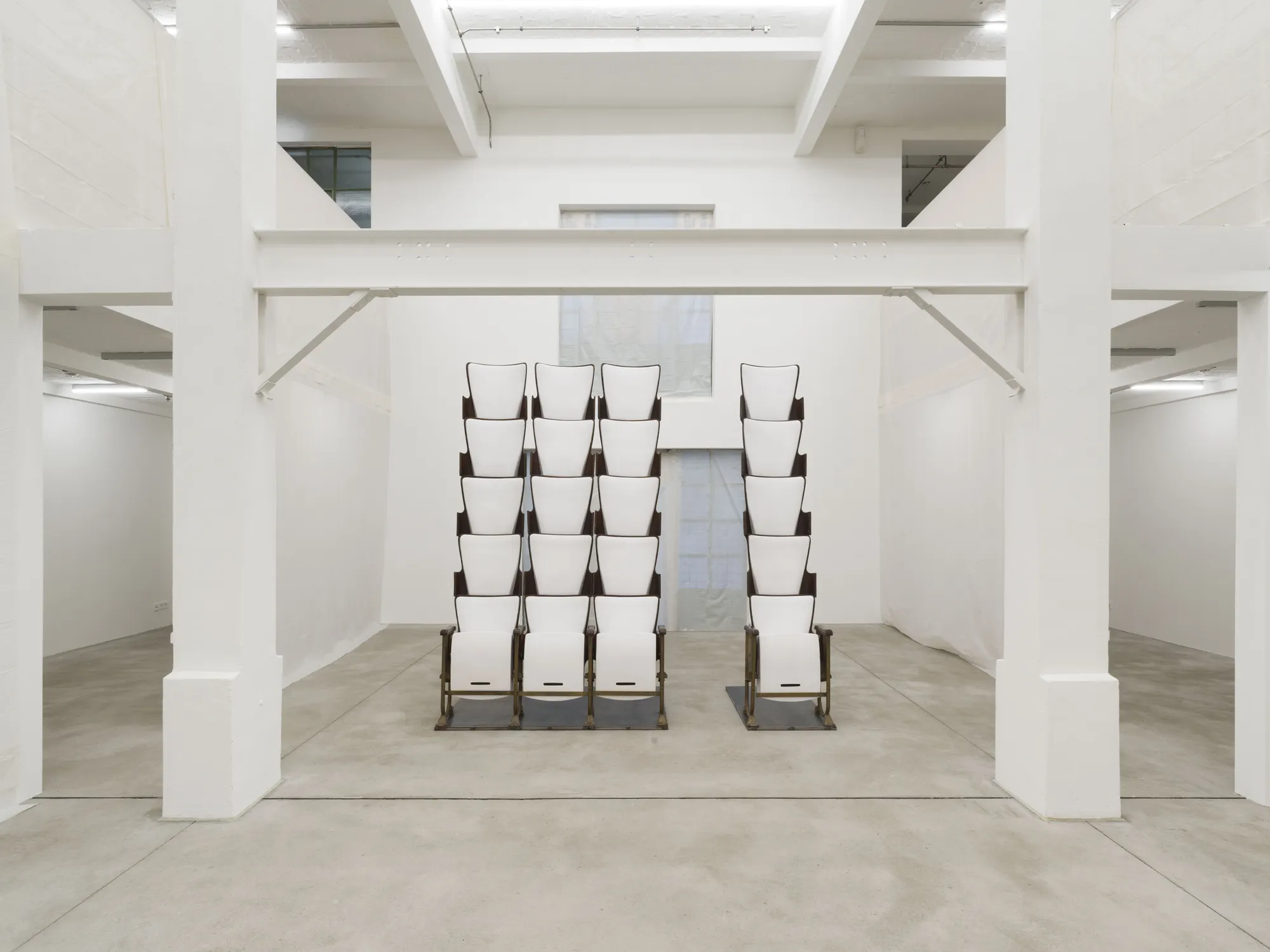



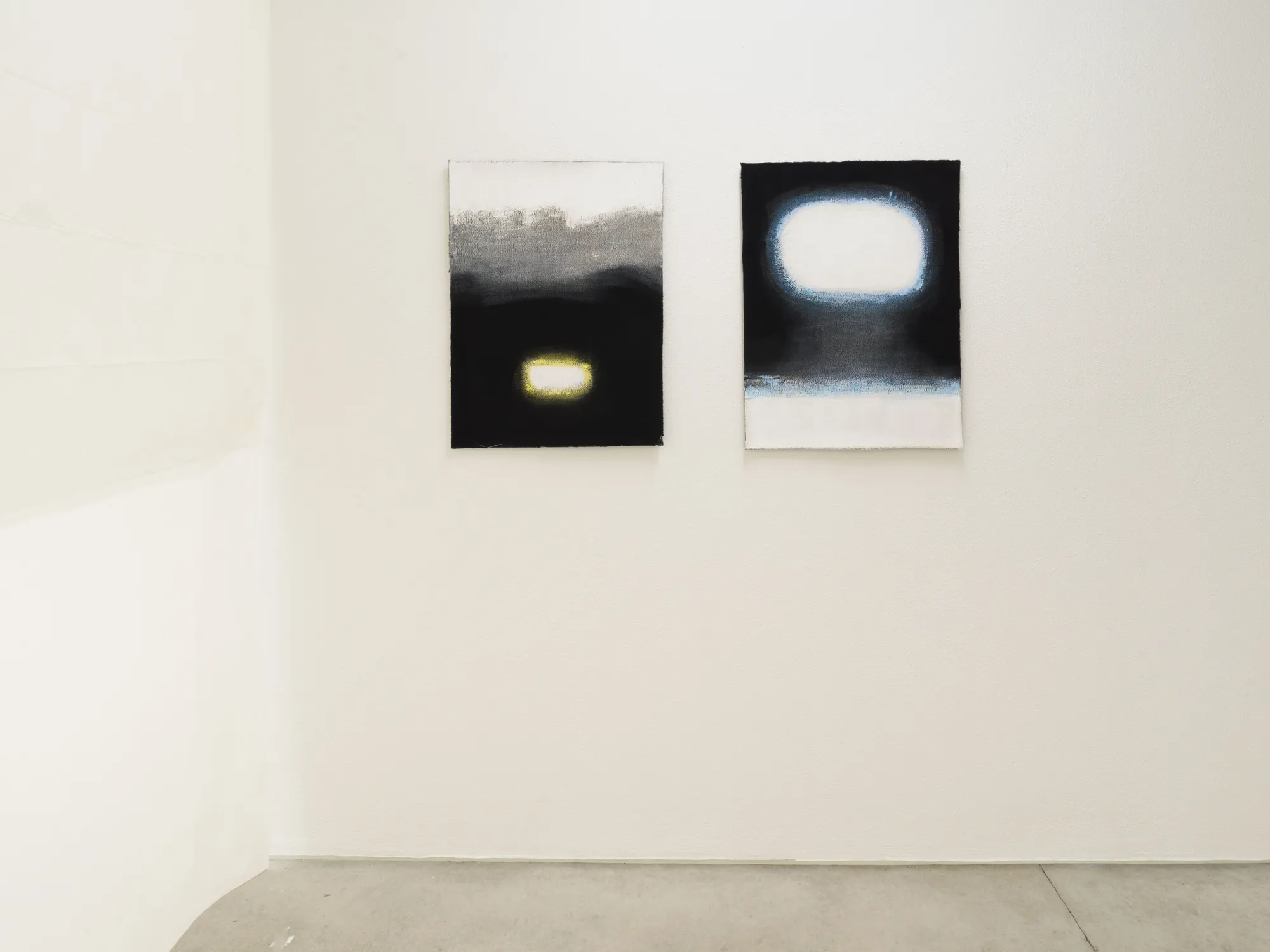


Cover image: Installation view, Martin Margiela in Berlin, Konrad Fischer Galerie, Berlin, September–December 2026. Courtesy the artist and Konrad Fischer Galerie, Berlin. Photo: Roman März.