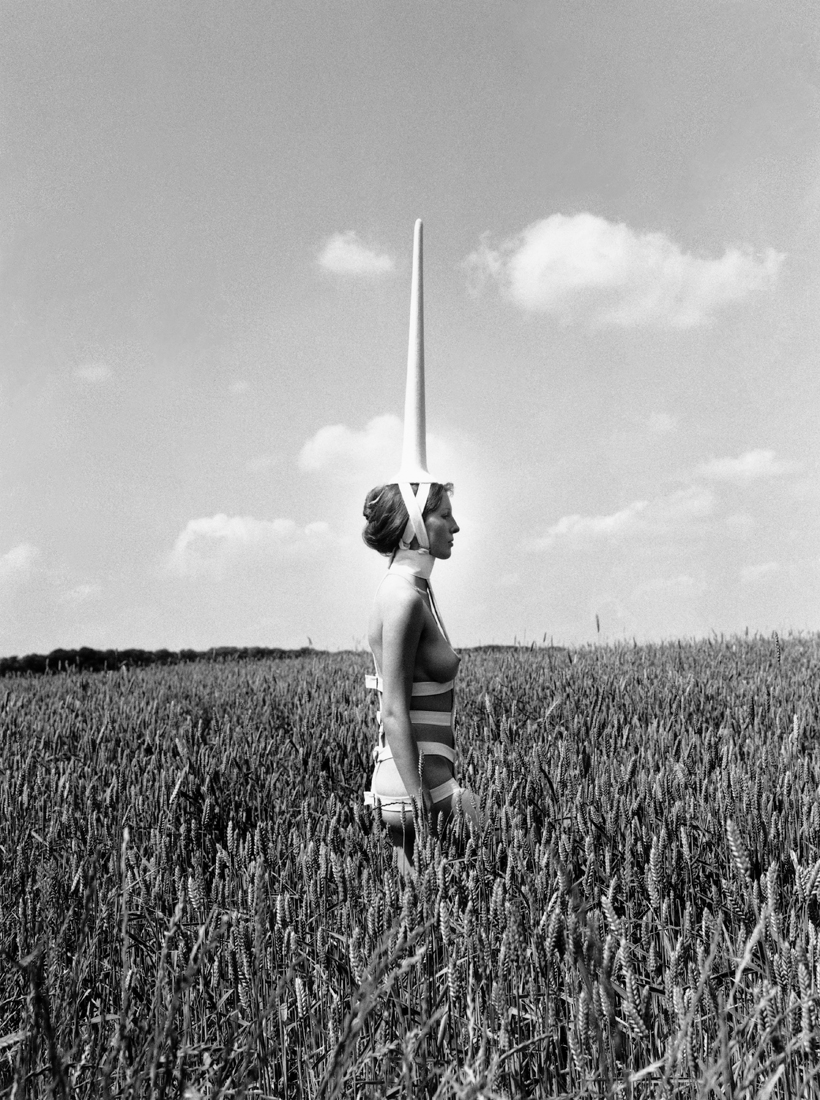



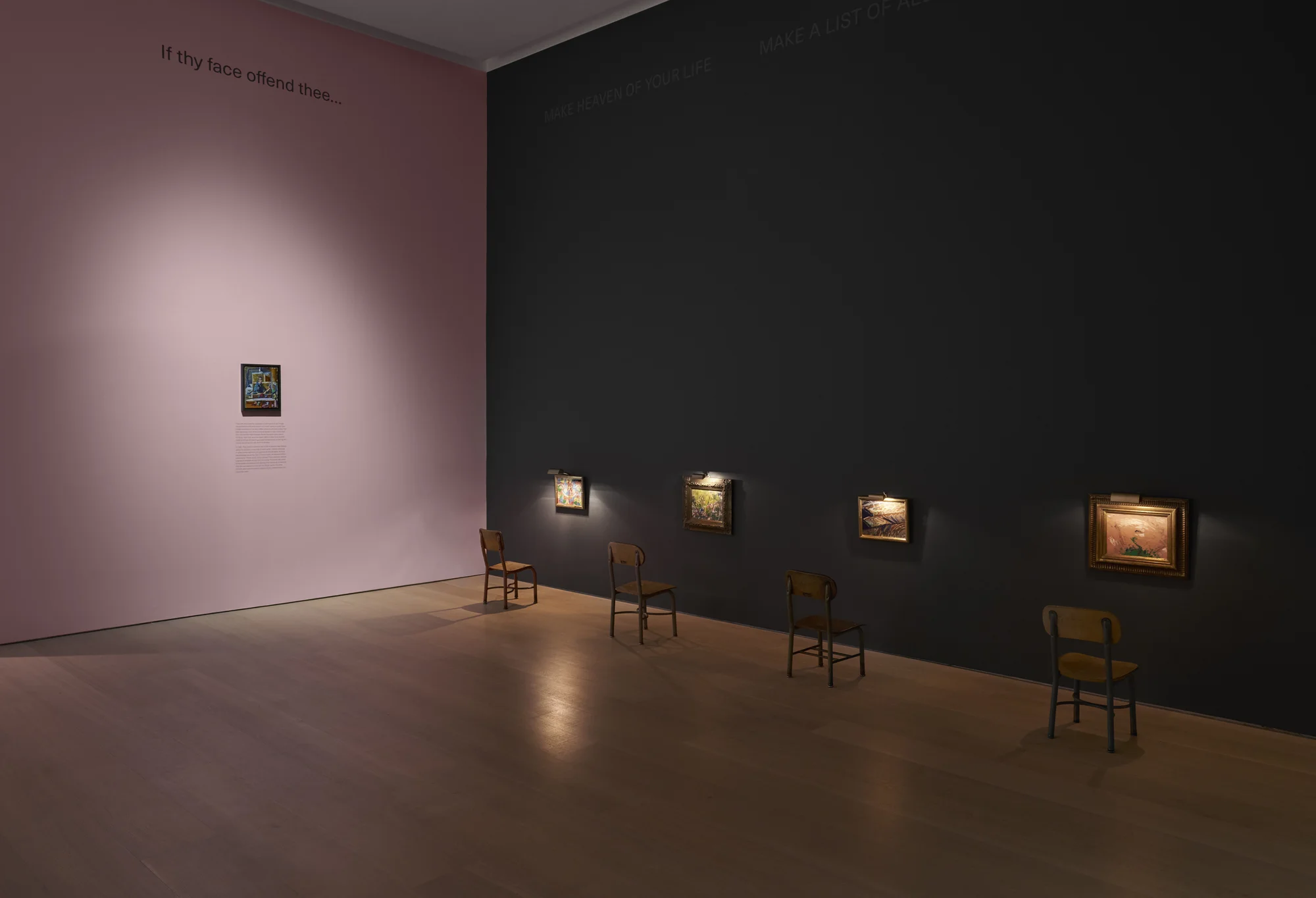
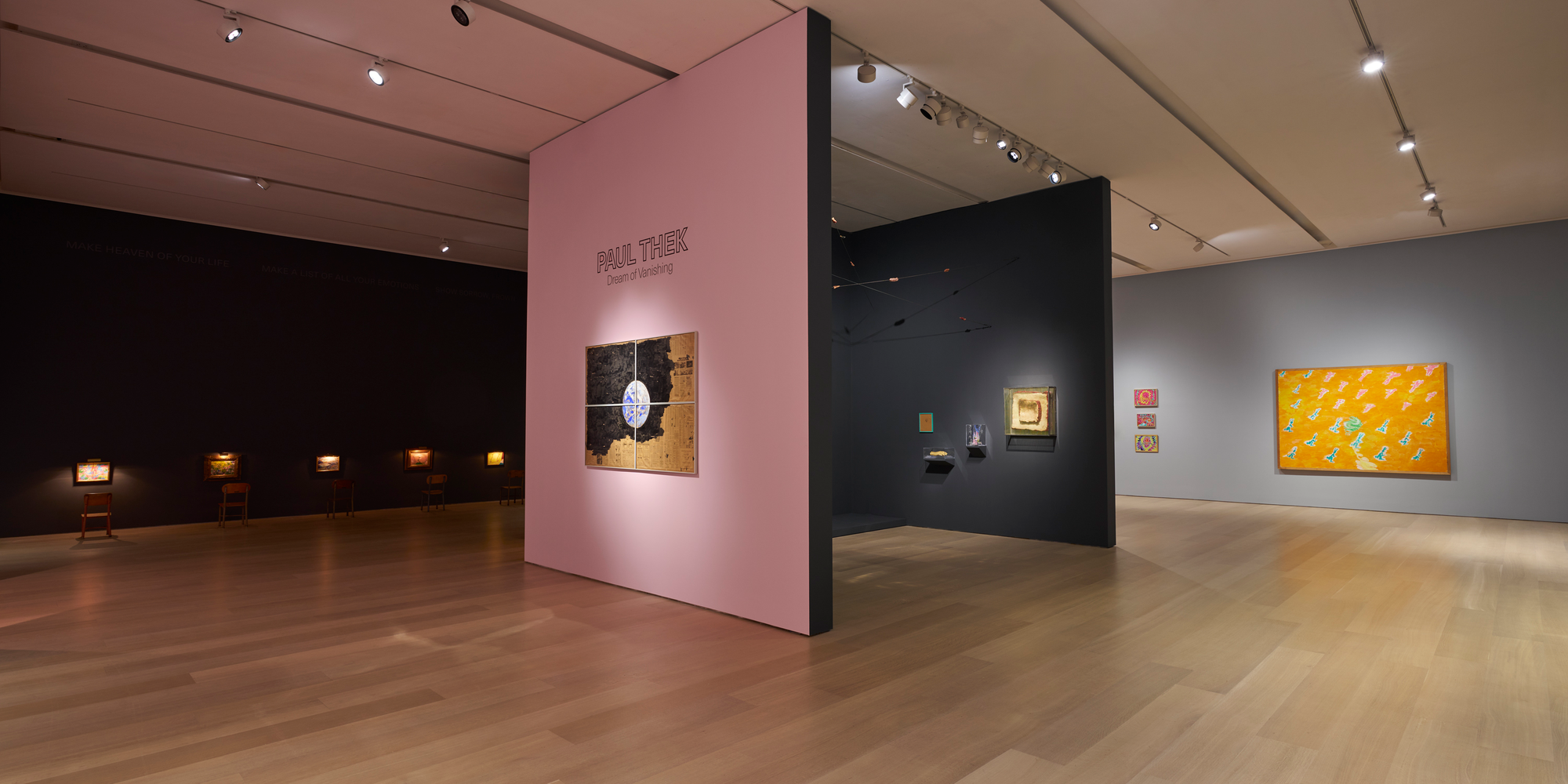
A row of picture-light works hangs at chair height along a dark grey wall at Pace. Wooden chairs face the group. Each work has its own brass lamp mounted above the frame. The lamps are on. Thek gives each work its own light. The works are small, late, and framed in salon-style gilt. Thek made them in the 1970s and into the 1980s, when he had stopped being known for his meat pieces and was painting in registers — devotional, vulgar, kitsch — that the New York art world had decided not to know what to do with. The chairs place the viewer’s body low, in a posture closer to classroom, chapel, or waiting room than to the usual standing position of gallery authority. They also make the structure visible: Thek does not let the painting wait for institutional approval. He builds the approval into the object.
Pace’s argument is that Thek should be understood first as a painter, and that this exhibition recovers that practice from beneath the more famous sculptural reputation. The show takes its title from a phrase in Thek’s notebooks. Curated by Pace Founder and Chairman Arne Glimcher and Noah Khoshbin, director of the Paul Thek Foundation and curator of The Watermill Center, with Pace Chief Curator Oliver Shultz, the exhibition runs in parallel with Thek’s solo presentation at Galerie Buchholz.
The frame is generous. The work mostly rewards it. Pace’s installation also makes a stronger reading available, one its recovery language does not fully name.
Thek has been a sorting problem for sixty years. First he was the sculptor of the meat pieces, then the fugitive, the dreamer, the painter the field had lost. Pace’s painter-recovery is the most sympathetic version of the move so far, but it changes which bin he goes in rather than whether the bin is the right unit. If the medium bin holds, the Technological Reliquaries remain sculptures with paint on them, the picture-light panels remain small late paintings with lamps, and the notebooks remain ephemera around the real work. This is not another recovery of Thek into the right category. It is an argument that category was the error.
The through-line is the set of things that hold, light, frame, and display the painted surface. Thek refuses to treat those conditions as separate from the work. What they hold is also almost always a body: wax flesh, hair, teeth, faces, hands, instructions addressed to a body, a hand that keeps working until it cannot. Mike Kelley, writing in 1992, helped make Thek legible through the environments, where the room becomes the unit of the work. Pace makes visible a smaller, more stubborn version of the same problem: the painted surface fused to the device that holds, lights, or frames it.
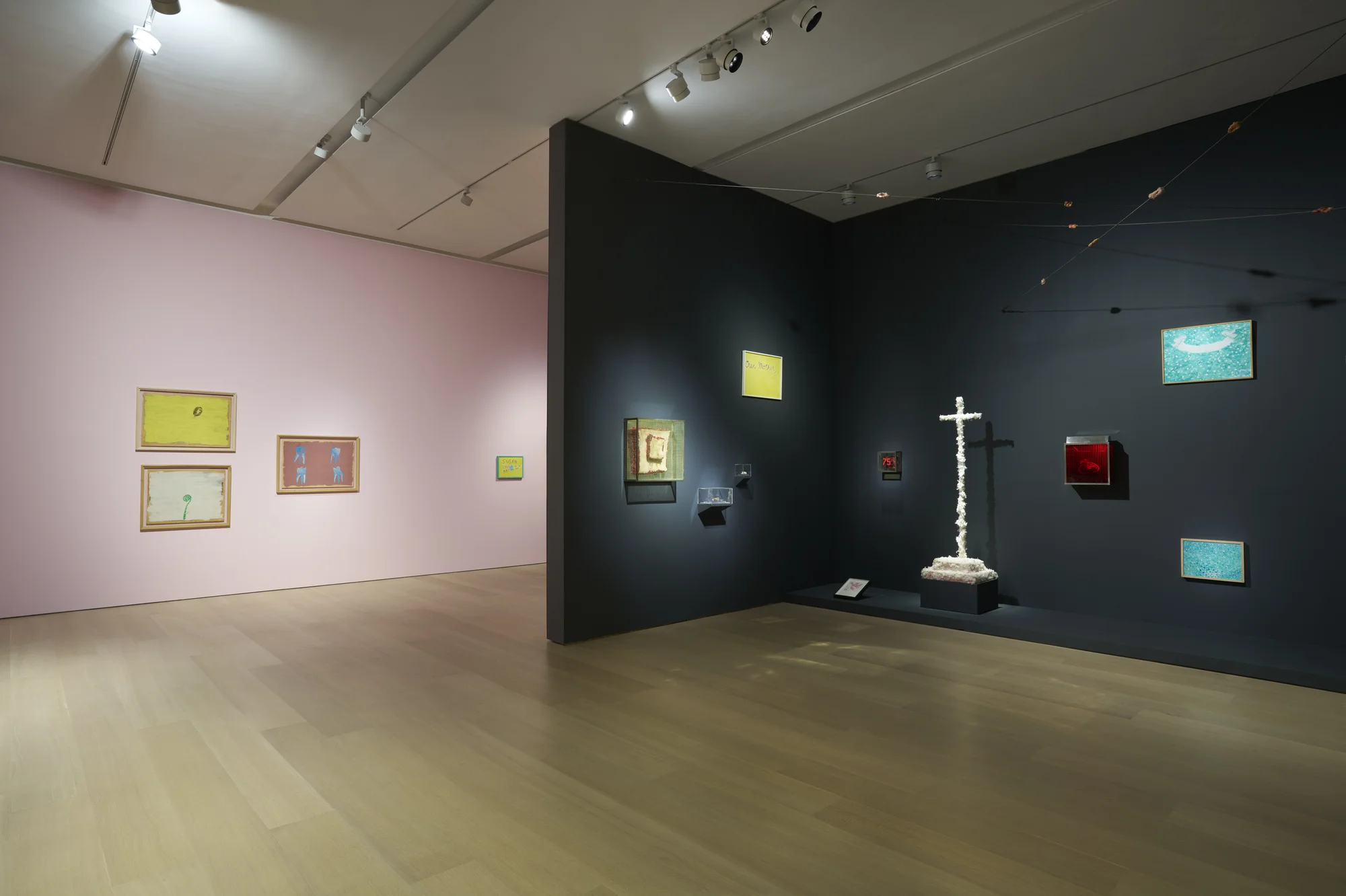
The Technological Reliquaries sit two rooms back, on a dark grey wall behind yellow-tinted Plexiglas vitrines mounted on cantilevered shelf brackets. Painted beeswax under glass: hunks of mock flesh sectioned into geometric portions, hair sprouting, the surface tinted to read as still-living tissue. Thek made them between 1964 and 1967, after a visit to the Capuchin Catacombs in Palermo, and they made his reputation faster than anything else he ever did. The standard reading treats them as sculpture — a religious answer to the cold rectilinear authority of Minimalism. The reading is correct as far as it goes. It misses that what makes them function is not the wax alone, but the wax inside its case. The vitrine is not the container of the Reliquaries. It is half the work. The clean box was the period’s authority form, the form Minimalism had made serious. Thek paints flesh and installs it inside the box that announces art. Surface and case are one piece. Without the case, the wax is a wax sculpture. With it, the wax becomes a relic: a painted body held by the thing that decides how it is seen.
In the same room, a thin wire system crosses the ceiling, small painted fragments suspended from it like the leavings of a saint’s hair. A pale cross stands at the room’s center on a low pedestal, its surface densely encrusted. The cross sits on display, while the wire and vitrines do the work of displaying. Flesh, hair, cross, fragment: the room keeps turning painted matter into something held for looking. Back at the chairs, the picture-light works compress the same logic into something more obvious. The lamp is bolted to the painting. The gilt frame carries the register of devotional and parlor painting. The brass lamp turns visibility into part of the object — the museum’s lighting code lifted off the ceiling and re-installed at hand-height on the work itself. What had been distributed across vitrine, wax, and base in 1965 is fused into a single object in 1980. The surface arrives already lit.
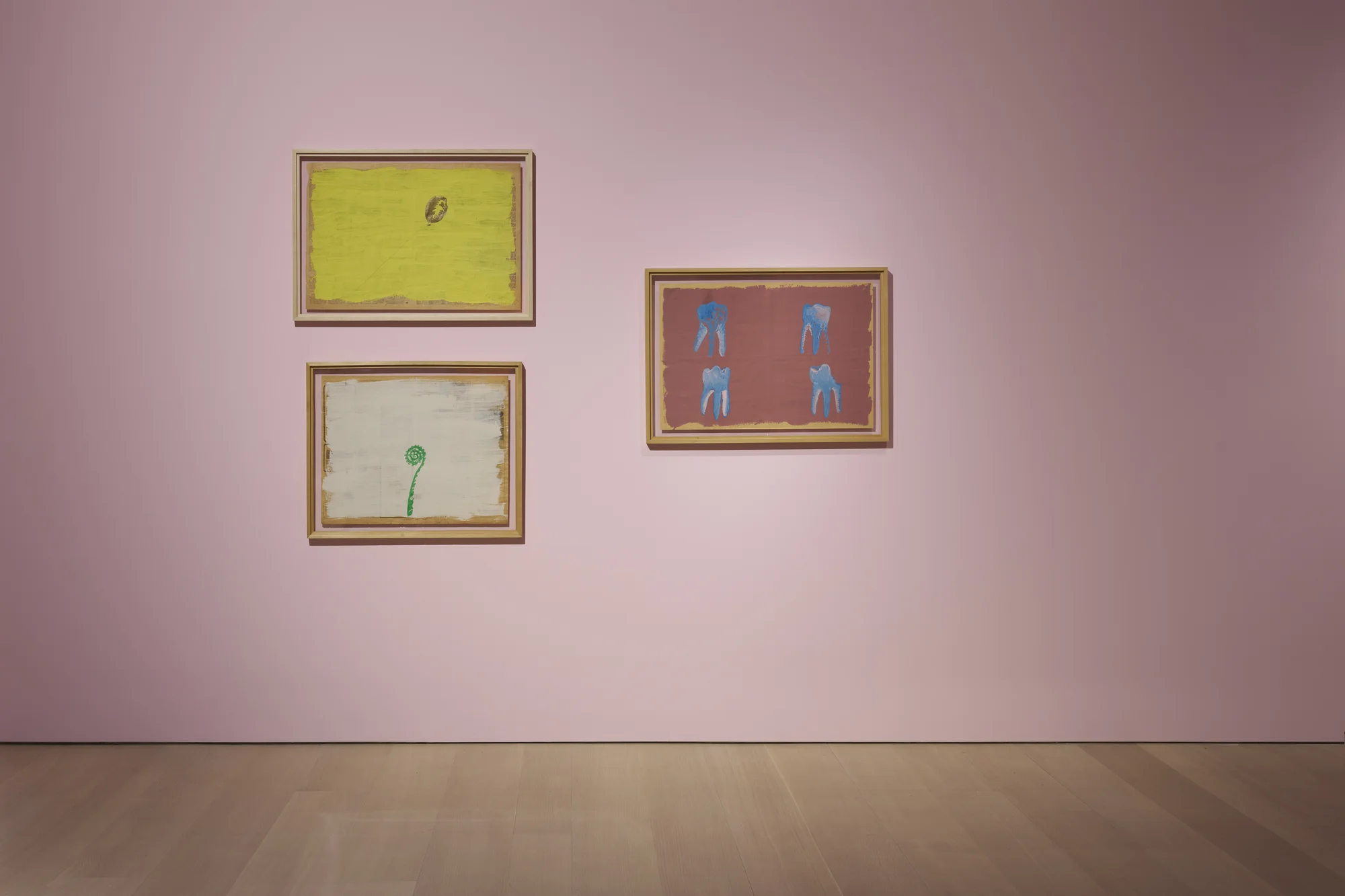
This is what makes the small paintings on the adjacent pink wall — the green fiddlehead, the four blue teeth on rust ground, the yellow rectangle with a dark pod or pit — not minor. Thek chooses a deliberately awkward register: small images, bodily fragments, strange growths, vulgar frames, theatrical lights. These works do not wait for the institution to lift them. They arrive with their own system for being seen. What looks like cheapness becomes a way of building institutional rescue into the work itself.
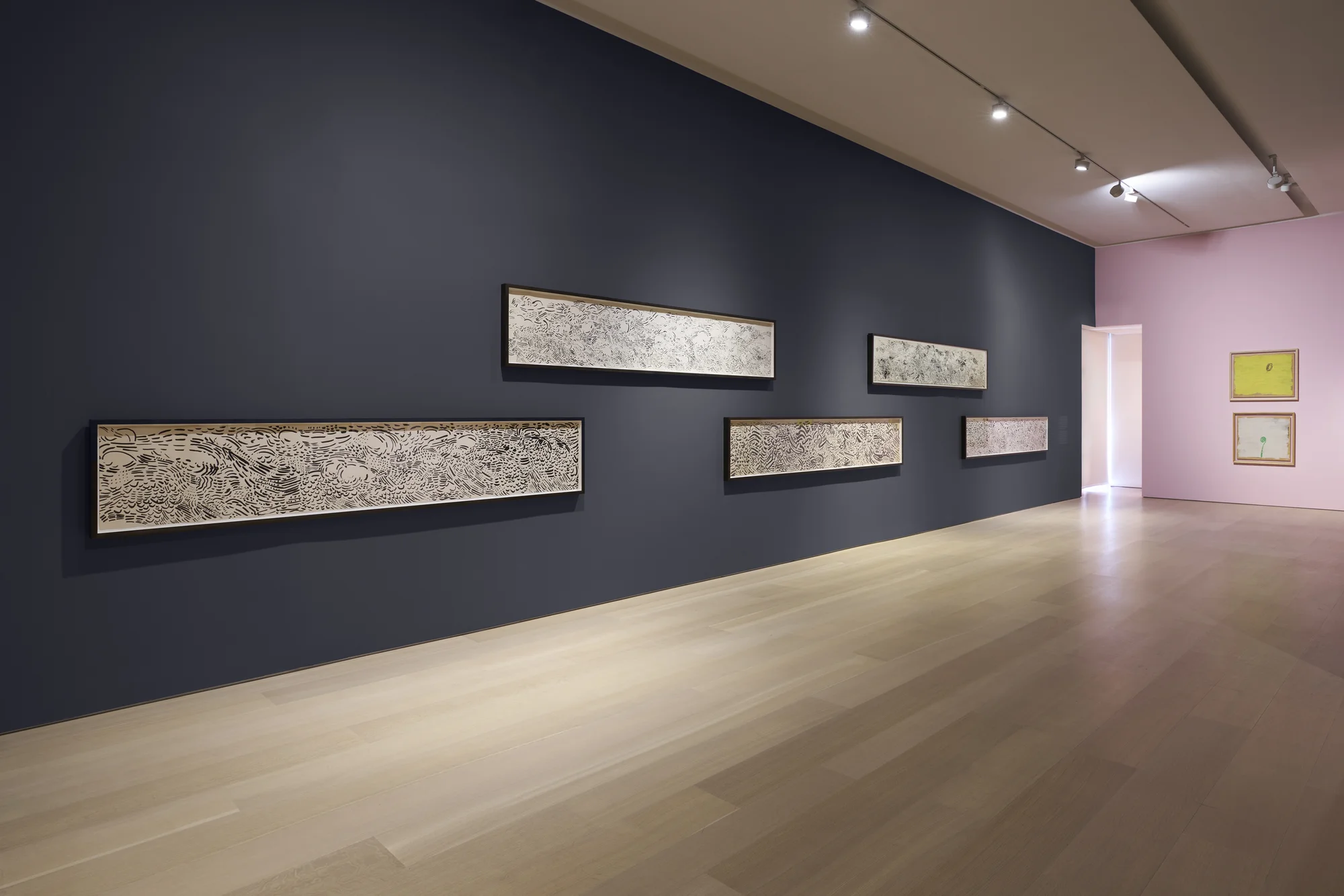
The scrolls hang at low height in a dark room. Five lengths of paper, each ten feet, each covered in black watercolor and ink that resolves into nothing figurative. Pace describes them as evoking landscape, but to read them as landscape first is to project the eye’s habit of finding scenes. Up close they are mark accumulations. The hand moves across the paper for as long as the paper lasts, and what gets recorded is not depiction but duration. The scroll length carries the same operation into time. The works are too long for a single view; the viewer reads them section by section. Thek gave the scrolls to Robert Wilson, who held them privately until his death in July 2025. The exhibition is dedicated to his memory. Entering public view now, they are the show’s most consequential new material: long supports where the hand turns mark into time.
The notebooks compress further still. Notebook #41 — 1977, published by Pace in facsimile to coincide with the show — is a composition book filled with watercolor, ink, lists, transcriptions of philosophical and theological texts, sketches. Thek considered the notebooks artworks and made over a hundred of them. The notebook becomes the smallest functioning unit of the practice: page, hand, binding, painted matter held inside.
The late works occupy the final rooms, panels at chair scale hung beneath vinyl instructions running along the upper walls in Thek’s own voice — Make Heaven of Your Life. Make a List of All Your Emotions. If thy face offend thee. The instructions address the body as directly as the paintings do. Thek made these works in the final two years of his life, under the pressure of the AIDS diagnosis that shaped his final period. The structure holds: panel, frame, attached lamp, painted surface, instruction overhead. The hand is failing, but the structure still holds.
Pace’s framing — Thek the dreamer, Thek the painter recovered from beneath the sculptor — is the available reading and not the only one. The exhibition’s actual evidence, room by room, is plainer. Thek did not vanish from painting. Painting is the through-line only if painting means paint plus the things that hold, light, frame, and display it. The continuity is not medium. It is apparatus. The dream of vanishing becomes material here: Thek’s painted surface depends on the conditions that let it be seen, and he built that dependency into the work itself. In Thek, the painting and the apparatus that frames it are not separate.
Pace’s exhibition recovers Paul Thek as a painter, but the installation makes a larger structure visible. Across the Technological Reliquaries, picture-light works, scrolls, notebooks, and late paintings, Thek does not separate painted surface from the thing that holds, lights, frames, or displays it. The vitrine is not only a container. The lamp is not only an accessory. The notebook is not only archive. Each becomes part of the work’s condition of visibility. The continuity is not medium. It is apparatus.
For a companion reading of Thek’s painting practice, see The Sea Is Painted Over the News, a review of Paul Thek at Galerie Buchholz.
.webp)
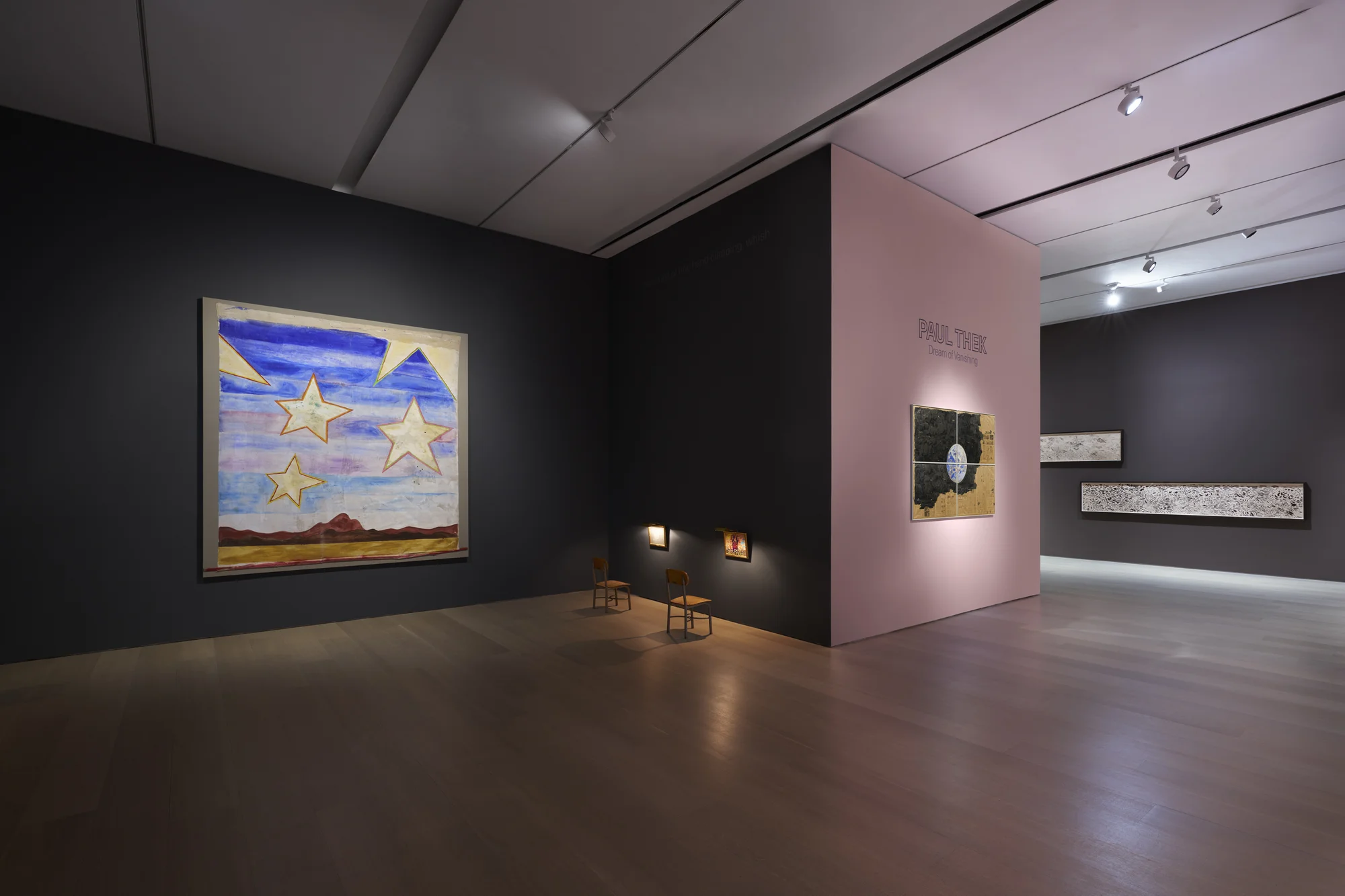

1. Exhibition view: Paul Thek: Dream of Vanishing, Pace Gallery, New York (15 May–14 August 2026). A row of small paintings hangs at chair height along a dark grey wall, each illuminated by its own brass picture light. © The Estate of Paul Thek. Courtesy Pace Gallery.
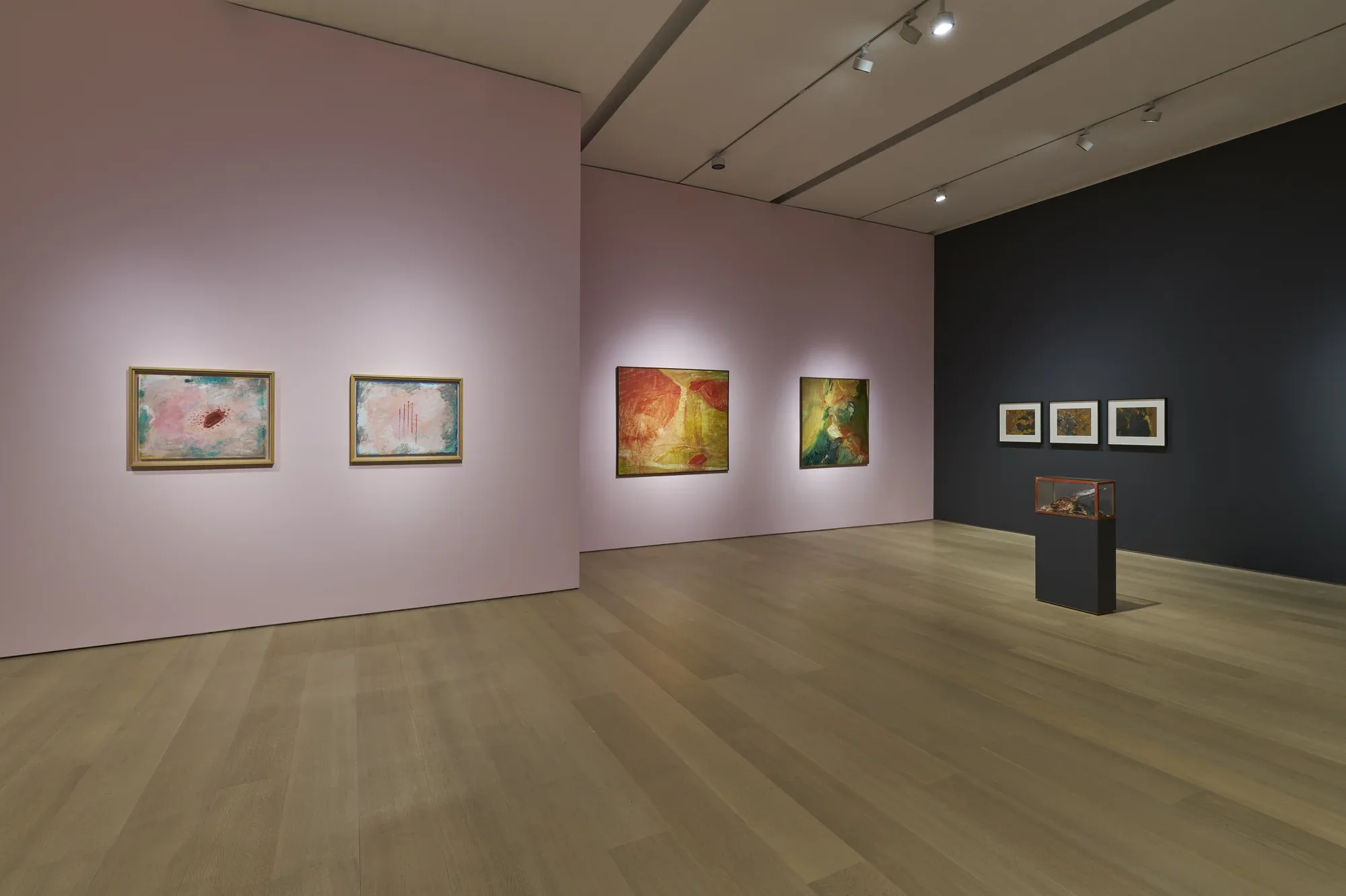
2. Exhibition view: Paul Thek: Dream of Vanishing, Pace Gallery, New York (15 May–14 August 2026). A newspaper painting anchors the pink partition between the exhibition’s darker and brighter galleries. © The Estate of Paul Thek. Courtesy Pace Gallery.
3. Paul Thek, Untitled (Earth Drawing I), ca. 1974, acrylic on four sheets of newspaper, 44 × 66 in. (112 × 167.5 cm). Photo: D. James Dee. © The Estate of Paul Thek.
4. Exhibition view: Paul Thek: Dream of Vanishing, Pace Gallery, New York (15 May–14 August 2026). A large framed painting with picture light faces a wall of illuminated works installed at viewing height. © The Estate of Paul Thek. Courtesy Pace Gallery.
5. Exhibition view: Paul Thek: Dream of Vanishing, Pace Gallery, New York (15 May–14 August 2026). Newspaper paintings extend across a dark wall, emphasizing sequence, repetition, and distance. © The Estate of Paul Thek. Courtesy Pace Gallery.
6. Exhibition view: Paul Thek: Dream of Vanishing, Pace Gallery, New York (15 May–14 August 2026). A relief, paintings, and suspended elements occupy a darkened gallery space. © The Estate of Paul Thek. Courtesy Pace Gallery.
7. Exhibition view: Paul Thek: Dream of Vanishing, Pace Gallery, New York (15 May–14 August 2026). The central gallery combines wall-mounted works, sculptural forms, and open circulation through the exhibition. © The Estate of Paul Thek. Courtesy Pace Gallery.
8. Exhibition view: Paul Thek: Dream of Vanishing, Pace Gallery, New York (15 May–14 August 2026). Three newspaper paintings hang on a pink wall opposite the exhibition’s darker galleries. © The Estate of Paul Thek. Courtesy Pace Gallery.
9. Exhibition view: Paul Thek: Dream of Vanishing, Pace Gallery, New York (15 May–14 August 2026). Large canvases and smaller works are installed across adjoining pink and dark grey walls. © The Estate of Paul Thek. Courtesy Pace Gallery.
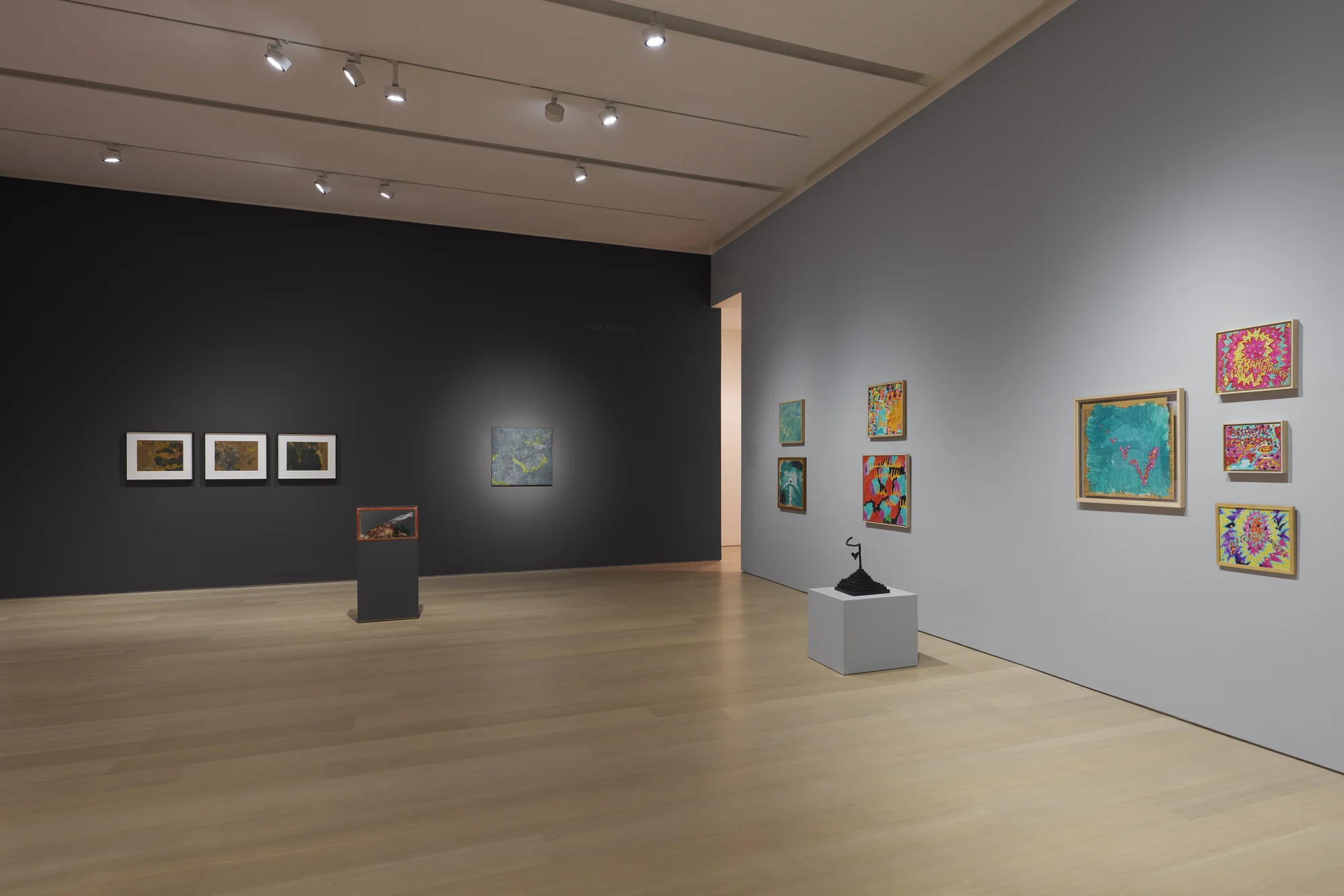
10. Exhibition view: Paul Thek: Dream of Vanishing, Pace Gallery, New York (15 May–14 August 2026). A vitrine-like sculpture stands before a wall of framed newspaper paintings. © The Estate of Paul Thek. Courtesy Pace Gallery.
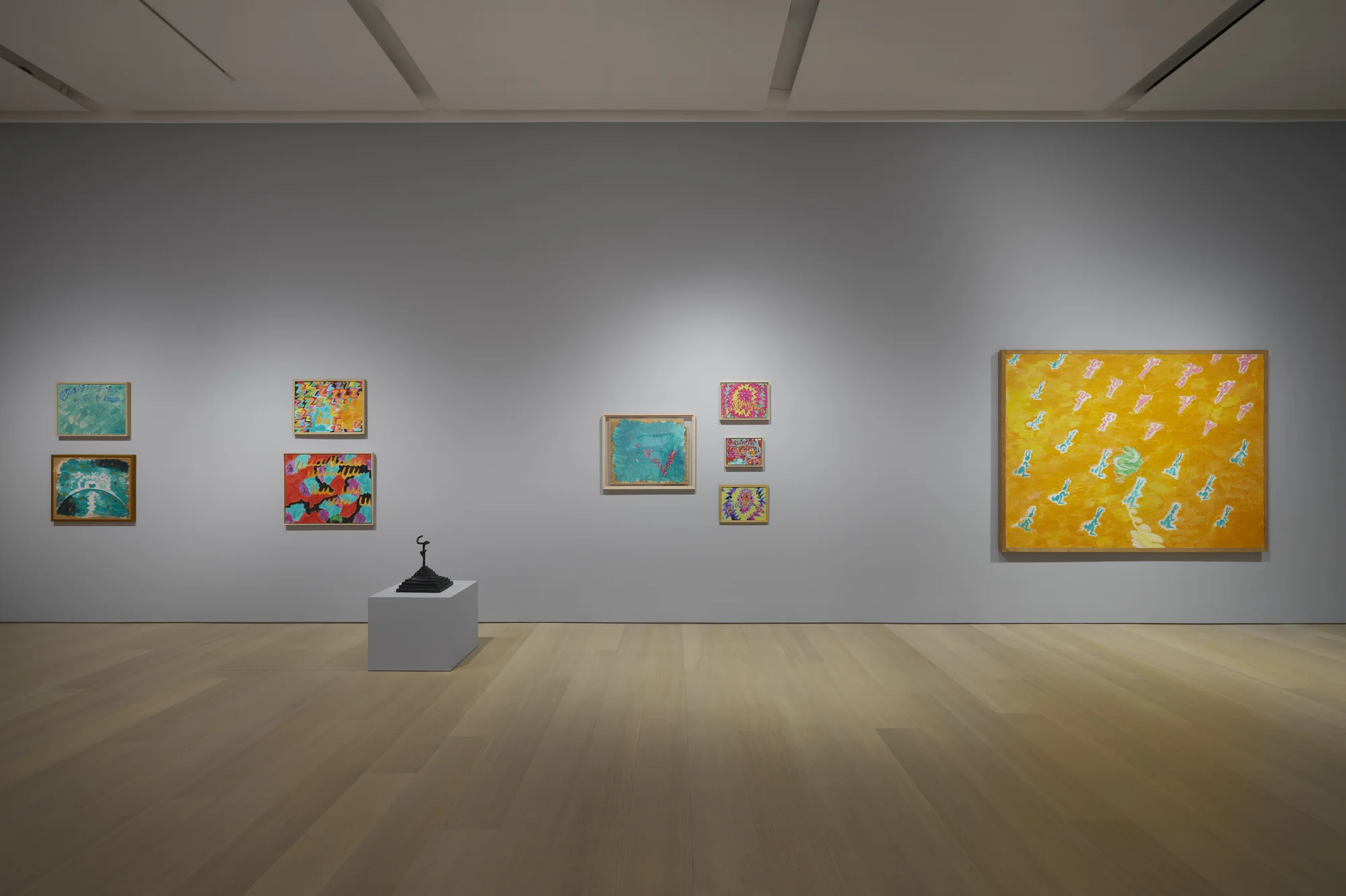
11. Exhibition view: Paul Thek: Dream of Vanishing, Pace Gallery, New York (15 May–14 August 2026). A large yellow painting anchors a group of smaller works arranged across a pale grey wall. © The Estate of Paul Thek. Courtesy Pace Gallery.
Cover image. Exhibition view: Paul Thek: Dream of Vanishing, Pace Gallery, New York (15 May–14 August 2026). © The Estate of Paul Thek. Courtesy Pace Gallery.
All images © their respective rights holders.
Image rights & attribution →