


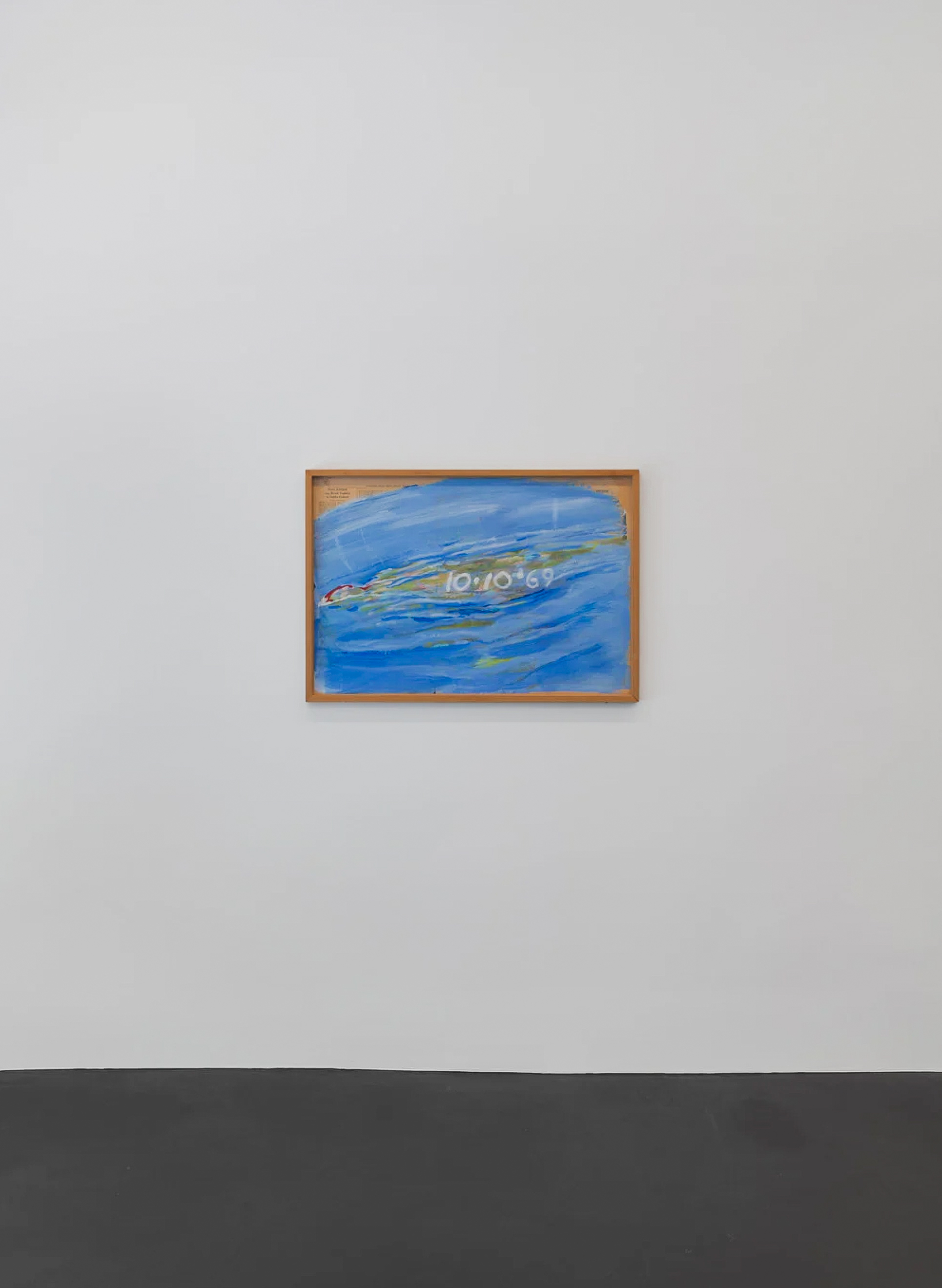
The blue water of Ponza rests above columns of print and headline. Beneath the swimmer, newspaper text remains visible. Beneath the island silhouettes, the grid and fragments of the page stay in view. The viewer reads down through the paintings at Galerie Buchholz: image, paper, date. The sea is painted over the news.
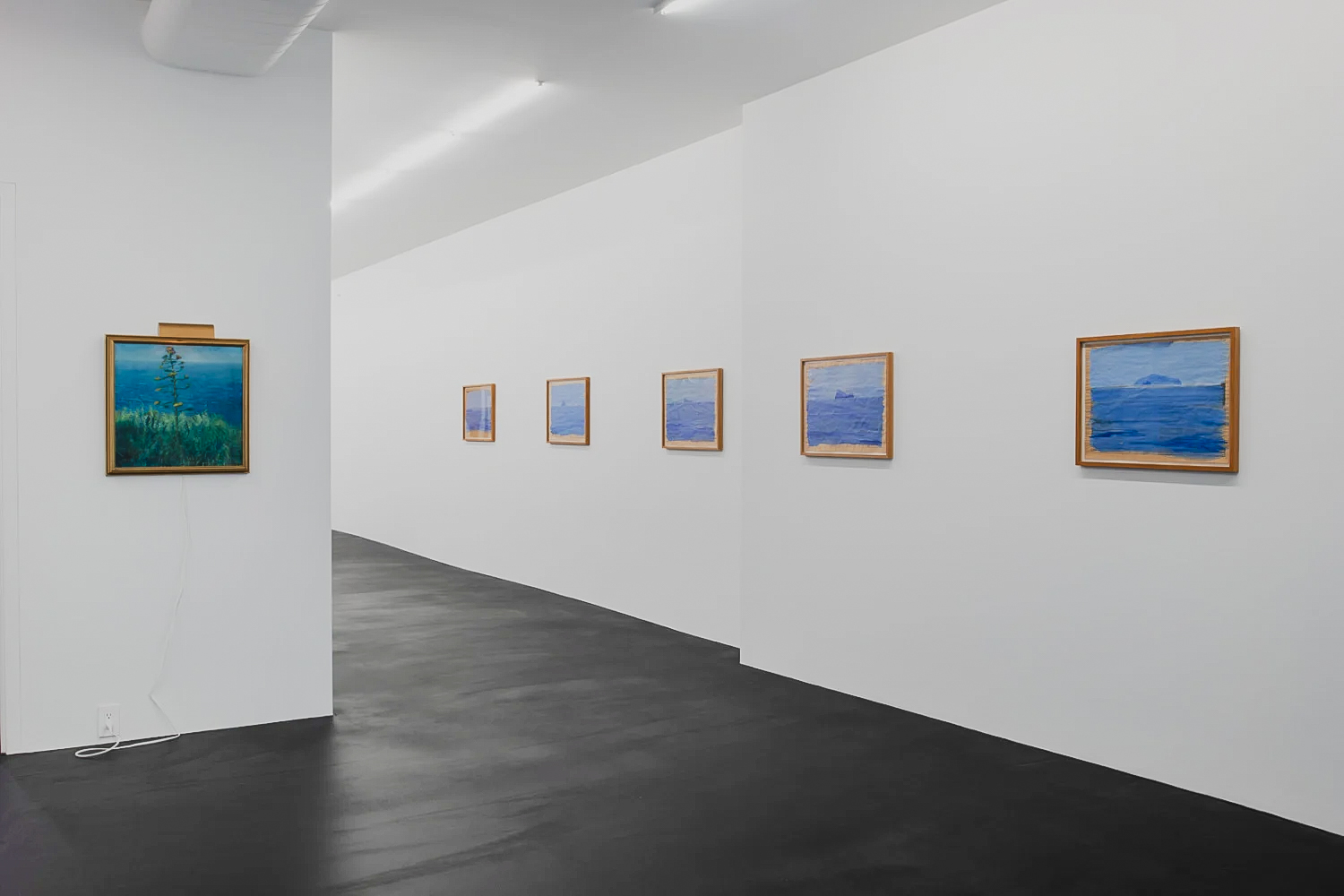
The 1969 works first offer the island. A swimmer in blue water. Scoglio Grosso seen across calm sea. Zannone at the horizon. The group reads as a quiet wall of retreat: small gouaches, pale washes, simple horizons, the eye held at the waterline. The pictures seem to promise distance from the world. That promise breaks at the surface. These images are made on print that already carries date, language, and circulation. The newspaper was there before the painting.
The practical explanation is easy to understand. Thek was moving between places, painting on what was at hand. A double-page spread of the International Herald Tribune could be folded, carried, painted on, set aside. The explanation is partly true.
It stops being enough when the practice continues. The newspaper paintings begin in 1969 and continue for more than a decade. By 1982, the island views have disappeared. The surface has not. Untitled (Abstraction) is still gouache and oil on newspaper. What may have begun as availability has become a method.
A painting on found ground can make that ground disappear. It can turn newspaper into texture, evidence, or support. Thek does something else. His image covers the newsprint without making it vanish. The date stays. The language stays. The page keeps its prior life under the paint.
Thek called painting on the International Herald Tribune and the Village Voice “working on my home soil.” The phrase is strange because the soil is paper: American, English-language, printed in Paris, carried through Europe, then painted over in Italy with images of Ponza. The ground is displaced before the image arrives. Thek’s home soil is not simply Ponza, and not simply New York. It is the printed circulation of America abroad.
The newspaper format had already been put to art use in Thek’s circle. Between 1968 and 1971, Steve Lawrence published Newspaper, a wordless picture-only periodical edited with Peter Hujar and Andrew Ullrick — fourteen issues at the scale of the New York Times. Thek contributed. Edwin Klein contributed. The format was already active before Thek began painting on its physical surface.
In the 1969 works, blue paint pools across the Herald Tribune’s grey grid, covering the print in some places and leaving edges, columns, and fragments visible in others. Sea crosses column. Island sits on date. The image crosses the columns, but the page keeps its structure. The news remains legible at the edges, in the gaps between strokes, wherever the paper shows through. Landscape is still pushing against the ground.
By 1971, the works change their relation to the page. The seven panels of Untitled (Red Men by Sea) hang as a sequence. Untitled (Dinosaur), Untitled (Dragons), Untitled (Duck), Untitled (Tomato), Untitled (Cherries) each presents a single subject isolated against the columns. A dinosaur on the news does not function as escape. It becomes one more discrete item added to a page that already organizes the world through discrete items. The newspaper has not changed. The painted image has. By 1971, the image sits singular and centered, closer to one item among items on the page than to a view outside it. The duck on the news takes the page’s format rather than escaping it.
The same year, Untitled (Dinosaurs) turns that relation into a small constructed scene. The work is made from wood, steel, glass, cloth, paint, and plasticine. Instead of a dinosaur floating on newspaper, there is a dinosaur inside a contained environment. The item no longer sits on the page. It occupies a box. What had been a painted subject against columns becomes an object given ground, edge, and enclosure.
The 1973 works are captioned “Paul Thek (with Ann Wilson).” Wilson had collaborated with Thek on the Processions environments, and here she joins Thek on newspaper: gouache, collage, ink, colored pencil, crayon, and in one work gold leaf laid over a dated public spread. The ground was already shared. Collaboration makes the hand shared too. Gold leaf turns the surface toward icon, and the date stays underneath.
The vitrine gives the room another version of the same problem. Inside are a 1967 Stable Gallery poster on pink tissue, a 1969 Stedelijk Museum brochure, jointly attributed photographs by Thek and Edwin Klein, and A Document, the artist’s book Thek and Klein produced in 1969 for the Stedelijk and Moderna Museet exhibitions. In A Document, objects — museum postcards, pornographic magazines, Polaroids, mushrooms, cigarette butts, hyacinth blossoms, wine bottles — are arranged on a double page of the International Herald Tribune. The same ground returns, but paint is replaced by photographed objects. These materials are not simply ephemera around the work. They are the public side of the same structure. Pace foregrounds Thek’s painting practice alongside the Technological Reliquaries. Buchholz keeps returning to the surfaces underneath and around them: posters, brochures, publications, photographs, newspaper pages. The page at Buchholz had already circulated.
The 1977 Flag (from Processions) expands the question beyond newspaper. The signs and colors of the American flag become sewn fabric for the Processions environment. It is no longer a printed page, but it is still a public surface that Thek turns into material.
The two oil-on-canvas works at Buchholz — Ponza Agave from 1975 and Bread and Buttocks from 1979–80 — arrive in artist-made frames with picture lights. The canvas works no longer have newspaper as an active ground. Instead, they depend on frame and lamp to set the conditions of viewing. When Thek leaves newspaper, he gains the lamp.
Buchholz moves the question to the place where painting begins. Where Pace’s surfaces arrive through lamps, frames, and vitrines, here they begin on paper that had already passed through the world — printed in Paris, distributed internationally, dated, folded, set down, painted over. The newspaper does not vanish under the image. The sea is there, and the news is still underneath. Thek’s painting does not leave the world it covers.
At Galerie Buchholz, Paul Thek’s newspaper paintings do not treat newspaper as neutral support. Dates, headlines, advertisements, circulation, and public life remain visible beneath swimmers, islands, dinosaurs, fruit, and sea. Across the newspaper paintings, the Ann Wilson collaborations, A Document, the Flag, and the picture-light works, Buchholz traces a consistent question in Thek’s practice: what happens when the ground beneath an image remains active rather than disappearing behind it?
For a companion reading of Thek’s painting practice, see The Surface Arrives Already Lit, a review of Dream of Vanishing at Pace Gallery.

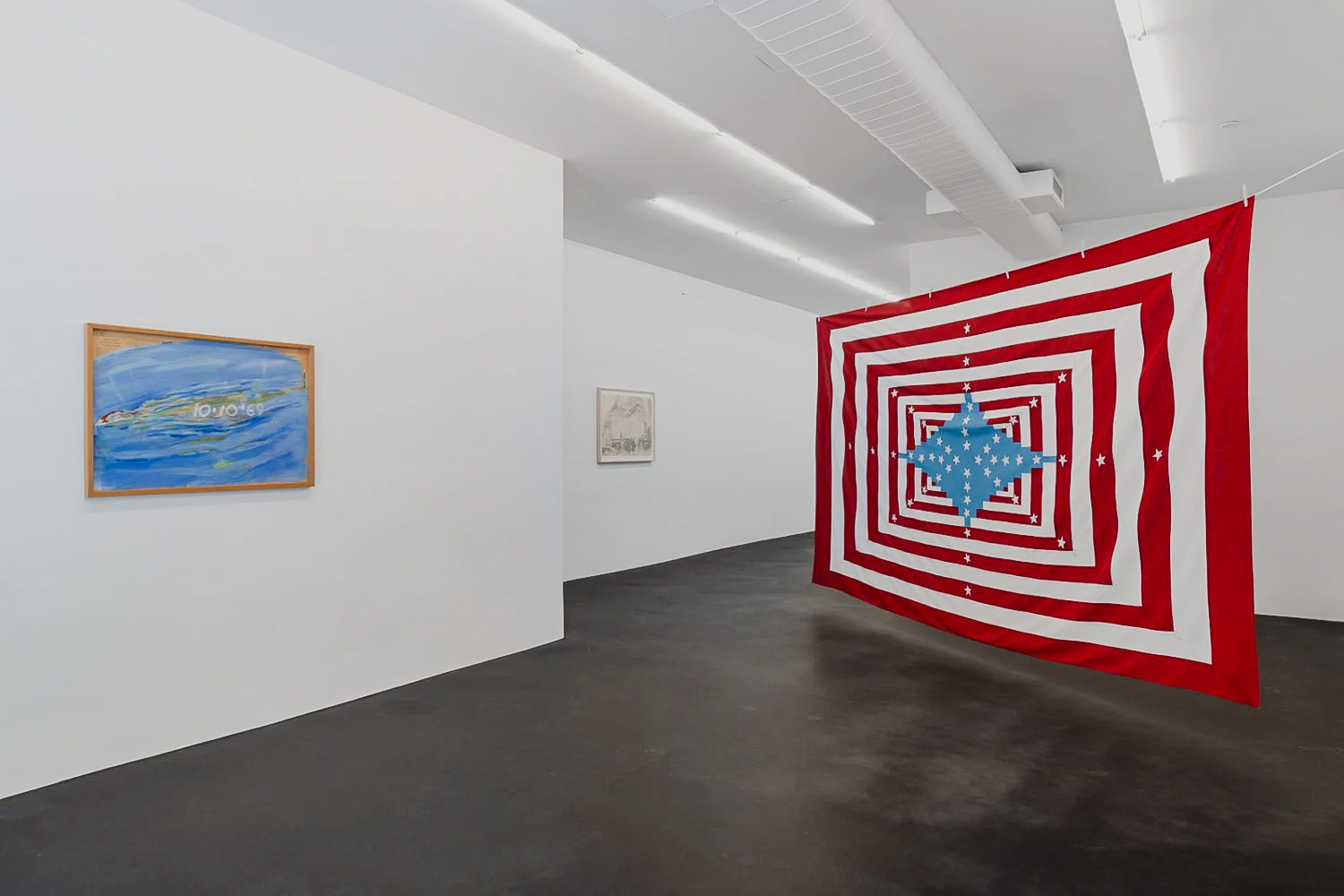




1. Installation view: Paul Thek, Galerie Buchholz, New York (13 May–25 July 2026). © The Estate of Paul Thek. Courtesy Galerie Buchholz, New York.
2. Paul Thek, Untitled (Swimmer), 1969. Acrylic and gouache on newspaper, 57.5 × 84.5 cm. © The Estate of Paul Thek. Courtesy Galerie Buchholz, New York.
3. Installation view: Paul Thek, Galerie Buchholz, New York (13 May–25 July 2026). © The Estate of Paul Thek. Courtesy Galerie Buchholz, New York.
4. Installation view: Paul Thek, Galerie Buchholz, New York (13 May–25 July 2026). © The Estate of Paul Thek. Courtesy Galerie Buchholz, New York.
5. Installation view: Paul Thek, Galerie Buchholz, New York, 2026. Works shown: Paul Thek, Exhibition Poster for Stable Gallery, New York, Opening September 19, 1967, 1967; and Paul Thek/Edwin Klein, Untitled, 1969. © The Estate of Paul Thek. Courtesy Galerie Buchholz, New York.
6. Installation view: Paul Thek, Galerie Buchholz, New York (13 May–25 July 2026). © The Estate of Paul Thek. Courtesy Galerie Buchholz, New York.
7. Paul Thek, Untitled (View of Zannone and Scoglio Grosso from Ponza), 1969. Gouache on newspaper, 41 × 57 cm. © The Estate of Paul Thek. Courtesy Galerie Buchholz, New York.
8. Installation view: Paul Thek, Galerie Buchholz, New York (13 May–25 July 2026). © The Estate of Paul Thek. Courtesy Galerie Buchholz, New York.
9. Paul Thek, Untitled (Blue Seascape), 1969. Gouache on newspaper, 41 × 57 cm. © The Estate of Paul Thek. Courtesy Galerie Buchholz, New York.
10. Installation view: Paul Thek, Galerie Buchholz, New York (13 May–25 July 2026). © The Estate of Paul Thek. Courtesy Galerie Buchholz, New York.
11. Paul Thek, Ponza Agave, 1975. Oil on canvas, in artist’s frame with picture light, 50 × 50 cm. Installation view: Galerie Buchholz, New York, 2026. © The Estate of Paul Thek. Courtesy Galerie Buchholz, New York.
12. Paul Thek, Untitled (Red Men by Sea), 1971. Seven parts, tempera and oil on newspaper. Installation view: Galerie Buchholz, New York, 2026. © The Estate of Paul Thek. Courtesy Galerie Buchholz, New York.
13. Paul Thek, Untitled (Dinosaur), 1971. Gouache and oil on newspaper, 57.5 × 84 cm. © The Estate of Paul Thek. Courtesy Galerie Buchholz, New York.
14. Installation view: Paul Thek, Galerie Buchholz, New York (13 May–25 July 2026). © The Estate of Paul Thek. Courtesy Galerie Buchholz, New York.
15. Paul Thek, Untitled (Dinosaurs), 1971, with Untitled (Dinosaur Tail), 1971. Installation view: Galerie Buchholz, New York, 2026. © The Estate of Paul Thek. Courtesy Galerie Buchholz, New York.
16. Installation view: Paul Thek, Galerie Buchholz, New York (13 May–25 July 2026). © The Estate of Paul Thek. Courtesy Galerie Buchholz, New York.
17. Paul Thek, Untitled (Cherry / Volcano Smoke), 1971. Gouache, oil, and pencil on newspaper, 57.5 × 84 cm. © The Estate of Paul Thek. Courtesy Galerie Buchholz, New York.
18. Installation view: Paul Thek, Galerie Buchholz, New York (13 May–25 July 2026). © The Estate of Paul Thek. Courtesy Galerie Buchholz, New York.
19. Paul Thek (with Ann Wilson), Untitled, 1973. Gouache, collage, ink, and crayon on newspaper, 48.5 × 65.5 cm. © The Estate of Paul Thek. Courtesy Galerie Buchholz, New York.
20. Installation view: Paul Thek, Galerie Buchholz, New York, 2026, showing works by Paul Thek and Ann Wilson. © The Estate of Paul Thek. Courtesy Galerie Buchholz, New York.
21. Paul Thek (with Ann Wilson), Untitled, 1973. Gouache, collage, gold leaf, ink, colored pencil, and crayon on newspaper, 47.5 × 64 cm. © The Estate of Paul Thek. Courtesy Galerie Buchholz, New York.
22. Installation view: Paul Thek, Galerie Buchholz, New York, 2026, showing Paul Thek, Untitled (Abstraction), 1982; and Bread and Buttocks, 1979–1980. The newspaper ground remains active beside the later picture-light work. © The Estate of Paul Thek. Courtesy Galerie Buchholz, New York.
23. Paul Thek, Bread and Buttocks, 1979–1980. Oil on canvas, in artist’s frame with picture light. © The Estate of Paul Thek. Courtesy Galerie Buchholz, New York.
Cover image. Installation view: Paul Thek, Galerie Buchholz, New York (13 May–25 July 2026). © The Estate of Paul Thek. Courtesy Galerie Buchholz, New York.
All images © their respective rights holders.
Image rights & attribution →