



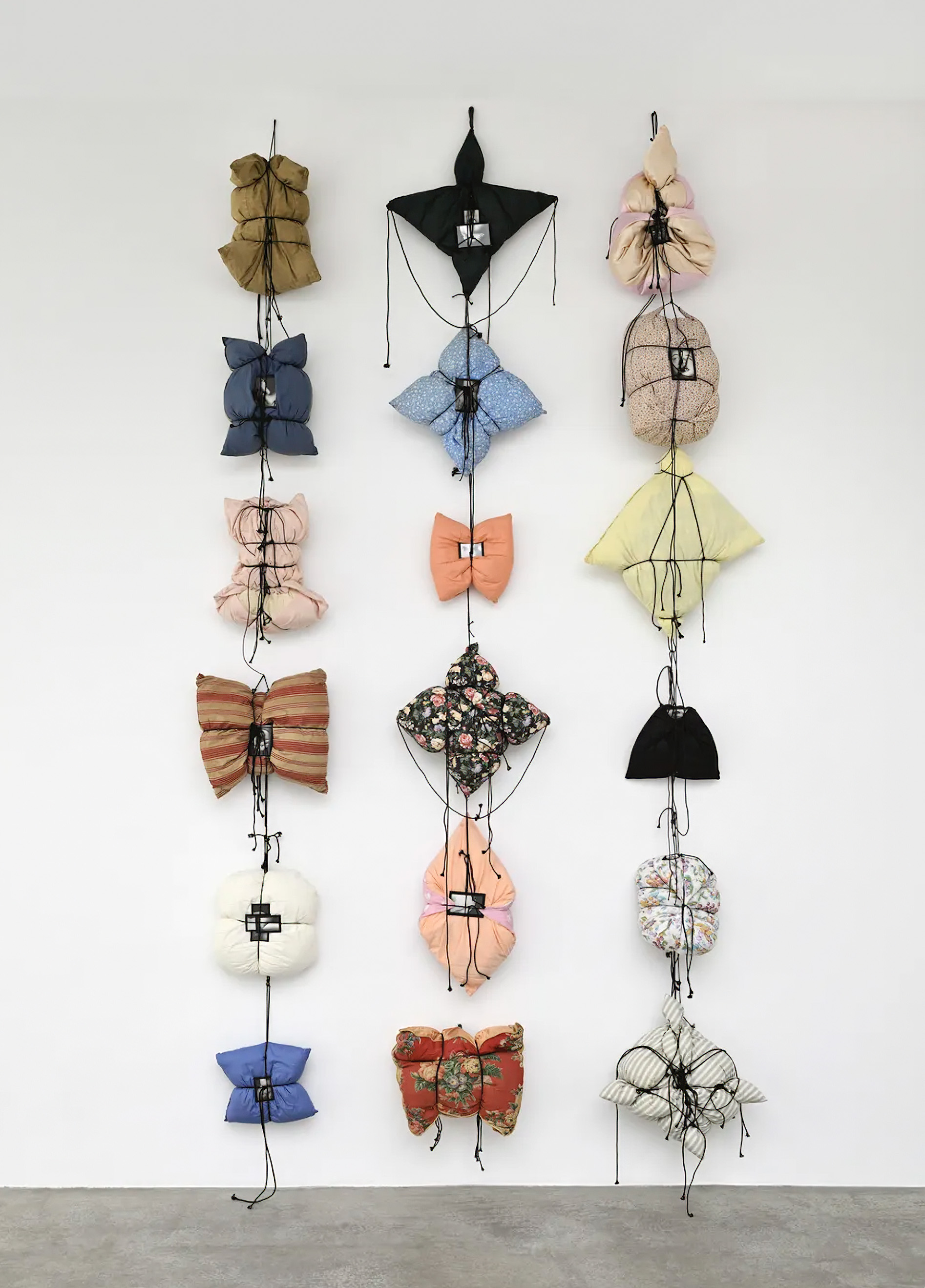
The pillows hang where the pictures should be. Eighteen of them come down the wall in three columns — floral, ticking, stripe, satin, one dark one drawn nearly into a kite — and each has been tied at the middle into a new figure: a bow, a parcel, a body with a waist. Where the tie is tightest a small photograph is fastened, gelatin silver under glass, a mouth, an ear, a hand. A black cord runs the columns and reaches the floor. From the door the wall has the order of a collection: things found, labelled, arranged. The fabrics keep the plain cheer of the bedroom. Nothing here looks hurt. It looks kept.
A pillow is where a certain kind of speech happens, low, to one person, meant to be gone by morning. Messager has kept that too. Forty-one scraps of black cotton carry one endearment each in coloured cursive thread — ma poule, ma cocotte, mon lapin, ma sauterelle, ma gonzesse, mon tendron — the names men have for women, each framed under glass and scattered across a corner of the large room with no order and no line to read them in. The stitching is careful and small; nobody made these in anger. Between the two works the show seems to have saved the whole scene of intimacy, the place it happened and the words it used.
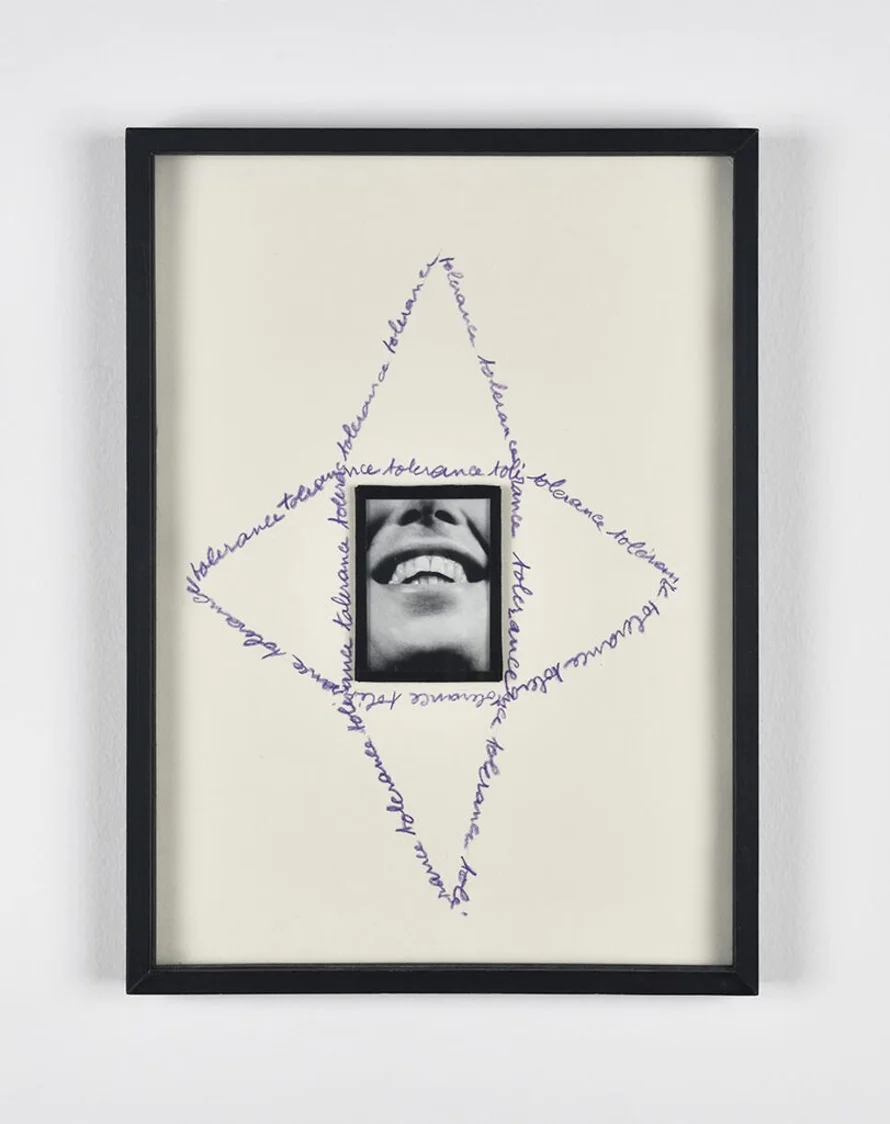
But the words came alone. An endearment is mostly tone — the same ma poule is fond, or absent, or contemptuous, and only a voice settles it. Under glass there is no voice, no listener, no dinner, no bed, and the scatter lets no sentence form. Each name hangs by itself between tenderness and insult and stays there. In Mes Ouvrages (Tolérance) a word is made to go on longer than words go. Around a photographed mouth — open, laughing, all teeth — tolérance is written out in violet ink and chained end to end until it stops being read and becomes a four-pointed border.
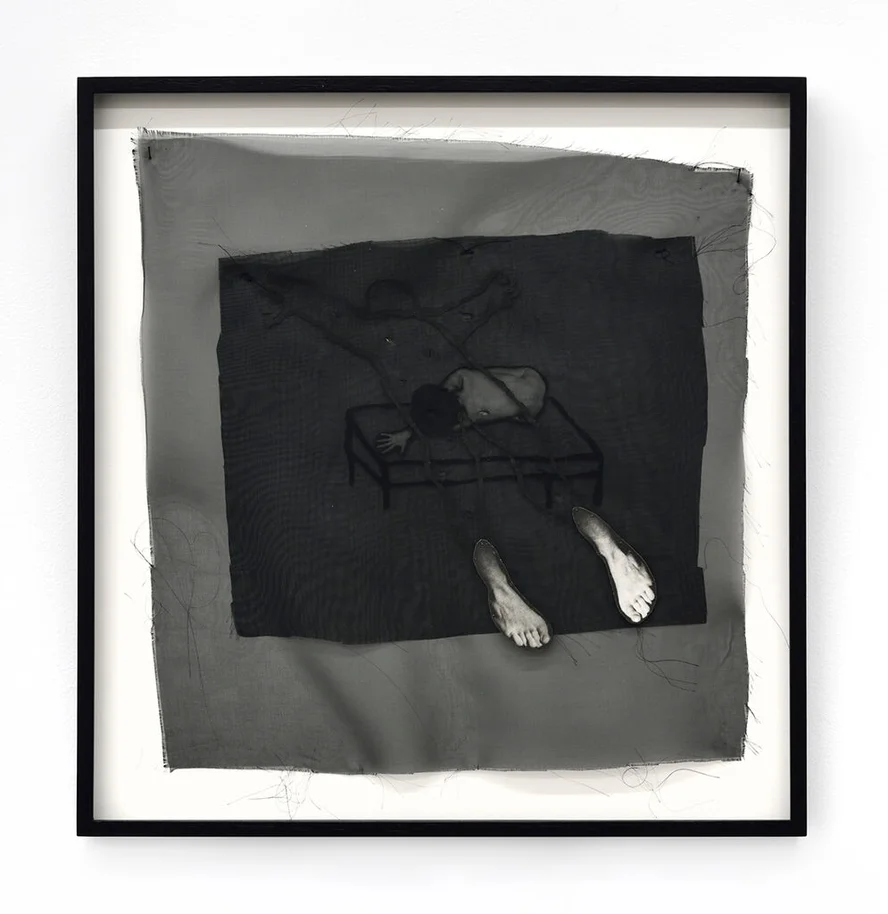
Les Voiles, from 1985, is the oldest work here and the only one that seems to know how to hide. In a black frame, two veils of gauze, one grey and one nearly opaque, hang over a small figure curled on a bed with a larger shadow standing at it. Look longer and the picture rides on the veil, carried by the thing that dims it. And the most bodily part of the image, two photographed feet, has been cut out and pasted to the front layer, ahead of everything, the plainest flesh in the work and the least concealed.
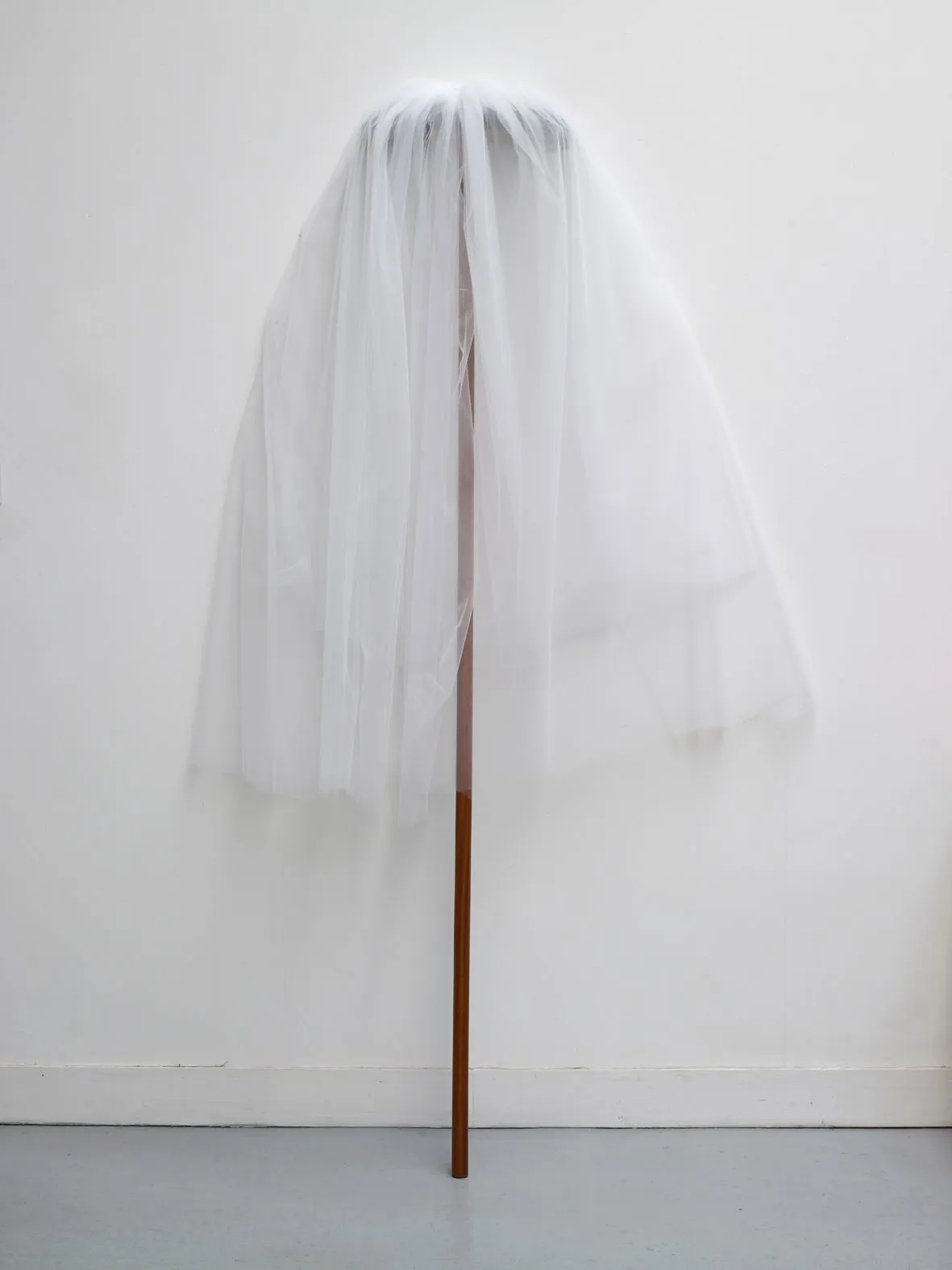
Just Married stands at nearly human height, at the pier between the window and the door where a person would stand to look at the garden. A white tulle veil crowns an upturned broom. The veil does everything a veil does — it crowns, it falls, it announces a wedding at any distance. Under it there is no one, only the broom, and the broom cannot do the standing either: it rests on the floor and leans into the wall, and it is the wall that keeps the whole thing from going down. Even the stand-in needs propping. Two supports for one absent bride, and the wedding is still, from across the room, perfectly legible.
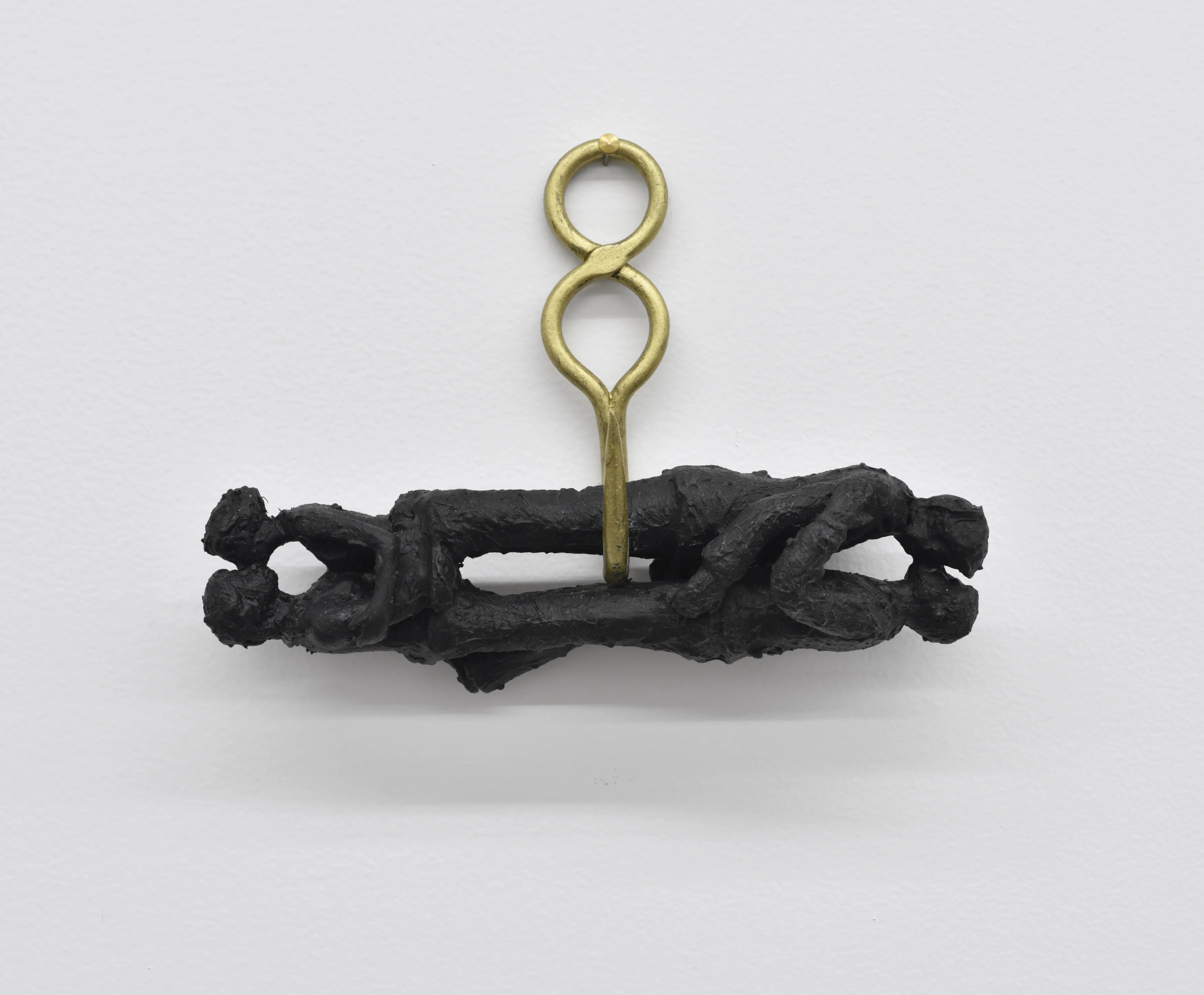
Les Amoureux is the size of a hardcover book. Two rough black couples, the kind that stand on wedding cakes, are pressed together horizontally and hang from a polished brass hook that passes through the middle of them and takes all their weight. The brass is the most finished thing in the work; the lovers are tarry and vague. Every object in this show hangs from something — this one lets you see it. Nothing in the figures holds them together any longer. The clasp is in the hardware now, kept from one point. What had passed between people now continues between materials.
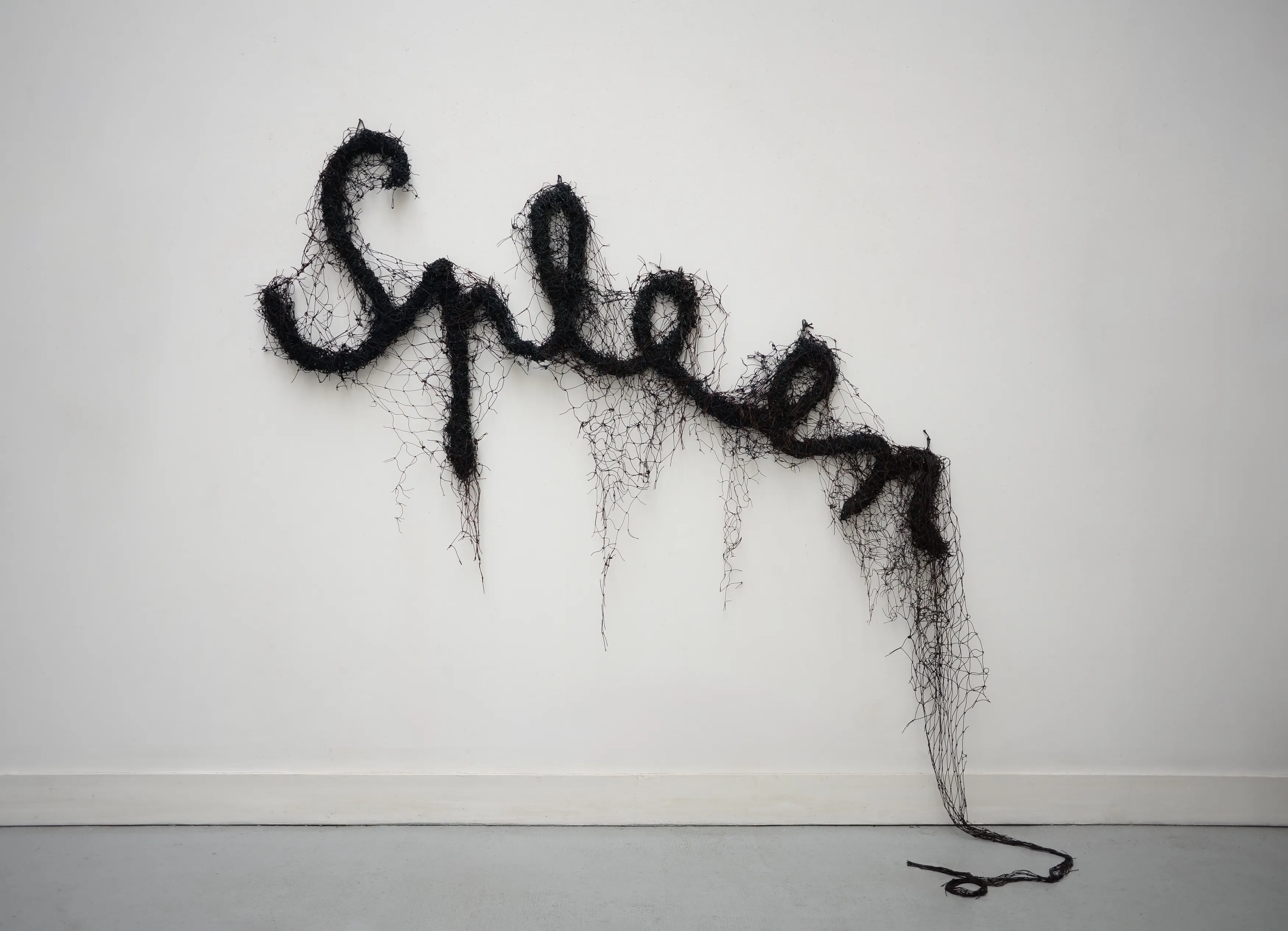
Spleen, from 2025, has the far wall of the largest room to itself. The word is written in cursive across two metres of wall out of black netting on wire, and it is fixed only at the tops of its letters. Everything below the pins belongs to gravity. Net sags out of every loop, hangs in dark drifts under the descenders, and at the last stroke leaves the wall and pools on the floor. The net would sag under any word. Spleen is the word that names what the net is already doing. The script stays legible the whole way down. Its body does not hold. And the pins are doing their job. Take them out and the fall finishes, a heap of net on the floor. Leave them in and it never finishes: the word is held at the crests in the act of giving way, and can go on giving way for as long as the show is open. The support is not saving the work from collapse. It is what makes the collapse durable.
That changes the tense of the rooms before it. These are not records of things that once happened to a veil, a pair of lovers, a word. The devices are working now. The wall is holding the broom up at this moment; the hook is keeping the embrace closed; the glass is keeping ma poule undecided this afternoon and will keep it so tomorrow.
Back in the first room, the cord that looked like installation hardware — the neutral means by which a pillow got to a wall — is doing something else. It runs between the columns and around the middle of every pillow, and it is the cord that gives one its bow, one its parcel, one its waist. The sleeper who might have pressed the pillow into shape is gone. The cord presses it now. Eighteen soft objects, each with a fragment of somebody fastened where the pressure is greatest, still receiving the weight of a body that is no longer there.
A pillow can retain the form of relation without retaining the person. It is where speech was lowered, touch was received, and one body rested beside another. Messager gathers these objects after the bodies are gone and lets their intimacy continue as arrangement.
The work does not preserve private history intact. It preserves the conditions through which privacy once existed: nearness, secrecy, attachment, concealment, address. The relation continued without them.


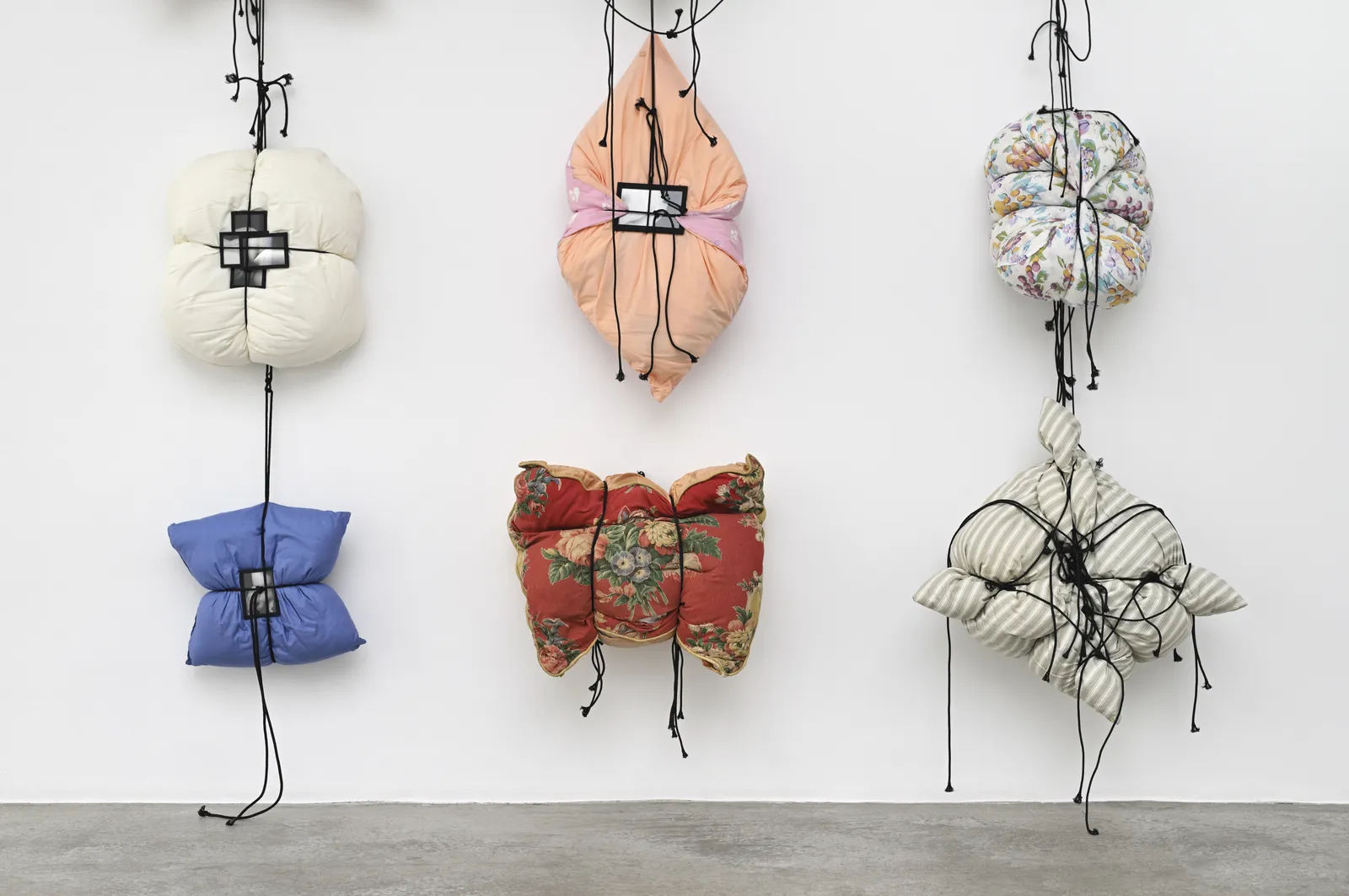

Cover Image: Image Credit: Annette Messager, Les Qualificatifs donnés aux femmes, 1972, and Spleen, 2025. Exhibition view, Histoires des oreillers, Marian Goodman Gallery, Paris, 2026. Photo: Rebecca Fanuele. Courtesy the artist and Marian Goodman Gallery. © Adagp, Paris 2026.