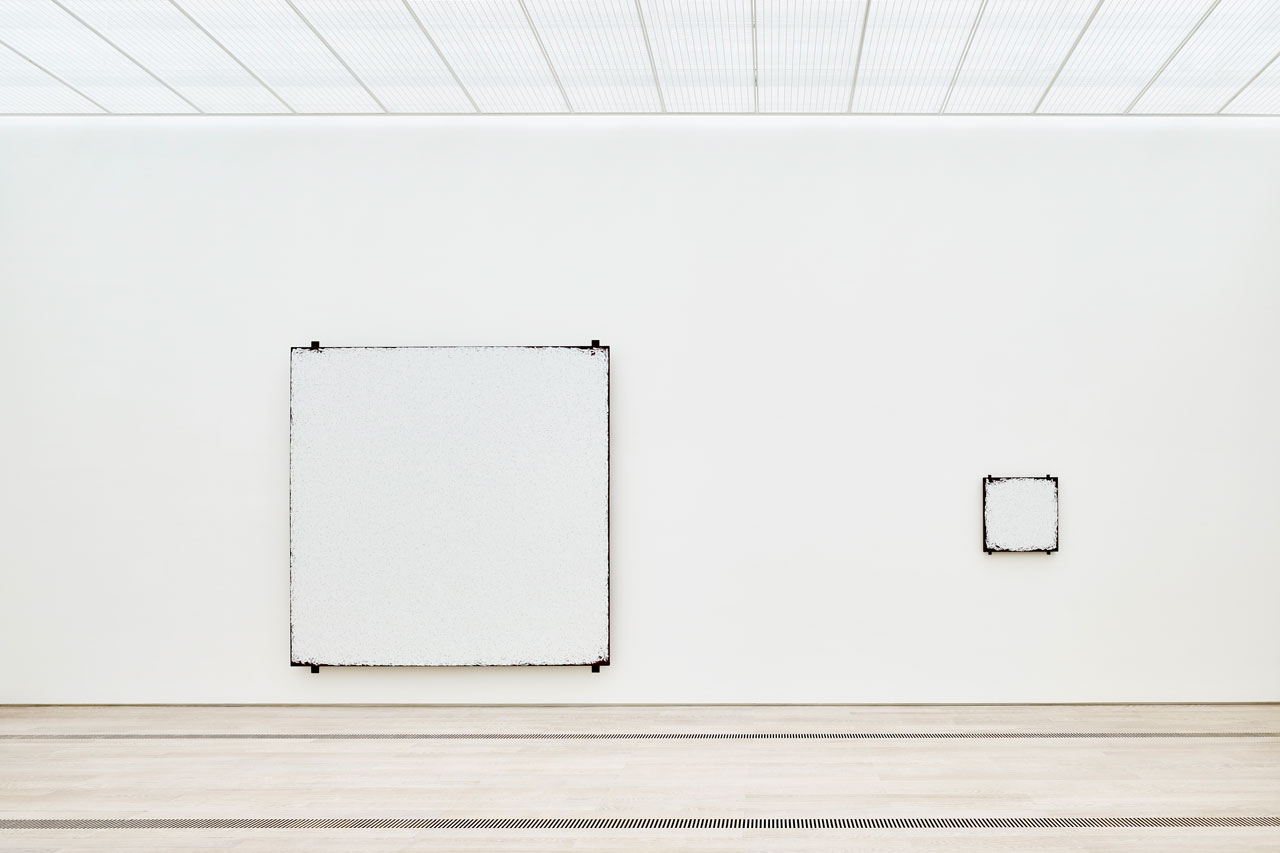


In October 1968 a painter stood in Leo Castelli’s gallery on East 77th Street arguing with Clement Greenberg about a date. The paintings waiting to be hung were white: one panel, two, three, four, seven. Greenberg insisted they had been painted in one year. The painter had researched them and said another. It was not, he admitted much later, a good idea to go up against Greenberg in those days. Whichever of them was right, the answer was not on the canvases.
He had just painted them. Robert Rauschenberg had made the White Paintings at Black Mountain College in 1951, and over the following decade had used most of the panels as grounds for other work. By 1968 he wanted the set back in the world, and the job went to the assistant who answered the phone and washed the windows at 381 Lafayette Street. New stretchers and new canvas were prepared for the set. The instruction was exact. Paint them so they look as if they haven’t been painted. No hand. Put a coat of paint on them. The assistant did as asked, and the show went up under Rauschenberg’s name with 1951 in its title.
The assistant was Brice Marden, and he had been making monochromes of his own. Rauschenberg bought two of them, and was, Marden said, the only person who did. They were grey, or a green that was also grey, oil and melted beeswax worked flat, and from across a room they could have passed for what he had just been hired to produce, a rectangle of one colour with nothing on it. Told in 2015 that his own monochromes must have prepared him for the Castelli job, Marden said they had “a real insistence on the hand.”
The earliest painting at Gagosian was finished in 1966, the year the job on Lafayette Street began.
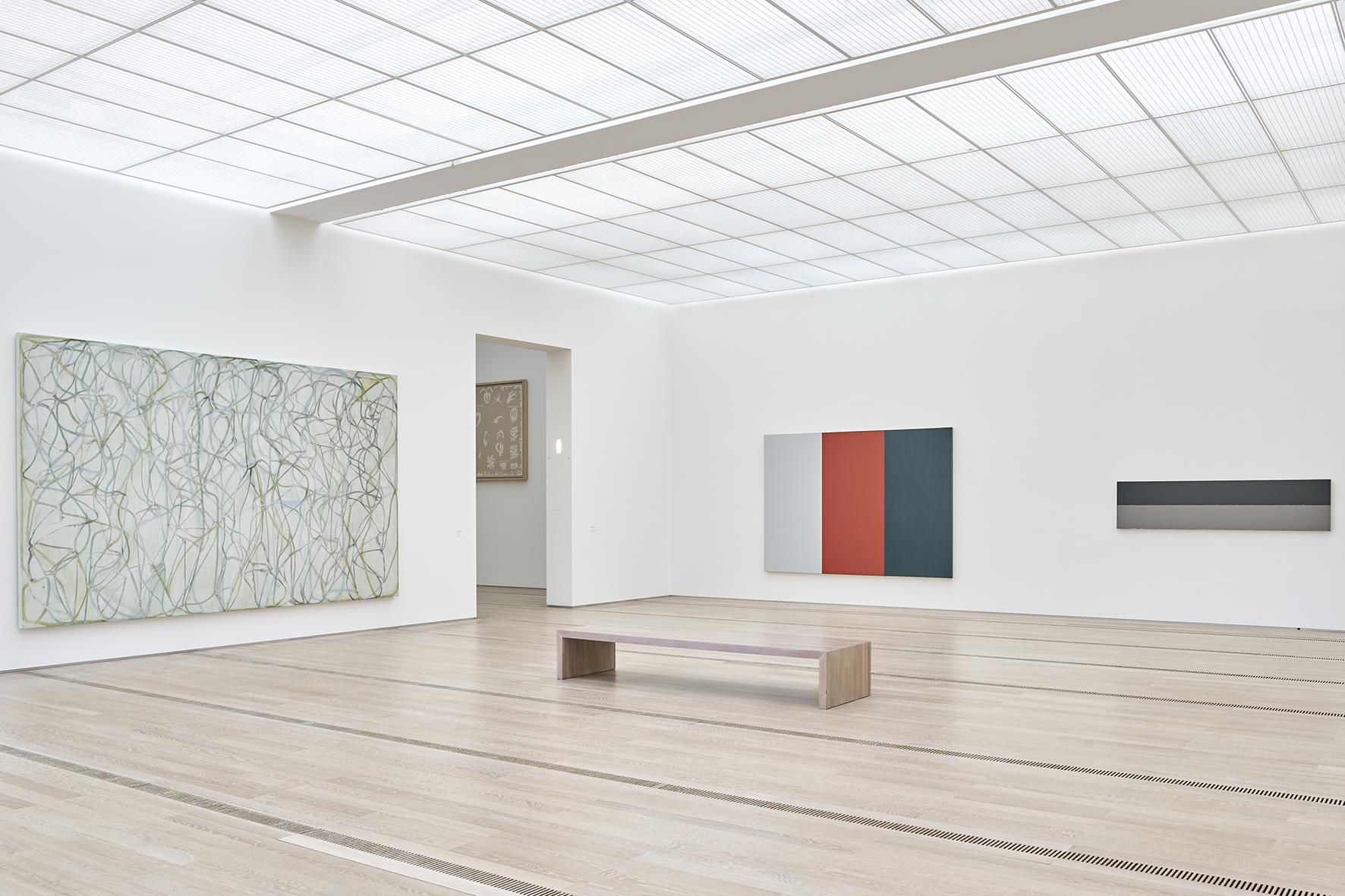
Nebraska is a single panel, fifty-eight and a half inches by seventy-two, grey-green, shown that November at Bykert in Marden’s first New York exhibition and kept in his home for the rest of his life. From across the room there is almost nothing to interrupt it. The grey-green is a green that has given up most of its green, and the beeswax holds it matte and still; the brushwork was scraped away with a spatula, and no stroke survives to follow. Point, 1969, hangs beside it, three abutted panels, a darker grey-green, a green, a lighter grey, and with them Summer Table, 1972–73, in grey-blue, yellow and slate, and Pumpkin Plumb, 1970/1973, in orange, slate blue and orange. Four paintings, ten panels, each panel one colour, and from the door not a mark on any of them.
Closer in, the busiest part of Nebraska is the bottom inch, a strip paler than the field whose upper edge is a fringe: the field drips into it in small runs that stop where they stop. It is a modest event, and it is the only one. Marden’s notebook from those years says what happened there. The drips accumulate on the marked-off section, and he redraws the bottom edge with a straightedge and a pencil. On Point the strip is a hairline. On Summer Table it is a hairline with specks of warm underpaint caught in it, the kind of thing seen on a second pass. The place was ruled before the paint ran, and within three years the ruling had moved almost to the edge.
On Pumpkin Plumb the strip is under an inch high, and along the bottom of the blue panel small flecks of orange show through. The painting carries two dates, 1970 and 1973, and the flecks do not say which colour belonged to which year. At Castelli a new coat had left the year where it was. Here a second year was added.
“Plane Image” was what Marden called the studio and, he said, himself, and the title turns it round. The planes came first. From the later 1980s there were lines as well, loops of colour drawn across whole canvases, and anyone who knows the career will be looking for two painters, one who scraped the strokes off his paintings and one who made paintings out of strokes, and for the place where they meet.
Cold Mountain 1 (Path), 1988–89, is an off-white ground nine feet by twelve down which dark grey-brown lines fall in five or six loose columns, the nearest these paintings come to writing. Round the lines are grey halos, and below the runs the ground carries grey stains. Across the corner, twenty years later, Only, 2009–11, is twelve feet wide, a pale olive ground laid on in short scumbled dabs, and over it grey-brown lines of one width, their edges ragged and their cores lighter than their edges, so that each line seems lit from inside. Under the ground, earlier lines show through as ghosts. On all four sides the olive stops short of the edge of the linen, and what shows there is red, a thin hot line the eye finds last.
The halos are where lines were. Marden described the procedure in 2006: “I start with these long brushes, but then I go back in and I erase all my brush strokes with a painting knife, and I redraw the lines with the painting knife.” The erasing stays on the canvas as a grey stain round the line that replaced the one wiped away. In Only the earlier lines were covered instead, with a coat of olive thin enough to let them through. At the perimeter, where the olive stops, the red remains; how far it once extended cannot be told from what shows, and whether it was meant to stay exposed the surface does not say. The red at the edge, the halo round a line and the orange flecks in Pumpkin Plumb are three kinds of evidence: a colour left visible at a boundary, the work of an erasure, a colour showing through from beneath.
Three paintings from 2016–17 hang together, each a dark square over a pale lower band: a mid-green over pale green, an olive-brown over ochre, a near-black green over pale mint. They are handsome in the way of things made from one material, three greens, three earths, the same proportion three times. They belong to a set of ten, each made in a different manufacturer’s terre verte and titled with the manufacturer’s name; the one at the left is Blockx. In each, thin rivulets of the square’s colour run down into the band, the only incident on surfaces that otherwise hold still. When the set was first shown Marden said he had gone back to making monochromes with the drips at the bottom, and that while he made them he kept thinking he no longer remembered how to paint. At a distance the three look as that sentence sounds, a painter letting the paint find its own way down and keeping what it did. They look, too, like what the instruction of 1968 asked for: one colour, no hand, and on the label a paint-maker’s name rather than the painter’s. What is left to ask is what, in them, the painter did.
Close to, Blockx is measured. The boundary between square and band is a straight ruled line, crisp at the left, with a darker edge just above it where the paint pooled. The square is built of many thin layers and no stroke is legible in it; it clouds. The band, about two feet high, is a thin wash with the weave and vertical brushing visible through it. The rivulets are parallel and mostly short; the longest gets two-thirds of the way down, and a few dark dashes reach the bottom. The procedure is on record: a wash over the whole surface, a horizontal measured off, the square built up in slow wet layers, the runs let into the band. The release came after the ruling. It is the first room’s arrangement at a scale legible from the doorway, a worked field above, a reserved zone below, and in the zone what the field let go. If this is surrender, it has a straightedge.
Round Rock, Tight Rock (4), 2000–02, is an opaque orange ground, brushy, with lines in three colours stacked dark red over slate grey over olive green. Along many of the lines runs a thin yellow margin, and in places a yellow line lies partly under the orange. Where it does, the orange is on top; that much the surface shows. The likeliest reading is that the yellow belongs to an earlier set of lines, and that the orange went back over them up to the new ones and left as a margin the width it did not reach.
Nemesis, across the corner from it, is dated 2009–20 and twelve feet wide, the size of Only. Its upper field is divided down the centre, and the division is painted: a blue line crosses it, red lines cross it, and the olive of the right half is brushed up to and over the red-brown of the left with a ragged edge. On the red-brown half the lines are green, blue and mauve-grey; on the olive half they are red, blue and mauve-grey. Figure and ground have exchanged roles across the middle of one canvas. Under both grounds earlier lines show grey through the paint, and patches of olive have been painted into the red half.
Below the field, a little more than a quarter of the height, is a band of olive set off by a thin darker strip. Drips descend into it in red, mauve, blue, green and yellow, of different lengths, some reaching the bottom edge. Some are muted within the olive, their colours half-buried; others stand sharply against it. Just left of centre a thin rust-coloured diagonal cuts across the vertical runs.
A band like this invites the reading the first room taught: paint from the field above, collected below it, the history of the painting in a place set aside for it. Read that way, its marks ought to sort as the red, the halo and the flecks did, into a colour left at a boundary, the work of an erasure, a colour from beneath. They do not. A muted run may lie under a film of olive, or may only be thinner than the one beside it. A sharp one may have fallen after the olive, or may simply carry more paint. The diagonal and the dashes did not run at all, yet they sit among the runs as if they belonged to the same account. Olive may have gone over some of what fell. Nothing on the surface says which, or whether it did.
The strip under Nebraska was marked off before the paint ran and its edge redrawn after, and what fell inside it still looks like what it is, runs that stop where they stop. The band under Blockx was washed in before anything reached it; the record and the canvas give the same order. Even the orange of Round Rock, where it seems to have gone back over earlier lines, left a margin that keeps the correction legible as a correction. A pencil line, a measured horizontal, the edge of a margin: the hand Marden insisted on has a place of its own in each, and what fell or was gone over keeps another. In the band of Nemesis the hand is in among what fell, in a row of dashes that nothing ran to make, a diagonal across what did, and perhaps olive over some of it.
Blockx is dated 2016–17, inside the years Nemesis carries, so the difference between the two bands is not one of development. Looking settles the order in the one. In the other, what is record, what is revision and what is picture will not settle, and the band has to be seen the way the field is seen, colours against olive, some sunk and some standing, a diagonal, a row of dashes. Nothing on the surface marks where the painting’s record stops and its picture begins.
On a wall at Gagosian, Marden says how to look at a painting. Stand as far away as it is tall. Go up close enough to lose the rectangle, and look at the surface and the marks. Go back to where you started, and then twice as far. It is, he says, like a little dance.
Untitled, 2021–23, oil and graphite on linen in three parts, two feet high and ten feet eight inches wide, is among the last paintings he made. Seven colours cross it in order, red, pale grey, red, orange, navy, olive, pale green. Seen whole, it belongs with the first room, panels of one colour side by side, and the first thing it gives is the plainest: seven colours chosen to sit next to each other.
There are three stretchers, not seven. Two of the six divisions are their edges, dark recessed lines with the linen wrapped round them. The other four are painted, one colour brushed up to the next and stopped, the meeting ragged where the brush did not hold the line. The navy is pooled and marbled with black, the orange is even, the olive is scumbled in diagonal strokes, and the pale green is a thin wash with the weave showing through. Under the grey, faint ruled lines of graphite still show.
There is no strip and no band. What Nebraska kept to an inch below the field, and Nemesis to a band below it, runs here inside the fields: in the two reds it is pale grey, the colour of the field between them, running down through the red. Below the red there is only the edge.
From the door it goes back to being seven colours chosen to sit next to each other, as plain as anything in the first room.
In 1968 Brice Marden was given the job of repainting Robert Rauschenberg’s White Paintings so that no hand would show. His own early monochromes keep the record of their making in a ruled strip at the bottom edge, where the drips collect; later paintings keep it in grey halos round erased lines and a red edge left showing where an olive ground stops short. Close looking can sort each of these into what came first and what went over it. In the band under Nemesis, dated 2009–20, it cannot: runs, dashes and a diagonal sit together, and nothing on the surface says which is record and which is picture. Untitled, 2021–23, one of the last paintings he made, has no band at all. The runs are inside its colours.


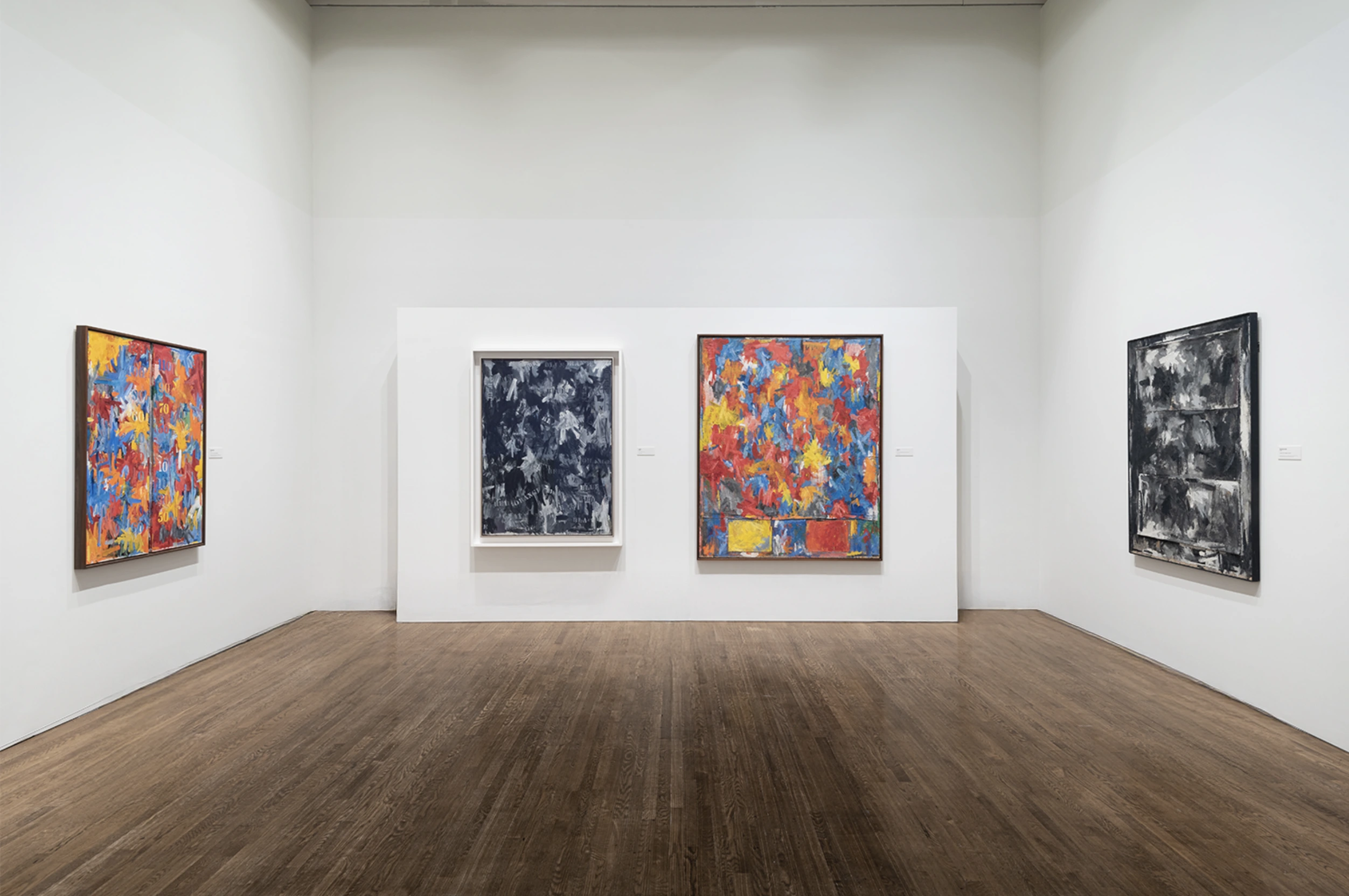
Cover image: Installation view, Brice Marden: I Am Plane Image, Gagosian, 522 West 21st Street, New York, 15 September – 12 December 2026. Artwork © 2026 Estate of Brice Marden/Artists Rights Society (ARS), New York. Photo: Owen Conway. Courtesy Gagosian.