

By the end of the 1990s, Helmut Lang’s clothes seemed to have settled the question of restraint. Nothing in them looked unfinished, excessive, or unresolved. Line held. Fit held. Material held. A jacket arrived fully as a jacket. A trouser arrived as a trouser. The work carried the authority of something already decided. Reduction no longer looked like experiment. It looked final.
The language followed quickly. Clean. Reduced. Modern. Essential. Then the stronger word arrived: classic. Lang no longer seemed like a designer pushing fashion into new territory. He seemed like the point where fashion had already learned the lesson. The body entered the garment, the garment settled the body, and the whole thing disappeared into correctness.
That reading was useful because the field wanted it. By then, the fashion press had made minimalism the reflex language for any reduced silhouette, and classic was the word that made reduction safe. It turned pressure into poise, industrial material into taste, restraint into permanence. Lang was absorbed almost on contact because the clothes gave the eye enough calm to believe the story.
Then you try to get into the rubber dress.
Baby powder first. Then the rolled latex. Then the body works upward through pressure before the line can appear at all. The dress reads, in image, as narrow and controlled, almost demure. That is exactly why it matters. The silhouette belongs to the world already built around Lang: exact, reduced, self-possessed. But the dress does not begin as a silhouette. It begins as an operation. Skin meets resistance. Entry takes time.
Once the line appears, the pressure does not disappear into it.
Minutes later, longer than that, the body is still aware of being held — of the dress continuing to decide where it gives, where it grips, how completely it will let the wearer forget it is there. The forgetting almost arrives. It does not. Even after the image settles, the garment does not.
The materials matter because they do not behave like fashion materials pretending to be neutral. Latex, parachute nylon, rubber-coated cotton, technical fastenings, harness hardware: these come from outside the ornamental economy of dress. They do not soften into appearance. They hold, grip, suspend, resist, seal. Lang’s reduction was never only visual. It was built from materials that kept the relation active after the line looked calm.
Minimalism imagines a body that can almost disappear into clarity. Lang’s body cannot disappear. It has to enter, pull, fasten, carry, and remain aware of what holds it.
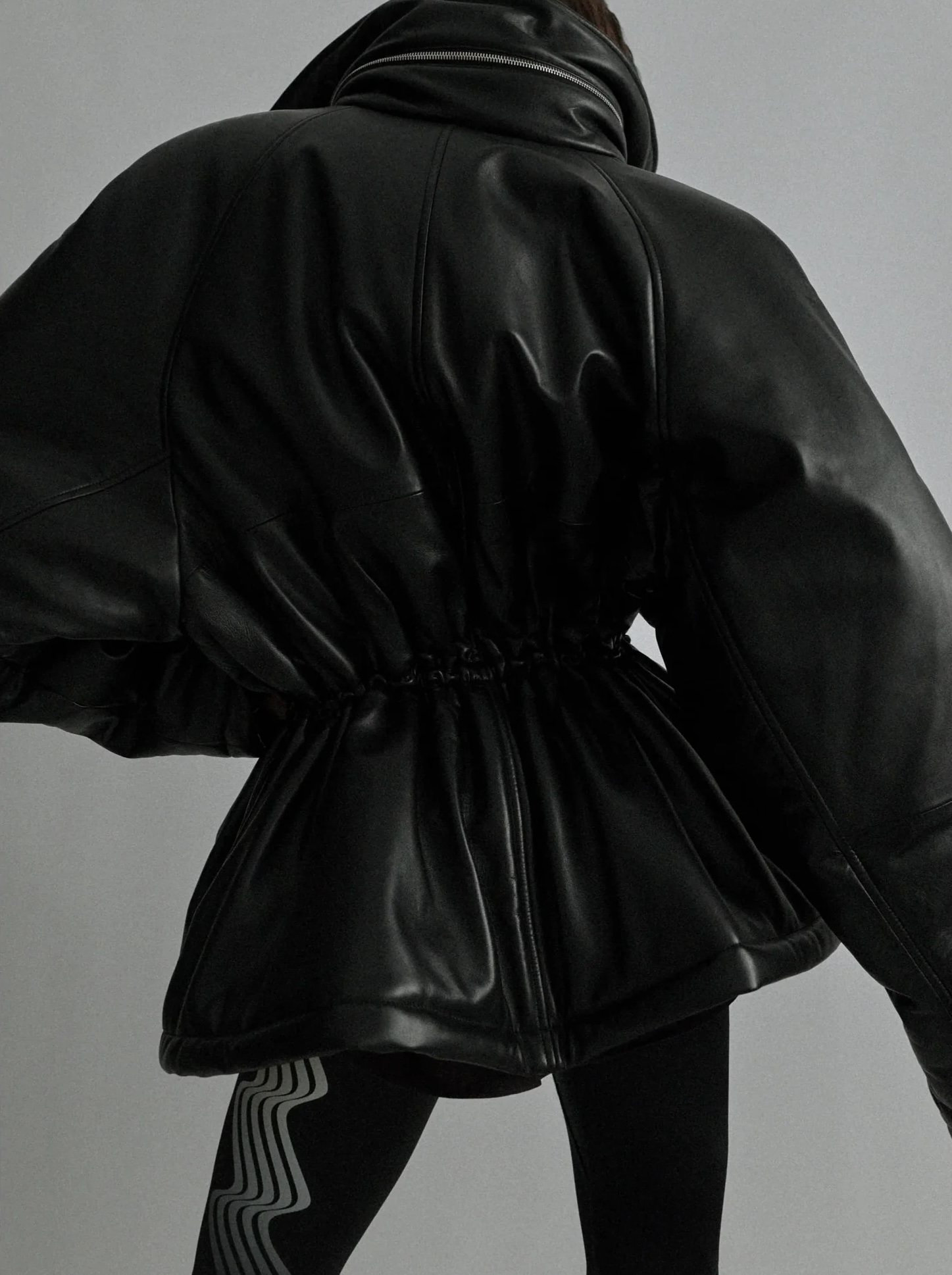
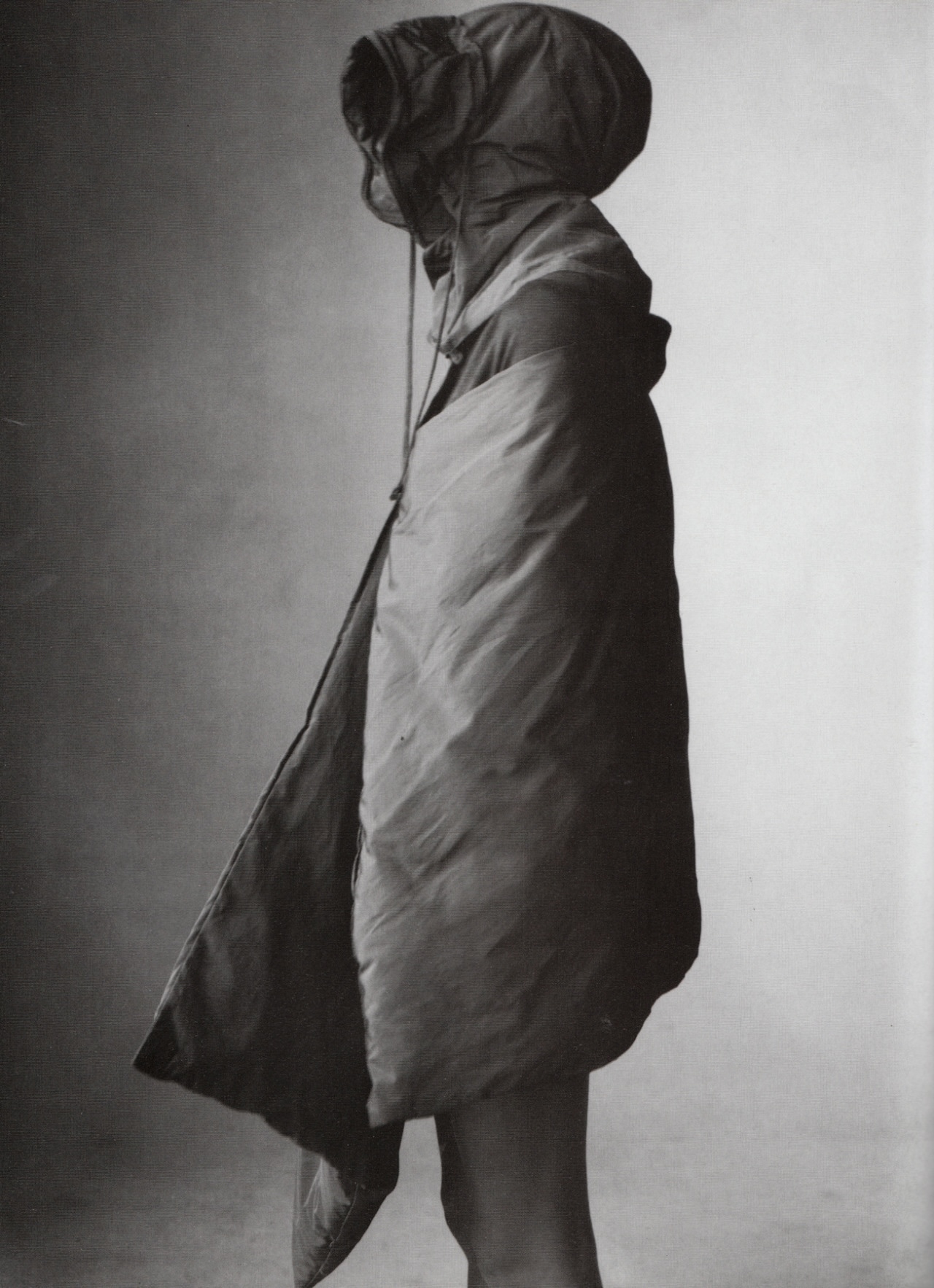
The Astro Biker Jacket makes the same condition harder to miss. A foldaway harness sits on the back so the jacket can hang from the body when it is no longer being worn. When the jacket is on, the body enters a fitted shell. When it comes off, that relation does not disappear; it is transferred into another mode of attachment. Support does not end. It changes state.
The harness is not flourish or hidden infrastructure. It is the logic of the garment made portable. The jacket does not stop at covering the body. It decides how the body will carry it, release it, and remain tied to it afterward.
Fit works the same way. It tightens the relation between body and object, directs it, keeps it active. Tailoring resolves. Lang calibrates. The relation is never settled and then hidden. It stays live throughout wear. The wearer does not disappear into correctness. The wearer completes what the garment refuses to finish on its own. The high armhole, the hold across the shoulder, the way posture is drawn out of the body — these are not finishing touches. They are the garment still working.
This is where minimalism fails. It can name what Lang removed: ornament, noise, easy declaration. It cannot name what remains in motion once that reduction is done. The rubber dress does not arrive at purity. It arrives at pressure. The jacket does not arrive at function. It arrives at a system that persists.
Classic fails even more precisely. Classic depends on support becoming invisible. The mechanics have done their work so completely that nothing else needs to be felt. Lang never lets that happen. His clothes keep the body aware of entry, hold, closure, tension. They do not hide the fact that correctness has to be produced and maintained.
The work could look calm and still never become neutral. The support remains, not as decoration, but as fact.
Anna Wintour buying the elbow-slit sweater and sewing the openings shut makes the point better than theory does. The reflex was immediate: close the opening. The sweater already read as Lang — controlled, reduced, correct. Once worn, it kept open something ordinary judgment wanted closed again. What had to be repaired was not excess. It was an active condition. The opening was not there to decorate the garment. It was there because Lang refused the fully closed object. Sewing it shut returned the sweater to a category it had already exceeded.
The late work makes the structure explicit rather than new. The parachute harness does not mark a departure from the earlier clothes; it exposes what had been operating inside them all along. Fit is no longer resolved and concealed inside tailoring. It is externalized, adjustable, and kept visibly active. The question is no longer whether support remains, but whether anything else is left.
If Lang is read as minimal, this late work looks like rupture. It is not. It is the operation finally visible without the surface calm that had allowed it to be misread.
Margiela exposes making. Lang exposes holding. One turns construction outward so the eye can see it. The other leaves support where it is and makes the body feel it anyway. The event is different: in one, the revelation happens to the viewer; in the other, to the body.
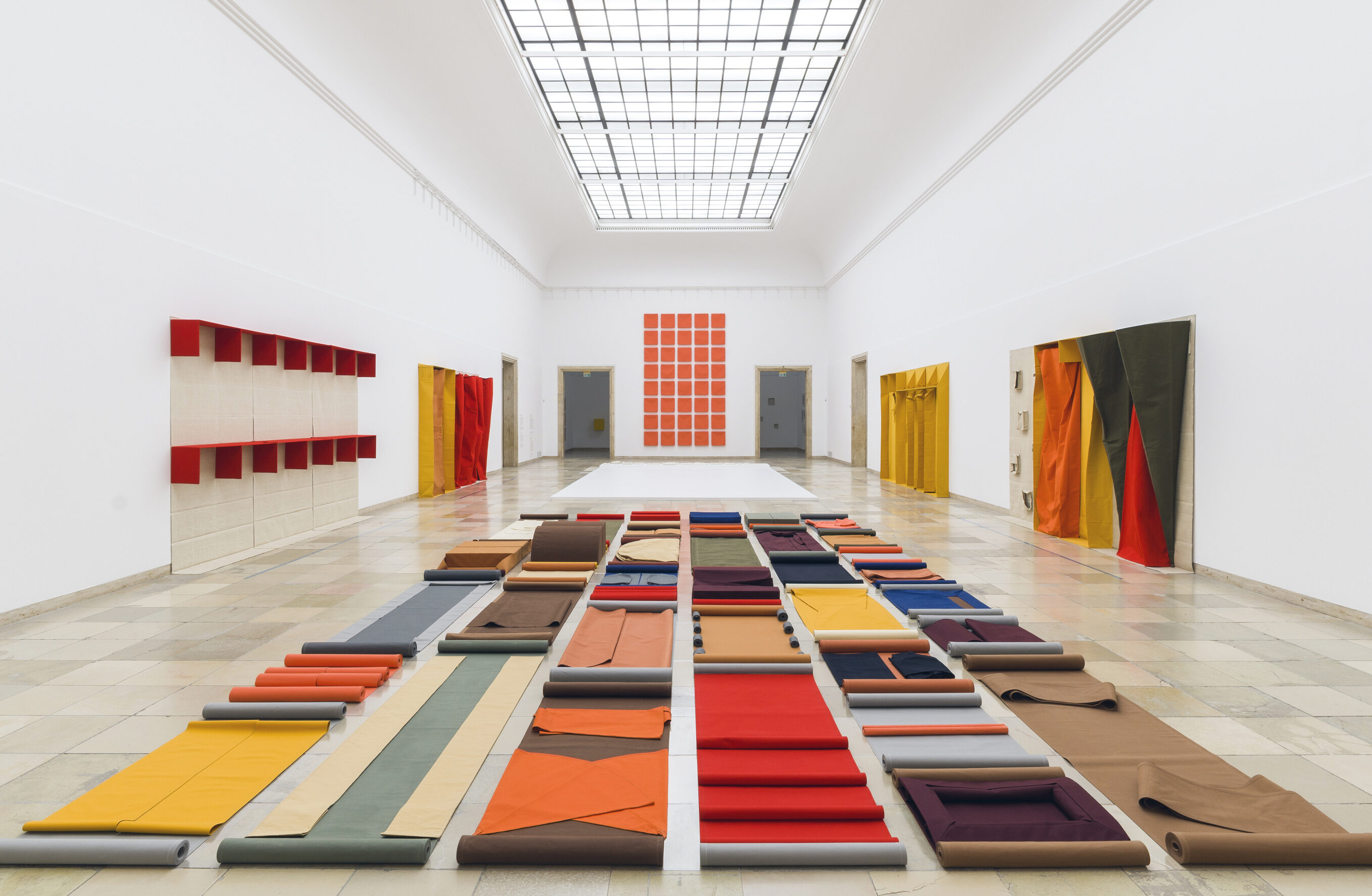
Franz Erhard Walther comes closer. His fabric works do not complete themselves at the moment of making. A body has to enter them, pull through them, fasten them, hold them in action. At rest they are stored. In use they become something else. Lang asks the same question inside clothing. The dress begins in entry. The jacket continues after removal. The harness makes support the object. The garment is not finished when it appears; it becomes itself in use.
What looked resolved was built on something that had not stopped happening.
The body never disappears into these clothes.
It keeps meeting them.
Reduction is sometimes understood as absence of excess, where simplicity risks emptiness or lack of definition. In Helmut Lang’s work, severity functions as a structural condition: silhouettes are stripped, materials industrial, and construction controlled so that every cut, strap, and fastening regulates proportion and spatial tension.
Hardware, seams, and joins register position and interaction rather than ornament. Form is governed by constraint rather than expression, with each element contributing to the cohesion of the body’s envelope.
Structure is maintained through calibrated austerity, where repetition, alignment, and industrial logic produce clarity across the ensemble.









All images © their respective rights holders.
Image rights & attribution →